Ask most people what a startup incubator does and the answer is vague: something about office space and maybe some funding. That undersells it, and the misunderstanding leads founders either to skip incubation entirely or to expect the wrong things from it. So what does a startup incubator actually do? At its best, an incubator is a support system for the parts of building a business that founders are usually worst at on their own: defining a market, reaching customers, accessing funding, and imposing the operating discipline a company needs to grow. The physical space is the least important part. The judgment, networks and credibility are the point.
What incubation support actually includes
Incubation support is a mix of many things. It also varies between programmes, and strong support tends to cluster around a few things. Below are the ways how incubation support looks like:
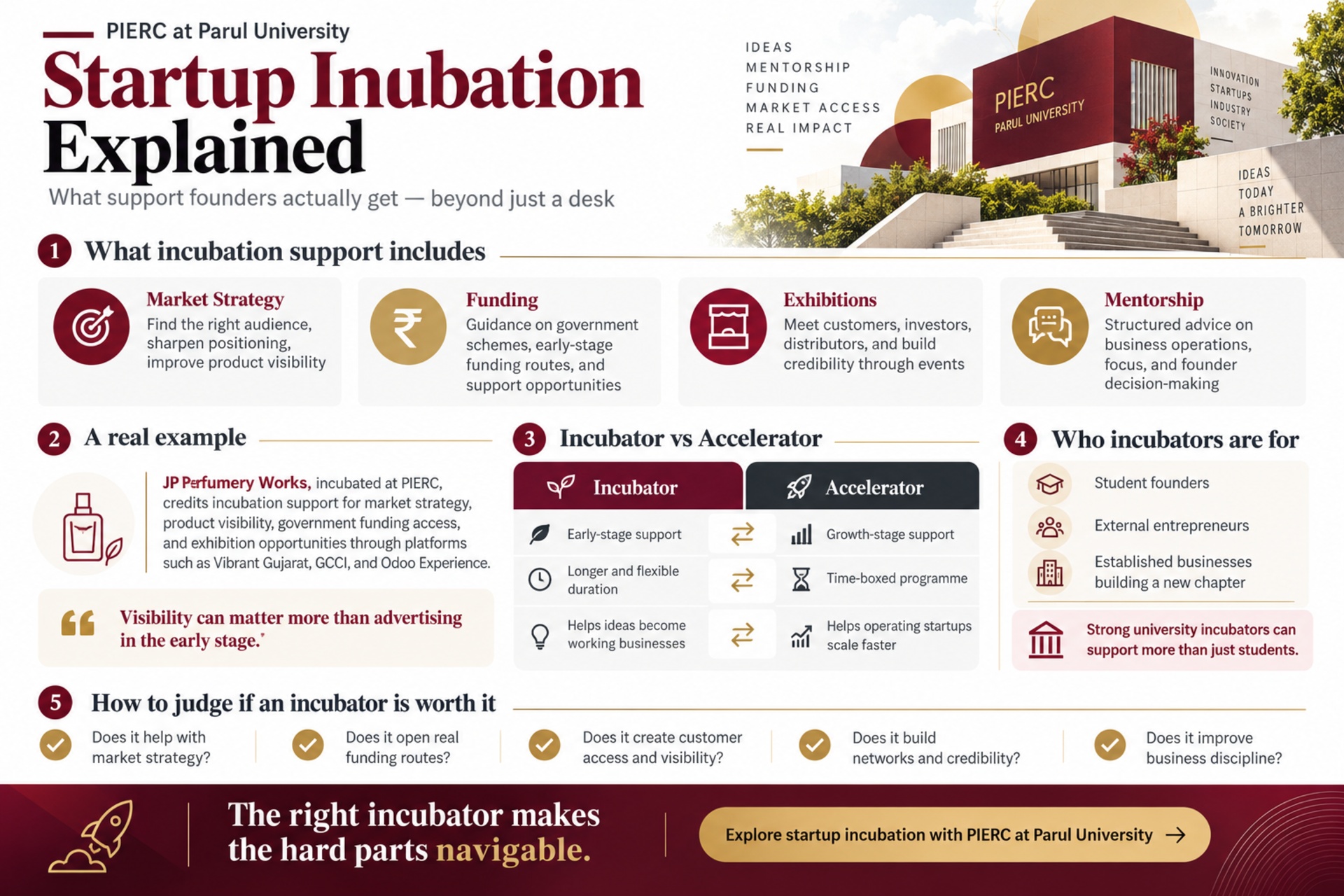
- Market Strategy: They support with making a market strategy so that product visibility can increase. They help with finding the target audience, customers who will like and use the product/service. They map how the business should be positioned and placed, how it should be made visible, and it is where a good startup starts.
- Funding: Guidance is the first thing that you get; it is from the government. That is getting funds from govt. schemes. It is like early-stage capital.
- Exhibitions: Incubators also help with networking, increasing credibility, and providing a platform for startups, established businesses and others. They also get to meet investors, customers, distributors and investors, which will help the startups to gain credibility.
- Mentorship: Incubators give structured guidance. They give mentorship that helps founders define how their business will run, rather than improvise.
The through-line is that an incubator substitutes institutional support for things a lone founder would otherwise pay for expensively, or go without. The most underrated of these is credibility: being associated with a recognised incubator and appearing at an established event gives a young company a legitimacy it cannot manufacture on its own.
A real example: visibility over advertising
Consider how this works in practice. JP Perfumery Works, a Vadodara fragrance enterprise incubated at PIERC, the Parul Innovation and Entrepreneurship Research Centre at Parul University, credits its incubator with help on market strategy, product visibility and access to government funding opportunities, plus exhibition platforms connected with Vibrant Gujarat, the GCCI and the Odoo Experience in Gandhinagar. The founder’s point was specific: those exhibitions let the company reach customers directly and build relationships through product experience, instead of depending entirely on paid advertising. For a startup with a limited marketing budget and a product that needs explaining, that substitution, direct credibility-building exposure in place of ad spend, can be decisive. It is a concrete illustration of what incubation support looks like when it works.
Incubator versus accelerator: a quick distinction
There is difference between both. An incubator supports the startup from the very start. It is related to support at early stages over longer period and flexible period. They help idea to get on the surface and get converted into a functional business. Whereas an accelerator is working on a business that is already operating. Their work is to focus on the growth part. They use time-boxed programme aimed at rapid growth, often ending in a demo day. A founder who wants to work on the business at the early-stage usually wants an incubator: one with traction looking to scale fast may want an accelerator.
Who incubators are for, including non-students
A common misconception is that university incubators are only for students. Many are not. Strong university-linked incubators support both students and external founders, including established businesses building a new chapter. PIERC is the incubation centre at Parul University. It is made for student founders and external entrepreneurs. It operates through Vadodara, Surat, Ahmedabad and Rajkot.
Most important thing is about getting the right support from the right person.
How to judge whether incubation is worth it
Not all incubation is equal, so a founder should evaluate it rather than assume. The useful questions are concrete: Does the programme actively help with market strategy and customer access, or only provide space? Does it have real routes to funding, including government schemes? Does it get startups onto credible exhibition and networking platforms? Does it push founders toward operating discipline, such as defining how the business differs from competitors? An incubator that scores well on these is providing the support that actually moves a business. One that offers only a desk and a logo is not worth reorganising around. The founder’s own job does not disappear inside an incubator; incubation makes the hard parts more navigable, it does not make them someone else’s problem. Learn about startups and innovation with an MBA in innovation and entrepreneurship.