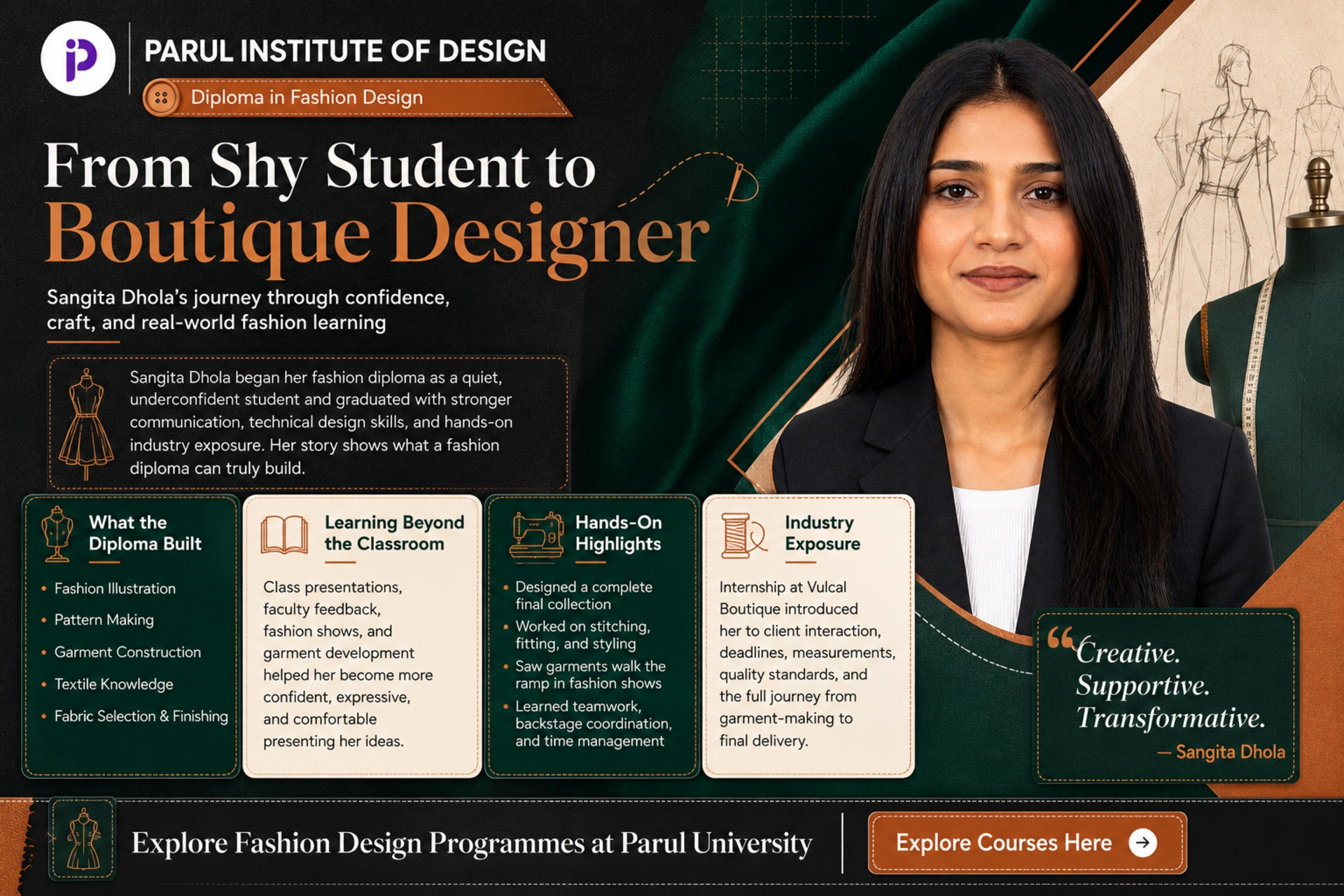
There is a perception that diplomas are not as worthy as other degrees, and this is where Parul University tries to make a difference by making a curriculum that gives theoretical as well as practical knowledge. Sangita Dhola took a Diploma in Fashion Design at Parul Institute of Design. Her story is something that will inspire others. The story of a shy girl who mustered the courage to explore all the domains. She could explore the craft of making clothes, technical skills, and garment construction, which led to personal growth. Her decision to join the university was because of the practical experience and hands-on learning, workshops, projects, exhibitions and fashion shows, along with theoretical knowledge.
The biggest change Sangita describes is not a skill but her confidence. Towards the end, she became a different person. She was a shy person in the first year, not feeling comfortable with speaking in front of the class, afraid to show her work and underconfident about her ideas, often feeling that they were not good enough. For her, the turning point came when teachers asked students to present and explain their design ideas, and this took place throughout the course; the repetition boiled her nervousness down.
Faculty feedback, which stung at first when mistakes were pointed out, she came to understand as help rather than criticism, and began actively accepting suggestions. Semester by semester, she started speaking up, sharing ideas, and presenting without fear, and today counts that transformation, from shy student to confident designer able to express her ideas clearly, as the biggest thing college gave her.
The Technical Foundation
Sangita is clear that fashion is not only creativity; it is technical knowledge, research, and constant practice, and her diploma built that foundation subject by subject. Fashion illustration taught her to draw designs and put ideas on paper, difficult at first, improved through steady practice. Pattern making, entirely new to her, taught her that every garment begins with a pattern and that if the pattern is wrong, the garment will never come out right, a subject demanding patience and precision through measurement, drafting, and fitting. Garment construction, her favourite practical work, taught her stitching, finishing, and how a design becomes a real outfit through work with different fabrics. And textile study taught her how different fabrics behave and why choosing the right one is essential to a good design. Together, these gave her both the creativity and the technical grounding the industry demands.
Fashion Shows and the Ramp
Among her best college experiences were the fashion shows. For any fashion student, seeing your own garment walk the ramp is a singular feeling, and behind it lie many days of design, stitching, fitting, and styling under real-time pressure, with small mistakes to correct and last-minute problems to solve as a team. Watching models walk in garments she had worked on made all of it worth it, and the shows themselves taught her backstage coordination, teamwork, time management, and how to handle pressure, practical lessons the classroom alone cannot deliver.
The Project That Stays With Her: The Final Collection
Creative. Supportive. Transformative. Those three words explain my whole college journey.
– Sangita Dhola
The project Sangita holds closest is her final fashion collection, the culmination of everything she learned. She did almost all of it herself: research, ideation, fashion sketches, fabric selection, pattern making, stitching, and the finished collection, and no step was easy: designs that did not look right, fitting problems, garments remade more than once. When the collection finally came together, she saw clearly how far she had grown since her first year, from not knowing many things to building a complete collection on her own. It was not a project for marks; every garment carried a memory, and it left her ready for the industry.
Also Read: Animation and VFX course at Parul University leading to Make Childhood Dream Come True
Industry Reality: Vulcal Boutique
Sangita completed her internship at Vulcal Boutique, deliberately choosing a boutique to see the full cycle, from meeting clients to making garments to final delivery. The work was very different from college: where projects had been for learning, here everything depended on client choice, quality, deadlines, and teamwork and had to be done properly. What made her proudest was discovering how much college had already prepared her: pattern making, garment construction, fabric knowledge, measurements, and finishing were all skills she used daily, letting her pick up the work quickly. The boutique also taught her the non-technical essentials of the profession: time management, because clients are waiting; clear, polite communication, because every client’s expectations differ; and patience, because rushing or reacting badly to change is never the answer. It was, she says, exactly the experience she had been looking for.
Frequently Asked Questions
What is taught in a fashion design diploma?
In a fashion design diploma, the focus is on creativity and technical skills building. It includes working on the tools and software required for designing, along with fashion illustration, pattern making, garment making, fabric and textile knowledge and finishing. The curriculum focuses on giving practical exposure through projects, fashion shows, and a final collection. It prepares students to face real industrial roles.
Why is pattern making important in fashion design?
Because every garment begins with a pattern, and if the pattern is wrong, the finished garment will not come out correctly. Pattern making covers measurement, drafting, and fitting, and demands patience and precision. Sangita Dhola describes it as one of the most important technical foundations of her diploma.
What is a fashion boutique internship like?
A boutique internship exposes a student to the full professional cycle, meeting clients, making garments to their choice and quality standards, meeting deadlines, and delivering, which differs from college projects done mainly for learning. It also builds non-technical skills like time management, client communication, and patience, as Sangita found at Vulcal Boutique.
Can I start a career after a fashion design diploma?
Yes, you can start a career after a fashion design diploma. A diploma is good enough to lay the foundations strong, technical exposure can be gained, knowledge of garment and pattern making, portfolio building, through projects and a final collection, and real industry exposure through an internship, which lets a graduate begin working in the field. Many designers build on it with further study or experience over time.