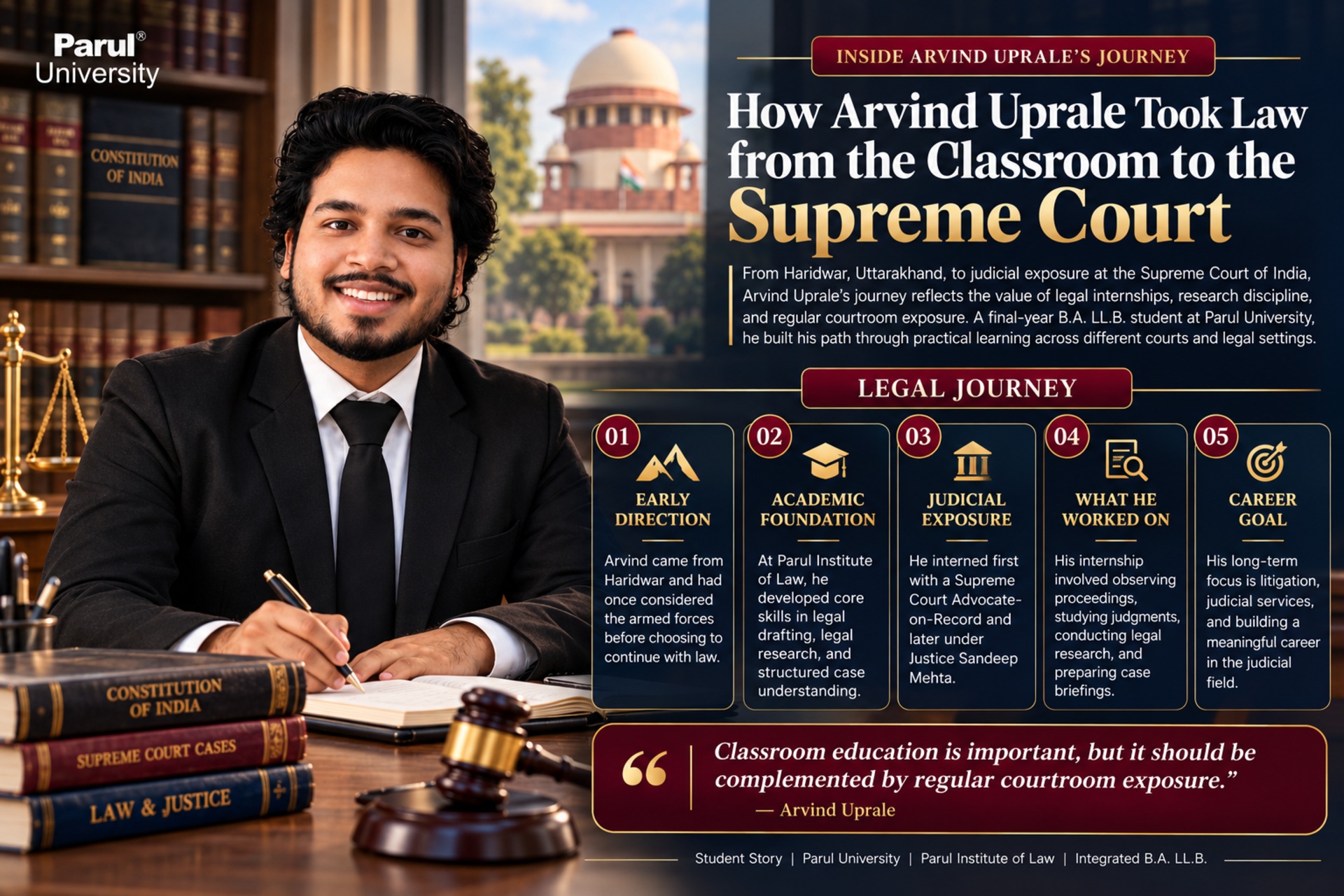
Arvind Uprale, a final-year B.A. LL.B. student at the Parul Institute of Law, completed a judicial internship connected with the Supreme Court of India, interning under Justice Sandeep Mehta and, earlier, under a Supreme Court Advocate-on-Record. From Haridwar, Uttarakhand, his path to the country’s apex court is a case study in how the right internship can transform a law student’s understanding of the profession.
A Choice Between Two Callings
Arvind’s route into law was not inevitable. Coming from Haridwar, where he completed his schooling at an institution his father also volunteers with, his early aspirations were tied to the armed forces, and he actually cleared the relevant selection process after already enrolling at Parul University. After discussing it with his father, he chose to continue his law degree. It is a decision that still shapes his ambitions: his long-term interests lie in litigation and the judiciary, including the Judge Advocate General (JAG) route, which would let him combine law with service, and judicial services.
Why Parul University
Exploring his options from Haridwar, Arvind was drawn to Parul University by its campus and the way faculty explained the programmes and opportunities. For him, law was never only about memorising provisions; it was about understanding how they work in a real courtroom. That instinct, that law is something you must see in practice, would define his entire law-school journey.
Inside the Supreme Court
The defining experience of Arvind’s degree was his judicial internship at the Supreme Court of India. Through the university’s Training and Placement support, he learned of the opportunity, applied based on his interests and preferred location, and was placed, first for a month under a Supreme Court Advocate-on-Record, and later as an intern under Justice Sandeep Mehta. His work was that of a judicial intern: he primarily observed court proceedings rather than participating directly in arguments, and outside the courtroom he conducted legal research, studied judgments, and prepared case briefings used within the legal-work process. Living in Noida and travelling to Delhi by metro, his days moved between watching hearings and doing research back at the office.
The internship also introduced him to the role of Law Researchers, who assist judges by examining case material, and he found the environment professional yet supportive, with researchers willing to guide interns through difficulties.
Classroom and Courtroom Different Experience
Classroom learning and courtroom experience are always going to differ. In the courtroom, students gain real-world experience and learn how to connect classroom knowledge with practical application. Arvind gained this experience and recognised the gap between the two. Classroom learning is more theoretical, helping build a strong foundation. He made notes but also understood that courtrooms do not follow a fixed pattern. There is uncertainty, live interpretation, and situations that no book can predict.
He credits the workshops and seminars at Parul University, especially those on legal drafting and legal research, for preparing him. The ability to research a matter and prepare a structured brief proved directly useful. Knowing that his research could contribute to material eventually considered at the judicial level made him far more conscious of accuracy, discipline, and attention to detail.
Classroom education is important, but it should be complemented by regular courtroom exposure.
– Arvind Uprale
Lessons in Discipline, and Humanity
Two observations stayed with him. The first was discipline: far from the dramatic arguments of film and television, he found the court a highly structured environment built on punctuality, preparation, and professional conduct, and he was struck by the sheer extent of preparation that goes into understanding cases before a hearing. The second was human. Among the matters he observed, one family-court hearing, involving a young student in financial difficulty, moved him by showing how directly the law touches ordinary lives. It taught him that legal professionals need both discipline and sensitivity, and that behind every case file is a person. On the final day, he and the other interns had the opportunity to meet Justice Sandeep Mehta individually, a brief, nervous, and, for Arvind, unforgettable moment.
A Journey Across Many Courts
The Supreme Court was the high point, but not the whole story. Over his five years, Arvind gained exposure across the legal system, including a district court, the Delhi High Court, and the Central Administrative Tribunal, believing every court offered something different to learn. A law clerk’s advice stuck with him: to stay open-minded and explore different areas of law while still a student, rather than narrowing his path too soon. As he approaches the end of his B.A. LL.B., he is focused on litigation and the judiciary, preparing for competitive examinations and gathering practical experience, with his sights set firmly on a career in the judicial field.
Frequently Asked Questions
Who is Arvind Uprale?
Parul University student Arvind Uprale. He is a final year student in B.A. LL.B. He is a law student. He came from Haridware, Uttrakhand to pursue a law degree here. Through this he got an opportunity to work as a judicial intern. He worked as an intern with the Supreme Court Judge of India Justice Sandeep Mehta. Before that he did his internship with Supreme Court Advocate-on-Record. Through this he got an opportunity to understand legal research and case briefings. His goal is to make a career in litigation and the judiciary.
What does a Supreme Court judicial internship involve?
Internships are meant for initial learning. The learning that teaches you how practical scenario looks like. Here comes the judicial internship. When you get to work with a Supreme Court Judge's office. Here, the main part is that the intern observes court proceedings and help with legal work. Help with behind the scenes. Then they have to conduct legal research, study judgments, and prepare case briefings and summaries. They also get an opportunity to see how the arguments are presented, and how to defend.
How do Parul University law students get such internships?
Parul University’s Training and Placement Cell helps law students identify and apply for internships according to their interests and preferred locations, including at District Courts, High Courts, and the Supreme Court. Combined with the Institute of Law’s workshops on legal drafting and research, this support helps students secure and succeed in demanding judicial and courtroom internships.