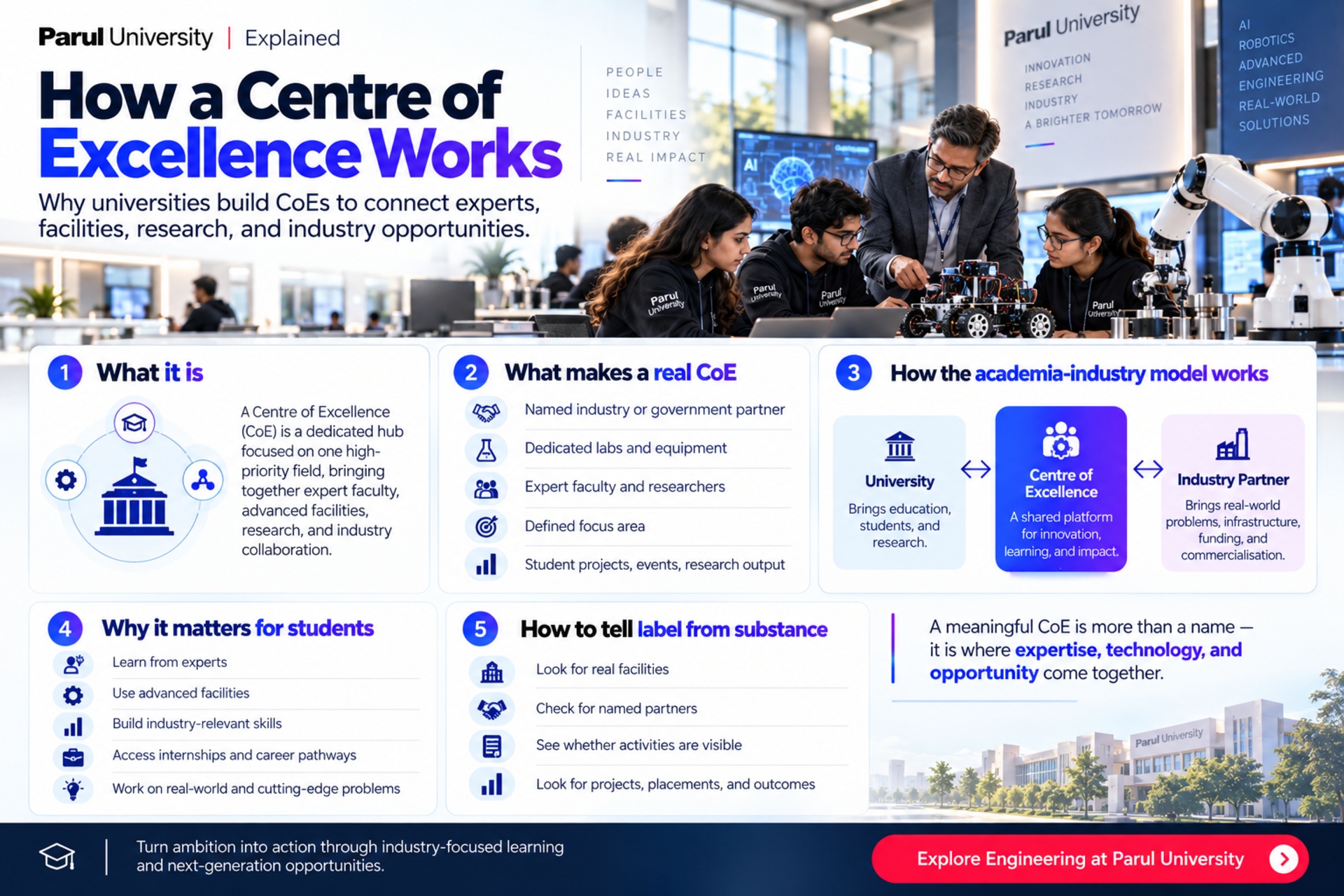
A Centre of Excellence (CoE) is a dedicated hub within an institution that focuses deep expertise, advanced facilities, and often an industry partnership on one high-priority area, such as quantum computing, AI, or robotics. The term appears constantly in higher education, and understanding what it really signifies helps students judge what a university actually offers. Here is a clear guide.
More Than a Fancy Name for a Lab!
The title is more than a fancy name for a lab. It’s more than a fancy name for a lab. A Centre of Excellence is, on the most basic level, a centre of expertise in a particular area of focus. However, a good one is more than a room with all the necessary equipment; it focuses a number of things in one place: specialised laboratories and equipment; faculty and researchers who know the field; a clear research agenda; and, more and more often, a formal partnership with industry or government. The principle is to achieve critical mass. A CoE brings together the people and resources that are best suited to address a single important problem and can accomplish more than an individual could, which is why institutions create them for the problems that are of greatest importance.
What other models are there beyond the academia-industry model?
The best Centres of Excellence come with a university and a partner from industry, and it’s a great idea because each side brings to the table what the other doesn’t. The university provides education, research potential, good students, and new ideas, while the industry partner provides real-world problems, funding, advanced or commercial infrastructure, and most importantly, a way to commercialise research into actual products and services. This is what makes a CoE different from a regular training tie-up. It’s not a one-way street: the university is getting industry exposure, and at the same time, it’s getting expertise and innovation that can be further developed at the partner.
Why It Matters for Students?
Being at a Centre of Excellence gives a student some tangible benefits:
- Drawing on the experience of experts, academic researchers, and industry practitioners at the forefront of the field.
- Access to advanced facilities and technology that they wouldn’t ordinarily be able to interact with in a regular classroom.
- Industry-relevant skills, as curricula and projects are driven by industry needs.
- Internships and job pathways, because they often come with real opportunities from the industry partner.
- Access to cutting-edge research and the opportunity to work on significant problems rather than textbook problems.
How to distinguish between a real CoE and a label?
With its widespread use, it is useful to understand what a proper Centre of Excellence actually is. Signs of strength include a real, named partner, not just an internal rebrand; dedicated facilities and equipment; identifiable, clearly defined areas of expertise leading the programme; a clear focus area and tangible activities; and research output, events, student projects, and placements, not just an announcement. A meaningful CoE demonstrates its work; it is what happens in the CoE, not what is written on the sign outside it. Inspired already? Explore the B.Tech in Quantum Computing and gain the skills to shape what comes next in this ever-evolving field!
FAQs
What is a Centre of Excellence in a university?
A Centre of Excellence (CoE) is a specific focal point within a university that brings together the expert faculty members, advanced facilities, a dedicated research program, and, in some cases, an industry or government partner to one high-priority field. The goal is to establish critical mass, move research, training, and innovation in that field beyond the reach of any one department, and take learning straight to the 'real world.'
What are the reasons behind the establishment of Centres of Excellence by universities?
Centres of Excellence are created at universities to concentrate the best resources on key, high-impact areas of research; to collaborate with industry or government to bring research to market; to secure funding and talent; and to provide students with cutting-edge facilities, experienced mentors, industry-relevant skills, and career pathways. A CoE is an excellent mechanism for developing the capability of a field seriously at a rapid pace, particularly for emerging fields.
What value is there to a Centre of Excellence for students?
Students experience state-of-the-art facilities and technology, gain knowledge from academics and industry experts, get a curriculum that is relevant to industry needs, and are provided an opportunity to do an internship/career pathway with the partner and to work on cutting-edge research, in addition to textbook problems. This specific and industry-relevant training is invaluable in today's technologically dynamic world to equip graduates.