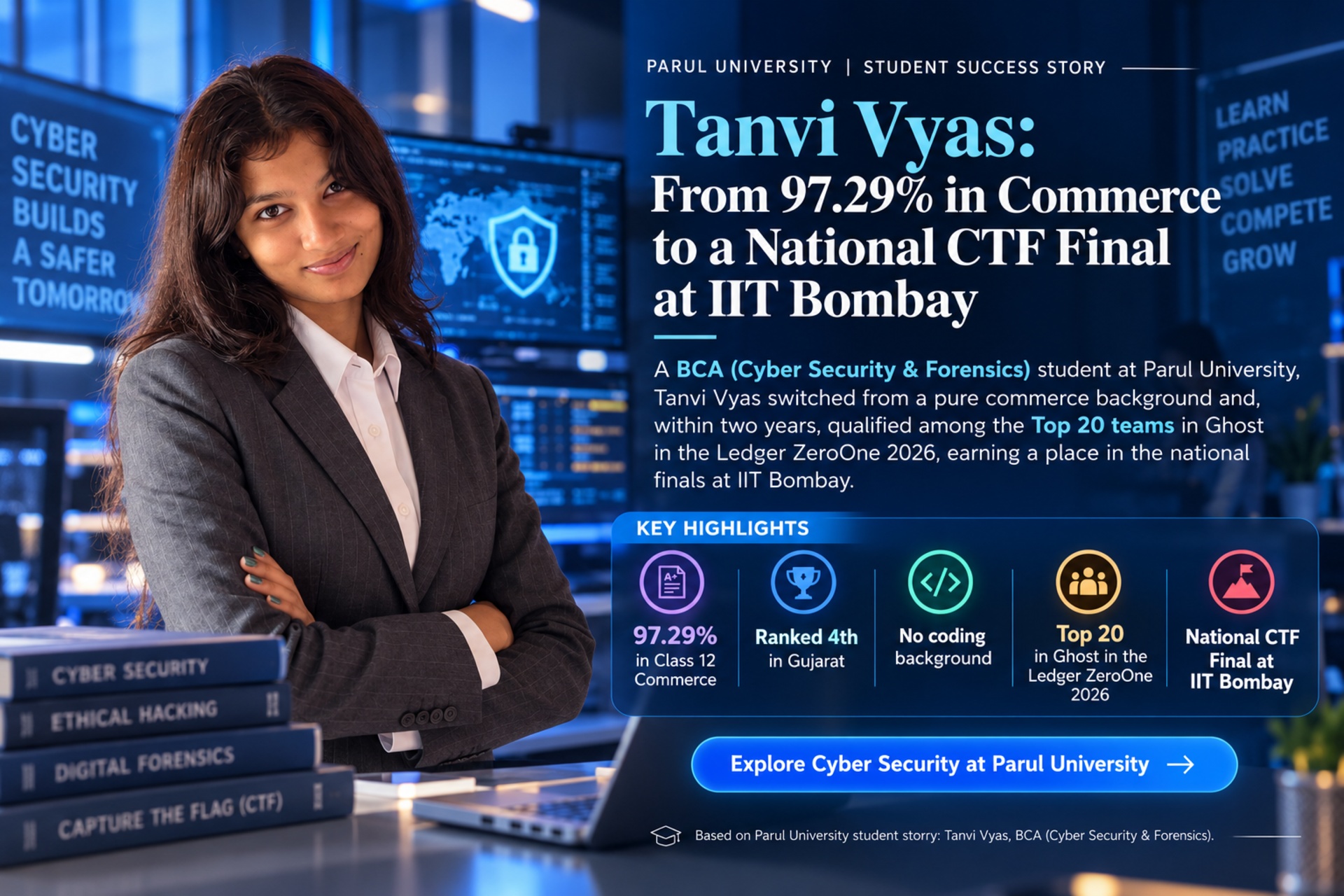
Tanvi Vyas, a BCA (Cyber Security & Forensics) student at Parul University, qualified among the Top 20 teams in Ghost in the Ledger ZeroOne 2026, a national Capture the Flag (CTF) competition, earning a place in the finals at IIT Bombay. What makes it remarkable is where she started: a commerce background, a 97.29% board score, and no technical training at all. Her journey is a case study in how a cybersecurity career can be built from scratch, combining a formal degree with the field she had fallen for.
Building the Foundation
Rather than rush ahead, Tanvi started with fundamentals: computer networking, operating systems, file systems, and programming (including Python). Crucially, she did not confine her learning to the classroom. She threw herself into practical cybersecurity through CTFs and workshops, and got involved with the university’s Tinkering Hub, where she met professionals and joined cybersecurity discussions. Workshops on bug hunting and a multi-day hackers’ meet deepened her grasp of networking and connected her to a community of people who, like her, were learning by doing. It is exactly the hands-on, community-driven path that the field rewards.
A Real Project: Automating Penetration Testing
Tanvi’s interest has centred on Vulnerability Assessment and Penetration Testing (VAPT), one of cybersecurity’s most in-demand specialisations. She has been building an automated penetration-testing tool: the idea is that you give it a URL, and it automates stages of security testing before presenting the vulnerabilities it finds. It is an ambitious project for a second-year student, and a clear sign of her instinct to apply what she learns to real problems rather than stopping at theory, strengthened by hands-on penetration-testing experience through her project work.
Inside the CTF: A Two-Hour Blind Sprint
The qualifier for Ghost in the Ledger ZeroOne 2026 was a two-hour “blind” sprint, from 6 to 8 PM, with the scoreboard completely hidden. The team had no idea where they stood and simply focused on solving challenges and making the most of the clock, only later discovering they had reached second place at one point, before finishing strongly enough to claim a Top 20 spot and a place in the IIT Bombay finals. Her team itself tells a modern story: she and her teammate, from Parul University and ITM Business University, met through LinkedIn over a shared love of CTFs, and split the work by strength, her teammate taking reverse engineering and cryptography, Tanvi focusing on web challenges.
What the Competition Taught Her
Two lessons stand out from Tanvi’s account. First, that cybersecurity is not purely technical. One challenge hid clues inside background music, requiring participants to listen carefully, spot patterns, and keep their composure, proof that creativity, observation, and presence of mind matter as much as code. Second, that reverse engineering, which she found genuinely hard coming from commerce, was best met head-on, using resources and AI-assisted learning to understand unfamiliar concepts rather than avoiding them. The deeper skill she built, she says, was learning to be comfortable with problems she did not yet know how to solve, which may be the most important skill in security of all.
Her Advice, and What’s Next
For students intimidated by cybersecurity, especially those from non-technical backgrounds, Tanvi’s advice is simple and hard-won.
Start small and practise consistently. Begin with basic concepts and beginner challenges, and work through them until the hesitation turns into confidence.
– Tanvi Vyas
Her own path proves it: from fundamentals, to CTFs, to a national final. Looking ahead, she plans to keep developing her VAPT automation project and aims to build a career as a bug hunter or penetration tester, eventually working internationally in vulnerability research. For a student who started in commerce two years ago, representing Parul University at IIT Bombay is a powerful marker of how far curiosity, practised consistently, can take you.
Frequently Asked Questions
Who is Tanvi Vyas?
Tanvi Vyas is a BCA (Cyber Security & Forensics) student at Parul University who qualified among the Top 20 teams in Ghost in the Ledger ZeroOne 2026, a national Capture the Flag (CTF) competition, earning a place in the finals at IIT Bombay. She came from a commerce background, scoring 97.29% in her Class 12 boards (fourth in Gujarat), before switching into cybersecurity.
Can you switch to cybersecurity from a commerce background?
Yes. Tanvi Vyas’ journey shows it is entirely possible: she came from pure commerce with no coding background and, within two years, reached a national CTF final. The key is starting with fundamentals (networking, operating systems, programming), practising hands-on through CTFs and projects, and building skills consistently, a path open to students from any background.
How to explain CTF competition?
CTF competition is Capture the Flag (CTF). It is a cybersecurity competition. In this competition, the students who participate have to solve security challenges. The challenges are designed in a way that it covers areas like web exploitation, cryptography, reverse engineering, and forensics. It is also to find the hidden flags. CTFs test real hacking and problem-solving skills under time pressure, and are one of the best ways for students to build and prove practical cybersecurity ability.