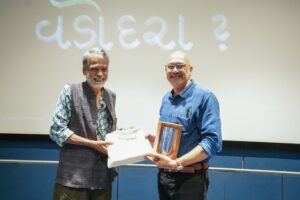
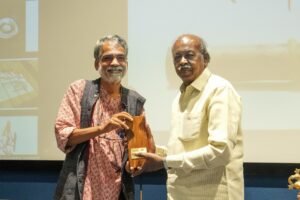
Every civilisation has faced the same challenge: how do you capture knowledge and pass it to the future? At Lipikalpa 2026, conservation expert Dr. P. Perumal, former Director of the Saraswati Mahal Museum, opened his session by tracing humanity’s long quest to record and transmit information, a story written across a surprising range of materials. Understanding it reveals why some ancient knowledge survives, and much does not.
Two Great Traditions: Engraving and Surface Writing
Dr. Perumal offered a useful way to organise the history of writing. He shared some methods. He said that historical writing methods have two categories, or two traditions. The techniques used were engraving. The cut or inscription of letters on a hard surface. This approach gave a way to write, draw, and incise letters ruled palm leaf manuscript culture and stone inscriptions. On the other hand, there is surface writing. It required applying ink or pigment onto a surface; this is the most used method behind paper and parchment traditions. This tells us how different manuscripts were made. And it is necessary to preserve.
Writing in Stone
If we look back in history, we will find that most durable surface for writing for stone. Observe rock carvings today, or temple walls; this is evidence that stone surfaces were a reliable one to write. Even the pillars are inscribed. It is learned that stone offered permanence above all else. Hence, the oldest records that have survived are inscriptions. But it had limitations too. Limitations such as stone is heavy, cannot be moved or is hard to move, is slow to carve, and cannot be used for things that require travel or to be produced quickly. It preserved a message for millennia, but it could never be a book.
Writing in Metal
Metals offered durability with a little more flexibility, and different metals were reserved for different purposes. As Dr. Perumal noted, gold was used for royal decrees, silver for sacred incantations, and copper for land charters and legal grants, with lead and iron also pressed into service. Copper plates, in particular, were a favoured medium for recording grants and legal transactions across India, precisely because metal resisted decay in a way organic materials could not. Metal writing carried authority and permanence, fitting for the most important records a society kept.
The Age of Organic Materials: Palm Leaf, Bark and Paper
With growing civilisation, humans required materials to write. Materials that were portable, that could be used when you travel, durable, and accessible. This led them to use plant and animal materials. Plant-based material turned out to be more usable. It was flexible and easy to handle. As we see or dig deeper, in India, palm leaves are used. A stylus is used to write. It is then placed in wooden boxes that carry stories, religious texts and knowledge from one generation to another. Then came the usage of tree bark and parchment. Parchment is prepared from animal skin, serving a similar purpose. And then came the invention of paper; it was lighter, cheaper and easier to handle.
In India, the palm leaf became the great medium of manuscript culture, incised with a stylus and bound between wooden covers, carrying epics, scriptures, and sciences across generations. Tree bark was used in some regions, while elsewhere in the world parchment (prepared animal skin) served a similar role.
Why the Material Matters
Dr. Perumal’s central point was that the physical and chemical properties of a writing material dictate its preservation needs today. Stone and metal endure for millennia with little care; organic materials like palm leaf, bark, and paper are vulnerable to humidity, temperature, insects, light, and mechanical stress, and demand active conservation to survive. The material a civilisation chose therefore shaped not only how it wrote, but how much of its knowledge would reach us. It is a reminder that every manuscript is a fragile bridge between the past and the future.
Guardians of Knowledge
This history carries a deeper meaning. Dr. Perumal linked it to National Library Day, observed on 12 August to mark the birth anniversary of Dr. S. R. Ranganathan, the father of Indian library science, and emphasised that libraries and manuscript repositories are the guardians of human intellectual history. The evolution of writing materials is not just a technical story; it is the story of how humanity has fought, again and again, to keep its knowledge alive. Preserving what survives, on stone, metal, palm leaf, and paper, is an act of safeguarding culture itself.
FAQs
What type of materials were used before paper?
Paper was a later invention. Before that, humans wrote on stone, metal (gold, silver and copper), palm leaves, tree bark and parchment in other regions. Each material was in accordance with requirements, offering a different balance of durability, portability, and ease of use.
How to differentiate between engraving and surface writing?
Engraving techniques cut or incise letters into a hard surface, as in stone inscriptions and palm-leaf manuscripts. Surface writing applies ink or pigment onto a surface, as with paper and parchment. This distinction shaped how different manuscripts were created and influences how they must be conserved today.
Have writing materials changed over time?
With growing civilisation, we need some good material to write. Material that is durable, easy to carry and handle, and more accessible than stone or metal. This led to the making or invention of organic materials like palm leaf, bark, parchment and finally paper. Paper is lighter, cheaper and easier to produce.