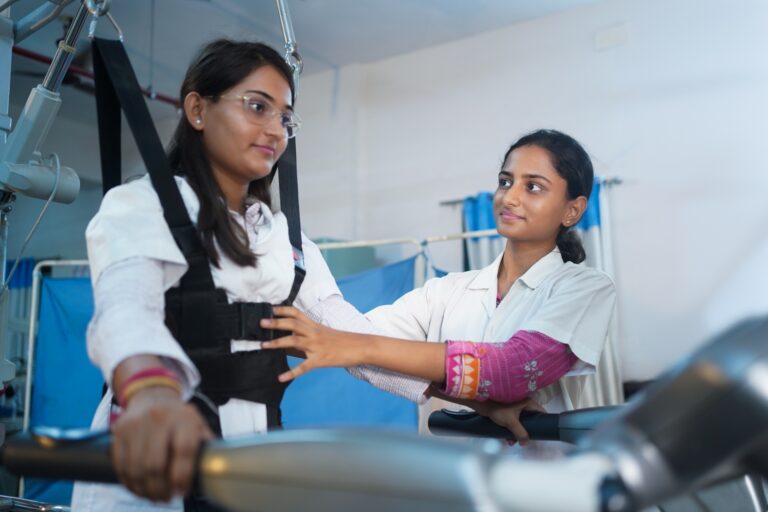
Connect anatomy knowledge with patient assessment, body movement and practical physiotherapy training.
For students interested in physiotherapy, learning about the human body is the first step towards understanding patient care.
During anatomy lessons, students study bones, muscles, joints, and nerves. However, the real challenge begins when they must connect this knowledge with a patient’s physical problems.
A Bachelor of Physiotherapy course helps students understand this connection through classroom learning and practical training.
Why Is Anatomy Important for Physiotherapy Students?
Anatomy is the study of the body’s structure. It helps students understand where different body parts are located and how they are connected.
For example, the knee contains bones, ligaments, muscles, and other structures that support movement.
When a patient experiences knee pain, physiotherapy students need to understand these structures before learning how to assess the problem.
Anatomy also helps students understand why some movements become difficult after an injury.
However, anatomy knowledge alone cannot identify the exact cause of pain. Students must also learn proper clinical assessment methods.
Which Anatomy Concepts Help Students Understand Patient Problems?
Different parts of anatomy become useful when students begin studying patient movement and physical difficulties.
Some important concepts include:
• Bones and Joints:
Understanding how the body’s structure supports standing, walking, and bending.
• Muscles:
Learning which muscles help perform different movements.
• Nerves:
Understanding how nerves carry signals that support movement and sensation.
• Spine Structure:
Studying the bones, joints, and surrounding tissues involved in back movement.
• Blood Supply:
Understanding how blood vessels provide oxygen and nutrients to body tissues.
These concepts give students the basic knowledge needed to study more detailed physiotherapy subjects.
How Do Anatomy Lessons Connect with Patient Assessment?
Consider a patient who finds it difficult to lift their arm after a shoulder injury.
A physiotherapist needs to understand the shoulder joint, nearby muscles, and surrounding structures to assess the movement problem.
Students may learn to observe how far the patient can lift their arm and whether the movement causes discomfort.
They also study how muscle strength, joint movement, and pain can affect daily activities.
Such observations are combined with medical history and other assessment findings.
This helps students understand how anatomy knowledge becomes useful during patient examination.
How Can Students Apply Anatomy Knowledge During Practical Training?
Practical training gives students opportunities to connect textbook lessons with body movement.
Under proper supervision, students may participate in activities such as:
• Identifying Body Structures:
Using anatomical models to understand bones, joints, and muscles.
• Observing Joint Movement:
Studying how different joints bend, straighten, and rotate.
• Understanding Muscle Actions:
Learning how muscles support everyday activities.
• Practising Basic Assessment:
Observing posture and movement using approved assessment methods.
These activities help students become more familiar with the human body.
They must also learn to explain procedures, obtain patient consent, and follow clinical safety instructions.
Get Complete Details From Expert
How Does Parul University Connect Anatomy Learning with Clinical Experience?
The Bachelor of Physiotherapy programme at Parul University is a five-year course that combines theoretical knowledge with practical clinical training.
Students study subjects such as anatomy, physiology, biomechanics, and therapeutic procedures.
The programme provides practical learning opportunities through laboratories, clinics, and hospitals from the early semesters.
Students also have access to the 750-bed Parul Sevashram Hospital, which supports clinical learning across different healthcare areas.
The Faculty of Physiotherapy provides a compulsory six-month rotating clinical internship, allowing students to gain supervised hospital experience.
Through these opportunities, students can understand how knowledge of muscles, joints, and body movement is used during patient assessment and rehabilitation.
Why Does Anatomy Knowledge Remain Important During Patient Recovery?
Anatomy continues to guide physiotherapists even after the first patient assessment.
For example, a patient recovering from an ankle injury may initially have difficulty moving the joint.
As recovery progresses, the physiotherapist may work on suitable movement, strength, and balance activities based on clinical findings.
Students must understand which body structures are involved and how the patient’s condition changes during rehabilitation.
They also learn that every patient’s recovery may be different.
One day, a student may be looking at a muscle diagram in class. Later, that same knowledge may help them understand why a patient cannot perform a simple movement.
Students who want to understand how the body works in real healthcare situations can explore the Bachelor of Physiotherapy at Parul University and kickstart their careers.