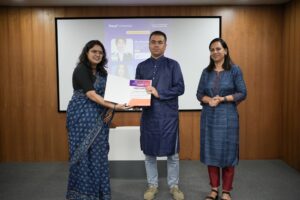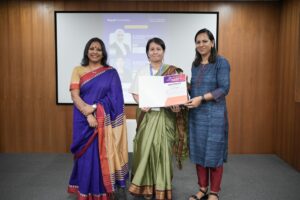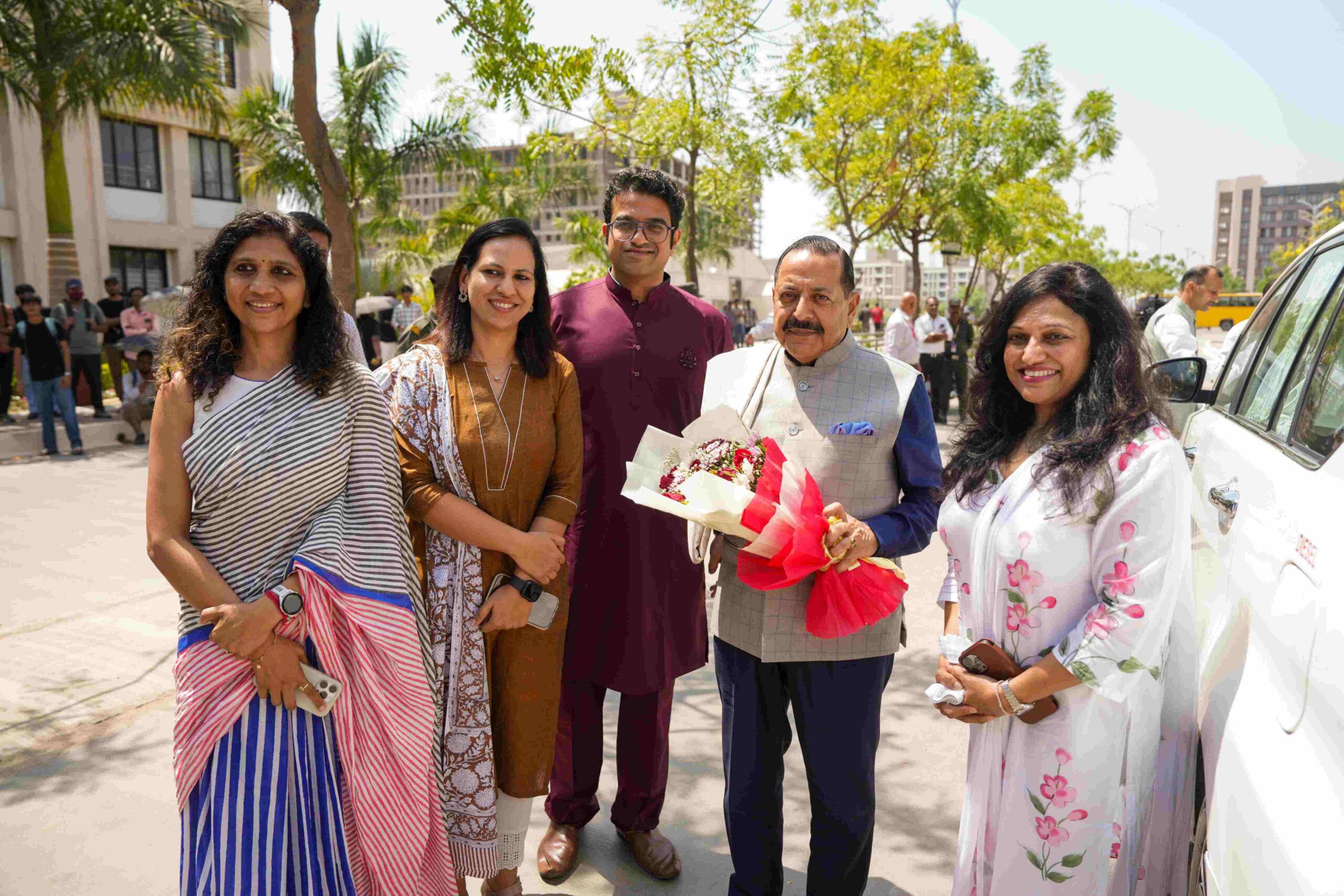
On the bright sunny day of 8th May 2026, India’s Union Minister, Dr Jitendra Singh, proudly inaugurated the 3 different facilities in the Vadodara campus of Parul University.
Lakshya 2047 – Parul University’s Centre for Future Skills, the Cadaveric Centre and an Advanced Medical Simulation Facility were officially inaugurated by Dr. Jitendra Singh – Union Minister of State for Science & Technology, Earth Sciences & MoS in the Prime Minister’s Office, Personnel, Public Grievances, Pensions, and Atomic Energy & Space.
Speaking of the event, it was verified via the press coverage from the Daily Excelsior – Dr Jitendra Singh deliberated that Lakshya 2047 is one of the fastest-moving operational implementations of Viksit Bharat 2047, as inspired by the vision of Prime Minister – Shri Narendra Modi Ji. Dr Jitendra Singh added that it’s driving in sync with the emerging technologies such as Quantum, Artificial Intelligence, Semiconductors, and deep tech, centralising India’s Youth at the centre for manoeuvring our nation to a developed nation. He even acknowledged Lakshya 2047 as a futuristic vision, not just a contemporary one!
The coreness of Lakshya 2047!
Lakshya 2047 was officially inaugurated on 8th May 2026. It’s a dedicated building at the ever-evolving Vadodara campus of Parul University, and it houses 20 industrial-grade laboratories, 9-future technologies and 25+ globally acclaimed certifications. The core meaning behind Lakshya in Hindi is a goal or a target. Subsequently, the core idea is to keep 2047 as a central year of Indian Independence, the deadline the PM has set for India to become a full-fledged developed nation.
The labs inside the building train students in cloud computing, artificial intelligence, cybersecurity, networking, software development, industrial automation, smart building management, design and engineering simulation, immersive technologies, semiconductor design, advanced materials and sensors, cognitive sciences, and drone operations. Each lab is built around a named industry partnership with a global brand, with each producing graduates who earn certifications recognised by the issuing companies themselves.
The core certifications include Microsoft Azure AZ-900, AZ-204, and AWS Academy Credentials. Besides this, it has NVIDIA’s deep learning institute fundamentals, Apple-certified professional support, Cisco CCNA & CCNP, Siemens Certified Drives & Automation, Schneider Electric EcoXpert Building Automation, ABB Advanced Robotics, Meta AR Developer Professional, and Synopsys Certified Professional certificate covering VLSI. ASM & International Materials Engineering, IEEE Sensors & IoT, CCST and the list is endless.
The total exceeds twenty-five distinct globally recognised credentials available to students inside one building. A detailed treatment of each credential and what employers actually expect of them is covered in the Lakshya 2047 global certifications guide.
The construction of the centre was deliberate in another way. It is not a single department’s resource. It cuts across faculties.
Engineering students use the industrial automation labs and the semiconductor and design infrastructure. Computer Science students train inside the Microsoft, AWS, NVIDIA, Apple, and Cisco labs. Design students work in the Adobe Creative Design Studio and the AR/VR immersive technologies suite. Architecture and Civil Engineering students use the Autodesk lab and the Home Automation simulation. Mechanical Engineering students engage the ANSYS computational simulation infrastructure and the prototyping zone. Medical and Nursing students use the Mind Lab for cognitive research. Aeronautical students operate the drone ecosystem. The course-to-lab mapping article lays out which Parul University programme connects to which Lakshya 2047 lab in detail.
The inauguration on 8 May 2026: what the Union Minister actually said
The choice of who inaugurates a building tells you what the institution is positioning itself as. Dr Jitendra Singh’s portfolio is very progressive and tremendous. He is serving as Union Minister of Independent Charge of Science & Technology, Earth Sciences, as Minister of State in the PM’s Office of Personnel, Public Grievances, Pensions, and Atomic Energy & Space. His portfolio thrives at the juxtaposition of next-gen technologies & polices of the central government. He deliberated on how he used the platform to walk through what the Government of India is doing in the technology and skilling space and where Lakshya 2047 fits in.
On the topic of the National Quantum Mission, Dr Jitendra Singh added that India has already completed 1,000 kms of quantum communication in the time span of 3 years, executing the entire target in less time than the expected deadline. This 8-year mission is designed for progressing 4 thematic hubs in collaboration with educational and research institutions across India. On speaking of the IndiaAI Mission launched in 2024, he deliberated that this front will lay a strong ecosystem for infrastructure, datasets, innovation, and future skills in amping up the holistic development of Lakshya 2047.
Talking of India’s global standing in innovation, he said, our country ranks 3rd in the startup ecosystem at the global level and has successfully crossed 1 lakh patents. The most valuable fact is that the majority of patents are filed by Indian residents, and India also ranks among the top and trending 5 nations globally in scientific publications, in sync with international citations & recognitions.
He even added that Lakshya 2047 is an additional infrastructure for a country that’s already ideating, producing and publishing world-class research and innovations. Besides this, laying this foundation will help in leveraging a workforce that will amp the entire trajectory. On talking about demography, he said India’s advantage is nearly 70% of the population below the age of 40 years, and this surely presents a major opportunity to rise as a global skilled workforce for the next 2 or 3 decades. Continuous skilling and upskilling are divided across Artificial Intelligence, Cybersecurity, Quantum Technologies, and semiconductor design, as this is the pivotal policy of Lakshya 2047.
On speaking of broader policies, he deliberated his views on NEP 2020, the National Quantum Mission, the IndiaAI Mission and the Anusandhan National Research Foundation (ANRF), Atal Tinkering Labs, and diverse startup-support programmes as well. On Artificial Intelligence specifically, he said India is pursuing an approach rooted in inclusion, responsibility, and the referring to the Global South AI Summit hosted by India earlier this year and the adoption of the Delhi Declaration on responsible AI. “One has to be intelligent enough to use Artificial Intelligence,” he remarked, adding that AI guided by ethics and equity can become a powerful force for healthcare, governance, and social transformation. The framing matters because Lakshya 2047’s AI training infrastructure (the NVIDIA Lab, the Microsoft Copilot training, the Adobe AI tools, the AR/VR development stack) is explicitly aligned with this responsible-use philosophy rather than with raw capability deployment.
Dr. Devanshu Patel, President of Parul University, addressed the event with a more institutional framing. He said the university’s approach is to develop “an environment where innovation, industry connections, and ethical considerations come together to ensure that students are well-prepared for the future.” That institutional voice runs through the design of Lakshya 2047 itself. The centre is the first major public commitment by Parul University’s leadership under Dr. Parul Patel, Dr. Devanshu Patel, and Dr. Geetika Madan Patel to operationalise the Viksit Bharat 2047 vision through physical infrastructure rather than rhetorical alignment.
On the year 2047, he said, will belong to the present generation of young Indians, who will be at the peak of their energy, careers, and capabilities when the country completes 100 years of Independence. Lakshya 2047 was built for those students.
How Lakshya 2047 operationalises Viksit Bharat 2047
The Viksit Bharat 2047 vision sets a national goal of India becoming a developed country by the centenary of Independence. The vision is structured around multiple pillars, including economic growth, social progress, environmental sustainability, infrastructure development, and the technology and skilling capacity required to underpin all of the above. A national vision of this kind is only as credible as the operational infrastructure that delivers against it, which is where Lakshya 2047 sits.
The centre operationalises the Viksit Bharat 2047 vision in four concrete ways:
- Domain alignment with national priorities. Cloud computing, artificial intelligence, cybersecurity, semiconductor design, quantum-adjacent computing, advanced manufacturing automation, immersive technologies, and cognitive sciences are all named priorities in the broader Viksit Bharat 2047 policy environment, and all have dedicated lab infrastructure inside Lakshya 2047.
- Industry-issued credentials, not just university degrees. The centre issues certifications recognised by the global industry rather than only by the issuing university. A student who completes the Microsoft Azure AZ-204 pathway inside Lakshya 2047 holds the same credential as a working software engineer at any IT services firm. The credential’s value does not depend on Parul University’s brand. It depends on Microsoft.
- Structural NSDC partnership. The curriculum is built around a partnership with the National Skill Development Corporation, the central government’s principal vehicle for implementing the Skill India Mission. NSDC alignment connects the centre’s certifications to national skill frameworks rather than only to industry expectations.
- Cross-faculty integration by design. The labs are not siloed inside one academic department. Engineering, Computer Science, Design, Architecture, Medicine, Nursing, Applied Sciences, and Management students all draw on the same infrastructure for different purposes, mirroring the cross-sectoral integration the Viksit Bharat 2047 vision requires of the workforce being built to deliver it.
A detailed treatment of how Lakshya 2047 operationalises Viksit Bharat 2047, including the specific policy passages the centre maps to and the measurable contributions it makes to the vision, is available in the dedicated Viksit Bharat 2047 implementation article in this suite.
The collaboration architecture: NSDC, Ethnotech, and Cambridge University Press and Assessment
A centre of this scale is not built by one institution acting alone. Lakshya 2047 was developed through three named external partnerships, each contributing something different.
- National Skill Development Corporation (NSDC). The central government’s principal skill development body, operated by the Ministry of Skill Development and Entrepreneurship as a public-private partnership with the mandate of catalysing the skilling ecosystem in India. NSDC’s involvement connects Lakshya 2047’s certification programmes to national skill frameworks and the broader Skill India Mission.
- Ethnotech. The industry-training partner that operates the certification programmes inside several of the labs. Ethnotech brings industry-current expertise into the classroom through trainers who work professionally in the domains they teach. The arrangement keeps Lakshya 2047 as Parul University infrastructure while Ethnotech delivers the specialised industry knowledge that allows students to clear globally recognised certification examinations.
- Cambridge University Press and Assessment. One of the oldest and most respected academic credentialing bodies in the world. Cambridge’s presence brings international academic validation to the centre’s training programmes and signals that standards are aligned with international academic assessment frameworks, not only with industry vendor certifications.
The three-way structure is the architecture that gives Lakshya 2047 institutional weight across all three credentialing dimensions students might be evaluated on by future employers or graduate schools. The dedicated NSDC and Parul University article covers the operational details of how the partnership runs day-to-day, including which credentials carry NSDC alignment and how Cambridge’s assessment standards intersect with industry certification examinations.
The nine future-technology domains inside Lakshya 2047
The Union Minister’s verified statement at the inauguration referred to training in nine future-technology domains. The twenty-plus individual labs inside the centre cluster into these nine domains by function. Each domain is briefly introduced below, with reference to the dedicated deep-dive articles where each is covered in detail.
1. Cloud Computing
Cloud computing inside Lakshya 2047 is delivered through three industry-anchored labs working together. The Microsoft Lab trains students for Microsoft Azure Fundamentals (AZ-900) and Microsoft Azure Developer Associate (AZ-204) certifications, with hands-on access to Azure cloud services and Microsoft Copilot. The AWS Cloud Computing Lab operates 39 stations preloaded with AWS development tools and connects students to the AWS Academy portal, with practical training in EC2, S3, IAM, and Lambda services leading to AWS Academy certifications. Together, they cover both major cloud platforms used in Indian and global IT industries.
2. Artificial Intelligence and GPU Computing
AI infrastructure is concentrated in the NVIDIA Lab, built around a Super Micro server hub running the RTX GPU system with the capacity to control 92 to 98 monitors simultaneously through 38 student workstations. The lab supports CUDA programming, Tensor RT optimisation, deep learning model training, robotics simulation through Isaac Sim, and the digital-twin work in NVIDIA Omniverse. Students earn NVIDIA Deep Learning Institute Fundamentals and NVIDIA AI Developer certifications. This is the same infrastructure pattern that companies like Google, Microsoft, and Meta use to train large-scale AI models, scaled appropriately for university research and student training.
3. Cybersecurity and Networking
Cybersecurity training is anchored by the Cisco Networking and Cyber Security Lab, which provides enterprise-grade Cisco routers, switches, firewalls, and the virtualisation infrastructure required to simulate real-world enterprise networks. Students train for CCNA, CCNP, and CompTIA Security credentials, with practical exposure to routing protocols, VLAN configuration, firewall implementation, intrusion prevention, secure cloud architecture, and Cisco IOS image recovery. The lab is designed to support students preparing for Cisco’s higher-level Certified Internetworking Expert (CCIE) examinations.
4. Software Development
The Apple Lab provides 15 to 30 high-performance Apple-based systems for iOS and macOS development training using the Swift programming language. Students earn Apple App Development with Swift certification and the Apple Certified Support Professional (ACSP) credential, with practical work in mobile application development, UI/UX design within the Apple ecosystem, and integration of Apple devices with broader software environments. The lab pairs with the Microsoft and AWS labs to give students working knowledge of both major mobile and desktop ecosystems.
5. Industrial Automation and Process Control
This domain spans four labs working together. The PLC and SCADA Lab trains students on Schneider Electric M221 Programmable Logic Controllers, SCADA monitoring systems, Human Machine Interfaces, and Variable Frequency Drives, with certifications including Siemens Certified Drives and Automation and the International Society of Automation Certified Control Systems Technician (CCST). The Industrial Drives and Control Lab provides three full industrial control panels with Schneider hardware and French-imported IoT modules for 3-phase motor control. The Home Automation Lab delivers training on Building Management Systems and HVAC simulation, with the Schneider Electric EcoXpert Building Automation certification. The ABB Lab operates an ABB IRB 1090 educational co-bot for industrial robotics programming in RAPID, with ABB Advanced Robotics and ISA Certified Automation Professional credentials.
6. Design, Modelling, and Engineering Simulation
Three labs cover the design and simulation domain. The Autodesk Lab provides industry-standard CAD studio infrastructure for mechanical machinery design, architectural modelling, and 3D visualisation, with integration to 3D printers and CNC machines and the Autodesk Certified Professional credential. The Adobe Creative Design Studio runs the full Adobe Creative Cloud suite, including Photoshop, Illustrator, Premiere Pro, After Effects, and Adobe Firefly generative AI tools, with Adobe Certified Professional (ACP) and Adobe Certified Expert (ACE) credentials. The ANSYS Lab provides engineering simulation software for structural analysis, computational fluid dynamics, thermal analysis, and electromagnetic simulation using finite element methods, with a dedicated 40-hour course duration focused on CFD specifically.
7. Immersive Technologies
The AR/VR Lab provides VR headsets, AR systems, motion sensors, radar tracking, GoPro Teleport cameras, green-room production infrastructure, and graphic-processing hardware capable of running real-time immersive applications. Students develop applications in Unity and Unreal Engine using C# and C++, with 3D modelling in Blender, and earn the Meta AR Developer Professional credential and the Autodesk Certified Professional in 3D Design.
8. Semiconductor Design and Advanced Materials
This domain is anchored by two labs that together cover the upstream and downstream of semiconductor and sensor engineering. The VLSI Lab provides 36 computer systems running Verilog HDL, VHDL, and the software-driven hardware design tools required for integrated circuit design and simulation, with Synopsys Certified Professional (VLSI) and IEEE VLSI Design certifications. The lab is directly aligned with India’s Semiconductor Mission, which has identified VLSI talent as a critical national capacity gap. The Material Synthesis Zone provides research-grade infrastructure for nanotechnology and sensor engineering, including a Techinstro Hydrothermal Autoclave, DC Plasma System, HOLMARC LWS-UV-T laser writing system for photolithography, Apex EZspin-PR spin coater, Autolab PGSTAT204N electrochemical workstation, Ossila Four-Point Probe, Tube Furnace with controlled gas atmospheres, and the supporting microscopy and analytical instrumentation. The lab carries the ASM International Materials Engineering Certification and the IEEE Sensors and IoT Certification.
9. Cognitive Sciences, Drones, and Prototyping
The ninth domain groups three substantially distinct but cross-cutting capabilities. The Mind Lab is a Cognitive and Sleep Physiology research facility with 24-channel dry-electrode EEG, fNIRS functional near-infrared spectroscopy, Tobii eye-tracking, Level I Polysomnography for overnight sleep studies, VR rehabilitation gaming systems, and Rehacom cognitive therapy software. The lab is built for cross-disciplinary research in neuroscience, psychology, neuroengineering, neurofinance, neuroaesthetics, and Brain-Computer Interfaces. The Drone ecosystem comprises the Drone Technique Lab, Drone Battery System Repair Lab, and Remote Pilot Training Operation (RPTO) Setup Lab, with AVPL Vraj Drone and student-built URI Bird Surveillance Drone, Mission Planner navigation software, GPS calibration setups, and the operational discipline frameworks aligned with India’s Drone Rules 2021. The Prototyping Zone and AICTE IDEA Lab round out the domain with Bambu Lab 3D Printers, PRUSA XL multi-tool printers, ELEGOO Resin Printers, CNC routers, laser cutters, the DGSHAPE SRM-20 milling machine, soldering stations, and the Major and Minor Machine Workshops for cross-disciplinary physical prototyping. The Prototyping Zone is recognised under the AICTE IDEA Lab scheme.
The 25-plus globally recognised certifications available through Lakshya 2047
The certification list is what separates Lakshya 2047 from a conventional university lab building. Every major lab issues at least one credential recognised by the company or international body that defines the standard in that field. Grouped by domain:
- Cloud computing: Microsoft Azure Fundamentals (AZ-900), Microsoft Azure Developer Associate (AZ-204), AWS Academy Cloud Foundations, AWS Academy Cloud Architecting, and the AWS Academy higher-tier credentials.
- AI and GPU computing: NVIDIA Deep Learning Institute (DLI) Fundamentals, NVIDIA AI Developer.
- Cybersecurity and networking: Cisco CCNA, Cisco CCNP, CompTIA Security+.
- Software development: Apple App Development with Swift, Apple Certified Support Professional (ACSP).
- Industrial automation: Siemens Certified Drives and Automation, International Society of Automation Certified Control Systems Technician (ISA CCST), ABB Advanced Robotics Programming, ISA Certified Automation Professional (CAP), Schneider Electric EcoXpert Building Automation.
- Design and engineering simulation: Autodesk Certified Professional, Autodesk Certified Expert, Adobe Certified Professional (ACP), Adobe Certified Expert (ACE).
- Semiconductor and VLSI: Synopsys Certified Professional (VLSI), IEEE VLSI Design Certification.
- Immersive technologies: Meta AR Developer Professional.
- Materials and sensors: ASM International Materials Engineering Certification, IEEE Sensors and IoT Certification.
A comprehensive treatment of what each certification actually qualifies a student for, the renewal cycle, the difficulty of the underlying examination, and how the industry actually weighs each in hiring decisions is in the dedicated certifications article.
The credentials matter because they are vendor-issued, not university-issued. A Microsoft Azure AZ-900 holder from Lakshya 2047 holds the same credential as an Azure-certified engineer at any IT services firm in India. The credential’s value is independent of Parul University’s brand because the issuing body is Microsoft. This is the structural argument against the worry, which appears periodically in discussions about private Indian universities, that a degree from a non-IIT, non-IIM institution does not carry weight in the hiring market. With Lakshya 2047, the question changes. A Parul University student with seven vendor certifications and a Cambridge-assessed academic record is no longer competing on institutional brand. They are competing on credentials that employers can verify independently.
How Lakshya 2047 connects to other national missions
Lakshya 2047 sits inside a broader national policy ecosystem that the Union Minister referenced directly in his inauguration speech. Each of the following missions intersects with the centre at a specific operational level:
The National Education Policy 2020 is the foundational policy that mandates multidisciplinary, skill-based, industry-aligned education in Indian higher education. Lakshya 2047 is built explicitly along NEP 2020 principles: multiple departments share the infrastructure, the curriculum is skill-based and outcome-anchored, and industry partnerships are structurally embedded rather than added as electives.
- IndiaAI Mission (launched 2024): Building national ecosystem capacity around AI compute infrastructure, datasets, innovation, and skilling. The NVIDIA Lab, the AWS AI services, the Microsoft Copilot training, and the Adobe Firefly tools inside Lakshya 2047 all contribute student-level capacity to this national effort.
- National Quantum Mission: An eight-year mission with the target of 1,000 km of secure quantum communication, already achieved within three years, according to the minister. The mission works through institutional partnerships, and Lakshya 2047’s computing infrastructure positions the centre to engage with quantum-adjacent research and skilling as the mission expands.
- Anusandhan National Research Foundation (ANRF): Consolidates India’s research funding architecture. Universities need infrastructure to absorb and execute ANRF-funded research. Lakshya 2047’s Mind Lab, Material Synthesis Zone, VLSI Lab, NVIDIA computing, and ANSYS simulation infrastructure collectively create the kind of research capacity in which ANRF projects can be hosted.
- India Semiconductor Mission – It has flagged a national shortage of VLSI talent. The Lakshya 2047 VLSI Lab is one of the operational responses to that gap, with Synopsys and IEEE certification pathways for students entering the semiconductor design workforce.
- AICTE IDEA Lab scheme: The Prototyping Zone inside Lakshya 2047 is recognised under this All India Council for Technical Education scheme, connecting it to AICTE’s institutional innovation framework.
- Skill India Mission: Operationalised through the NSDC partnership that anchors the centre’s certification programmes to national skill frameworks.
- Drone Rules 2021 and national drone policy: The RPTO Setup Lab and Drone Technique Lab are aligned with the Directorate General of Civil Aviation framework that governs remote pilot training and drone operations in India.
The Atmanirbhar Bharat vision of self-reliance is operationally supported by the centre’s industry-certification programmes that train Indian engineers on infrastructure they previously had to leave the country to access. The dedicated mission-alignment article maps each of these connections in detail.
Beyond Lakshya 2047: the Cadaveric Centre and Advanced Medical Simulation
The same day Dr. Jitendra Singh inaugurated Lakshya 2047, he also inaugurated two additional facilities at Parul University: the Cadaveric Centre and the Advanced Medical Simulation facilities. These are not part of Lakshya 2047 itself, but they were inaugurated as part of the same ceremony and represent the parallel infrastructure that Parul University’s Faculty of Medicine has built for medical education. The Cadaveric Centre provides cadaver-based anatomy training for MBBS and Anatomy students, replacing reliance on model-based learning with direct cadaveric dissection in line with international medical education standards. The Advanced Medical Simulation facilities provide high-fidelity simulators for emergency medicine, surgery, paediatrics, obstetrics, and intensive care, allowing students to develop clinical skills in a controlled environment before encountering live patients.
The strategic significance of all three facilities being inaugurated together is that Parul University is positioning itself across multiple priority sectors of the Viksit Bharat 2047 vision simultaneously. Lakshya 2047 covers the technology and skilling pillar. The Cadaveric Centre and Advanced Medical Simulation cover the healthcare-capacity pillar. The minister’s choice to inaugurate all three on the same visit signals that the central government views Parul University’s contribution to the Viksit Bharat 2047 architecture as multi-sectoral rather than single-domain.
Where Lakshya 2047 fits inside Parul University's larger picture
Lakshya 2047 is the most recent and most publicly visible piece of infrastructure at Parul University, but it sits inside a much larger institutional context. The university operates across four campuses with a research footprint that gives Lakshya 2047 the academic and infrastructural base it needs to function. Key institutional facts worth recording:
- Scale: Four campuses (Vadodara, Ahmedabad, Rajkot, Goa), more than 70,500 students across 25 academic disciplines, including 6,000-plus international students from over 70 countries.
- Accreditation and ranking: NAAC A++ with a CGPA of 3.55. QS World University Rankings 1001 to 1100 band for Asia 2026.
- Research footprint: More than Rs 58.31 crore in government-funded research across 315 funded projects, with seven faculty members in the Stanford-Elsevier global top 2 per cent of scientists.
- Entrepreneurship: 254 startups incubated through PIERC, more than Rs 20 crore in startup funding deployed, more than Rs 40 crore in startup revenue generated.
Lakshya 2047 connects to and reinforces this existing institutional infrastructure in specific ways. The Parul Innovation and Entrepreneurship Research Centre (PIERC) feeds directly from the Prototyping Zone inside Lakshya 2047, which gives startup founders the fabrication infrastructure to turn ideas into testable prototypes. The Micro-Nano Research and Development Centre (MNRDC) provides parallel research infrastructure for nanoscale materials and biotechnology that the Lakshya 2047 Material Synthesis Zone complements. The Centre for International Relations and Research (CIRR) hosts international students whose tailor-made academic programmes increasingly include time inside Lakshya 2047 labs.
FAQs
When and by whom was Lakshya 2047 inaugurated at Parul University?
On 8th May 2026, Dr. Jitendra Singh inaugurated it. He is the Union Minister of State with Independent Charge for Science and Technology and Earth Sciences, and also MoS in the Prime Minister's Office for Personnel, Public Grievances, Pensions, Atomic Energy, and Space. That same ceremony opened two more facilities at Parul University. The Cadaveric Centre. The Advanced Medical Simulation facilities. Dr. Devanshu Patel, President of Parul University, spoke at the event alongside the minister.
What is Lakshya 2047 and how does it connect to Viksit Bharat 2047?
Lakshya means goal in Hindi. 2047 is India's centenary of independence and the deadline attached to the Government of India's Viksit Bharat vision of becoming a developed nation. Put them together and the name of the centre says exactly what it is trying to do. Lakshya 2047 is the Centre for Future Skills at Parul University, Vadodara. Nine future-technology domains. Twenty-five-plus globally recognised industry certifications. The whole thing is built around one question: what skills does India need by 2047? It is one of India's first dedicated university infrastructure projects explicitly tied to the Viksit Bharat framework rather than just mentioning it.
How many labs are inside Lakshya 2047, and what do they cover?
20+ labs & 9 domains - Cloud computing runs on Microsoft and AWS. AI and GPU computing sit on NVIDIA infrastructure. Cybersecurity and networking are Cisco. Software development carries Apple. Industrial automation and process control bring PLC and SCADA, Industrial Drives, Home Automation, and ABB Robotics. Design and engineering simulation covers Autodesk, Adobe, and ANSYS. Immersive technologies handle AR and VR. Semiconductor and materials engineering runs VLSI and a Material Synthesis Zone. The ninth domain pulls together cognitive sciences, drones, and prototyping through the Mind Lab, the Drone ecosystem, and the AICTE IDEA Lab Prototyping Zone. Every single lab is anchored to a named global brand or international standards body.
Which Parul University students can access Lakshya 2047?
Cross-faculty by design. Engineering students across Computer Science, IT, Electronics and Communication, Electrical, Mechanical, Mechatronics, Aeronautical, Cybersecurity, and Robotics access the labs most directly. Design students use the Adobe Creative Design Studio and AR/VR Lab. Architecture and Civil Engineering students work with Autodesk and the Home Automation simulation. Medical, Nursing, Psychology, Physiotherapy, and Public Health students use the Mind Lab. Applied Sciences students in Physics, Chemistry, and Biotechnology use the Material Synthesis Zone. Diploma through PhD. All levels, appropriate complexity for each.
What national missions besides Viksit Bharat 2047 does Lakshya 2047 connect to?
Several. National Education Policy 2020 shaped the multidisciplinary, skill-based, industry-aligned design of the centre. IndiaAI Mission launched in 2024, connects through compute infrastructure and future skills. National Quantum Mission links through computing infrastructure and skilling. Anusandhan National Research Foundation connects through research absorption capacity. AICTE IDEA Lab scheme formally recognises the Prototyping Zone. NSDC partnership ties it to the Skill India Mission. The VLSI Lab aligns with the India Semiconductor Mission. Drone operations labs and the RPTO sit within the Drone Rules 2021 framework. Underneath all of it runs Atmanirbhar Bharat. Indian engineers trained on global infrastructure without leaving the country. That is the self-reliance argument made operational.