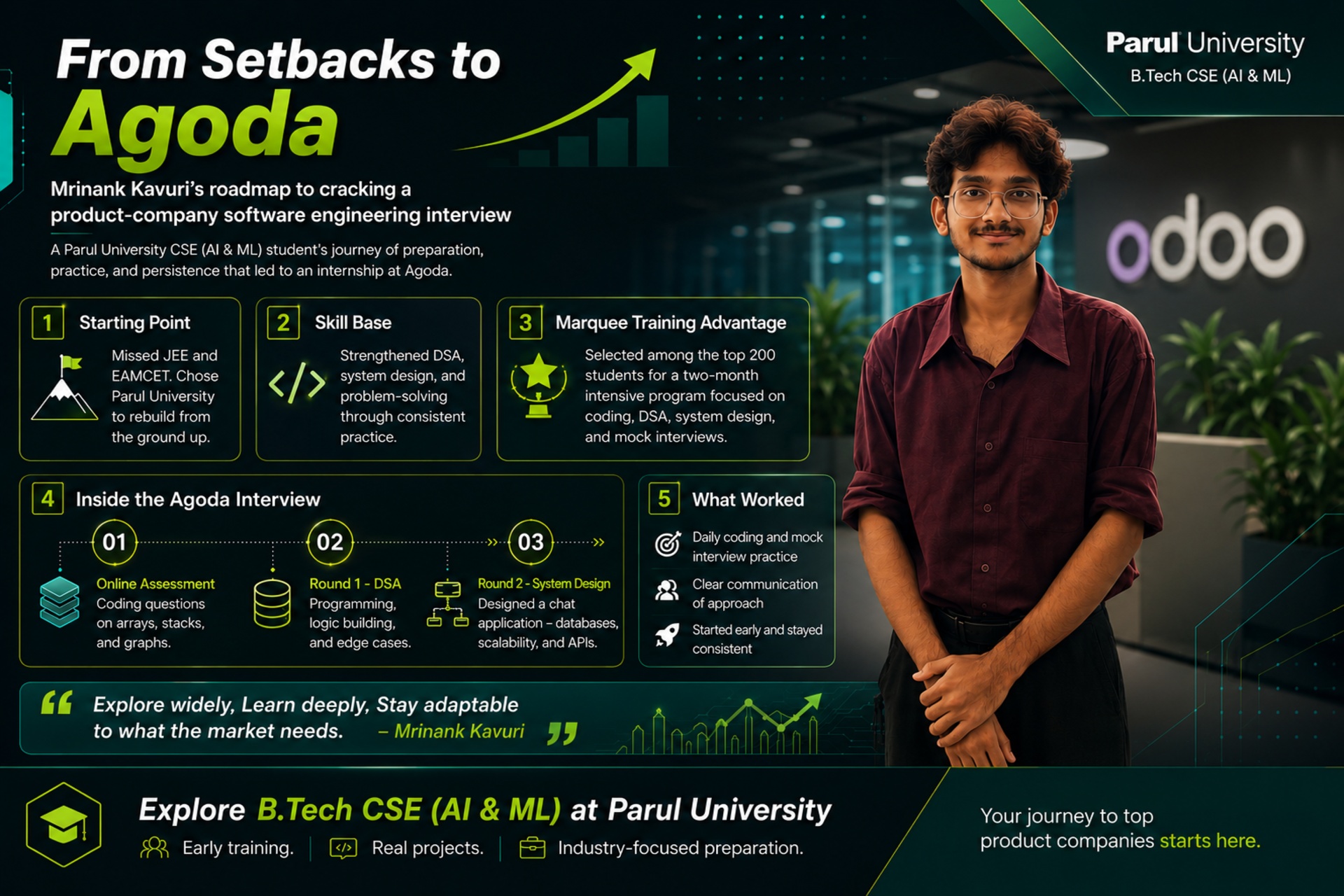
Cracking a product-based company interview is one of the most searched and most misunderstood goals in engineering. Mrinank Kavuri’s route to it is unusually instructive because he shared the real details. The Parul University student of B.Tech CSE with a specialisation in AI & ML got an internship at Agoda. Agoda is an online platform for travel bookings and more, headquartered in Singapore. Agoda has a wide market, with a large-scale distribution system making it a global platform. What makes his story an inspiration for others is that he failed the entrance exam, but preparation and a systematic approach led him to the placement.
From Exam Setbacks to a New Start
Mrinank hails from Hyderabad; he describes himself as an average student throughout school, never among the top performers. He took science in 11th and appeared for the engineering entrance exams after 12th, which are JEE and EAMCET, but couldn’t clear them. Losing hope was not in his books; he researched and widened his scope, getting shortlisted at Parul University, LPU, VIT and KIIT. He secured a seat in VIT and KIIT; he was careful with his choice of coming to Parul University. The reasons he ruled out VIT was, it was not the main campus, and KIIT was too costly and distant. The best option he had was Parul University as it has NAAC A++ accreditation, a growing national reputation, a curriculum focused on industrial learning, practical exposure, placement and a startup ecosystem with promising support leading to great future opportunities. After joining the university, he made sure to work hard and make a career path for himself that suited him and his dreams.
Building a Programming Foundation
Explore as much as possible. Don’t stick to one specific skill. Be adaptable to whatever the market suggests.
– Mrinank Kavuri
Mrinank understood early that classroom learning alone would not build a career in a fast-moving industry, so he explored widely before committing. He experimented with cybersecurity and cloud computing to broaden his sense of the field, then settled into programming with real intensity. He learnt C, mastering it in about a month, and moved straight to C++, building a strong base in logic and problem-solving. He then pushed into full-stack development, becoming proficient within his first year and sharpening his practical coding significantly. That habit of exploring first, then going deep, became the pattern of his whole engineering journey.
The Turning Point: Marquee Training
The defining moment came at the end of his second year, through Parul University’s Marquee Training Program, a competitive, selection-based placement-preparation programme. Many students took a break and went for summer vacation; Mrinank decided to stay, sat for the selection examination and got a place among the top 200 students for the intensive training. Through this programme, in two months, his skills were sharpened for what companies need. He learned about data structures and algorithms (DSA) through daily coding, system design and logical interview-style problem-solving. This makes a difference for candidates who can code and those who can work under pressure. Skills of confidence are gained through regular daily practice, technical discussions, and great mentorship. He gives credit to the training and programmes that gave him an impactful experience.
With this programme, things that can be inferred are:
- Selection: cleared the Marquee examination to make the top 200.
- Duration: the duration of the programme was two months of interview-focused training.
- Core content: Focusing on DSA, System Design and Problem-Solving
- Outcome: Foundation Strengthening, Faster Coding, Under-Pressure Task Completion, Confidence to Face Real Interviews.
Turned a Missed Opportunity into Motivation
Soon after the training, companies including Microsoft and ServiceNow visited campus, and Mrinank missed the drives because he had gone home and could not take part. It stung, but he turned it into a lesson about readiness and into fuel. From that point, his preparation became sharper and more disciplined: daily coding questions, deliberate work on algorithmic skill and computer-science fundamentals, a resume rebuilt to reflect his skills, certifications, and projects, and a real investment in building projects that demonstrated his programming and problem-solving ability. When his next opportunity came, he intended to be ready.
Inside the Agoda Interview
This is the part most students want, and Mrinank documented it honestly. The Agoda process ran in three stages: an online assessment, then two onsite rounds, one focused on DSA, one on system design.
Stage 1: The Online Assessment
The online assessment consisted of three to four coding questions, drawn mainly from arrays, stacks, and graphs, core DSA territory. He solved all of them, and about a week later received an email inviting him to the onsite interviews. The lesson is plain: consistent DSA practice on the fundamental data structures is what gets you past the first filter.
Stage 2, Round 1: DSA and Problem Solving
The first onsite round centred on data structures, algorithms, and some system-adjacent discussion. On the first problem, a group anagrams question, he reached a working solution by sorting each string, an approach with O(n times k log k) time complexity. The interviewer accepted it but was looking for the optimised O(n times k) solution using character-frequency counting rather than sorting, a reminder that a correct answer and an optimal answer are not the same thing. On a second problem, a modified atomic-molecules question, he correctly identified a stack-based approach and implemented it; though his solution had minor bugs, he explained the overall logic clearly, which mattered. The interviewer then moved into discussion: scenario-based questions on load balancing and different load-balancing algorithms, rate limiting, and questions drawn from his resume and projects. Mrinank also asked his own questions at the end, about how Agoda ensures reliability and availability at scale, and for feedback, which signalled genuine engagement.
Stage 2, Round 2: System Design
The second round was the one that separates strong candidates: system design. The interviewer first asked him to introduce himself and walk through one of his projects and its architecture, and offered improvements that Mrinank found genuinely insightful. Then came the core question: design a chat application supporting one-to-one messaging, one-to-many messaging, and read receipts similar to those in popular messaging apps. He approached it the right way, by first defining the functional requirements (what the system must do) and the non-functional requirements (scale, latency, reliability) before touching implementation. He then moved to database design, choosing an SQL database for the initial design and, with a few hints, completing the schema. The interviewer also probed practical engineering knowledge, asking what Docker is, why it is used, and what problems it solves. It is a textbook example of what a system-design interview actually tests: structured thinking, clear requirements, and sensible trade-offs, not memorised answers.
After roughly a month’s wait, Mrinank received the email confirming his selection. It was his first software engineering interview, and, by his own admission, he was nervous and fumbled at points, but he made sure to communicate his thought process clearly, explain his approaches, and actively incorporate the interviewer’s hints and feedback, which, as much as raw correctness, is what carried him through.
What He Credits: Early Preparation and Mock Interviews
Asked what made the difference, Mrinank pointed first to timing. At Parul University, he notes, placement preparation begins much earlier than at many universities, from the end of the second year rather than the final year, which lets students absorb industry expectations, sharpen skills, and prepare systematically well in advance. And it helps with landing at the best companies, even for internships. He also balanced an internship with his academics, attending internship work by day and studying and preparing in the evening and at night, a difficult but formative routine. And once he reached the onsite stage, he asked the university’s placement cell for a mock interview; they arranged it and gave him constructive feedback on both his technical answers and his presentation. The three things he credits most, in his own words, are continuous coding practice, the level of the projects he took on, and the skills built steadily over the years.
The one thing that helped me is continuously practising coding, the level of projects I was involved in, and the skills I gained over the years.
– Mrinank Kavuri
His Advice to Students
Mrinank’s guidance is organised by stage. For first-year students, he advises breadth: explore different technology domains, join hackathons and coding competitions, volunteer in technical clubs and university events, build connections with peers and mentors, and experiment across fields before choosing a specialisation. For second-year and senior students, he advises depth and discipline: master Data Structures and Algorithms, build meaningful projects, strengthen programming fundamentals, develop expertise across several technologies, practise coding consistently, follow industry trends, and stay adaptable as technologies change. His single line for all of it: be flexible, and be adaptable to whatever the market suggests.
Also Read: Sajid Dudekula Salesforce Developer Placement at Demandbase
Frequently Asked Questions
What should one do to crack the product-based company interview?
Consistent and regular practice leads to polishing skills and gaining new skills required for the interview. Systematic preparation in three areas – Data Structures and Algorithms (DSA), System Design and Communication – leads you to the path you are looking for. Mrinank used his summer break and took part in the training programme. He cleared his online assessment, a DSA round, and a system design round at Agoda with the help of coding practice, real projects, and mock-interview feedback.
What is a system design interview?
A system design interview is a technical round. In this, candidates are asked to make a design that is scalable. For eg: an application for chat with one-to-one and one-to-many messaging and read receipts. The candidates are required to work on defining the functional and non-functional requirements first, then design components and the database schema, and reason about trade-offs such as choosing SQL Vs NoSQL. Through this, the candidate's practical knowledge can be tested.
How should you prepare for DSA interview rounds?
To prepare for technical rounds, the candidate should practice regularly. Do coding daily where areas such as core data structures and algorithms, arrays, stacks, graphs, hashing and more, and focus on learning to reach not just a solution but an optimal one {for eg: solving Group Anagrams with character -frequency counting in 0(ntimes K) rather than sorting in 0(ntimes k log k)}. Being able to communicate and explain logic even if there are minor bugs matters as much as raw correctness.
What is Parul University’s Marquee Training Program?
Marquee Training is a competitive, selection-based placement-preparation programme at Parul University. Students clear a selection examination to join an intensive track (Mrinank was among the top 200) covering Data Structures and Algorithms, System Design, and interview-focused problem-solving over about two months, with daily coding, technical discussions, and mentorship.
What skills does a software engineer at a product company need?
Strong Data Structures and Algorithms, system-design ability, solid programming fundamentals (often in C, C++, and full-stack development), and practical knowledge of tools like databases and Docker. Equally important are clear communication of your reasoning, adaptability, and a portfolio of real projects, the combination Mrinank used to secure his internship at Agoda.