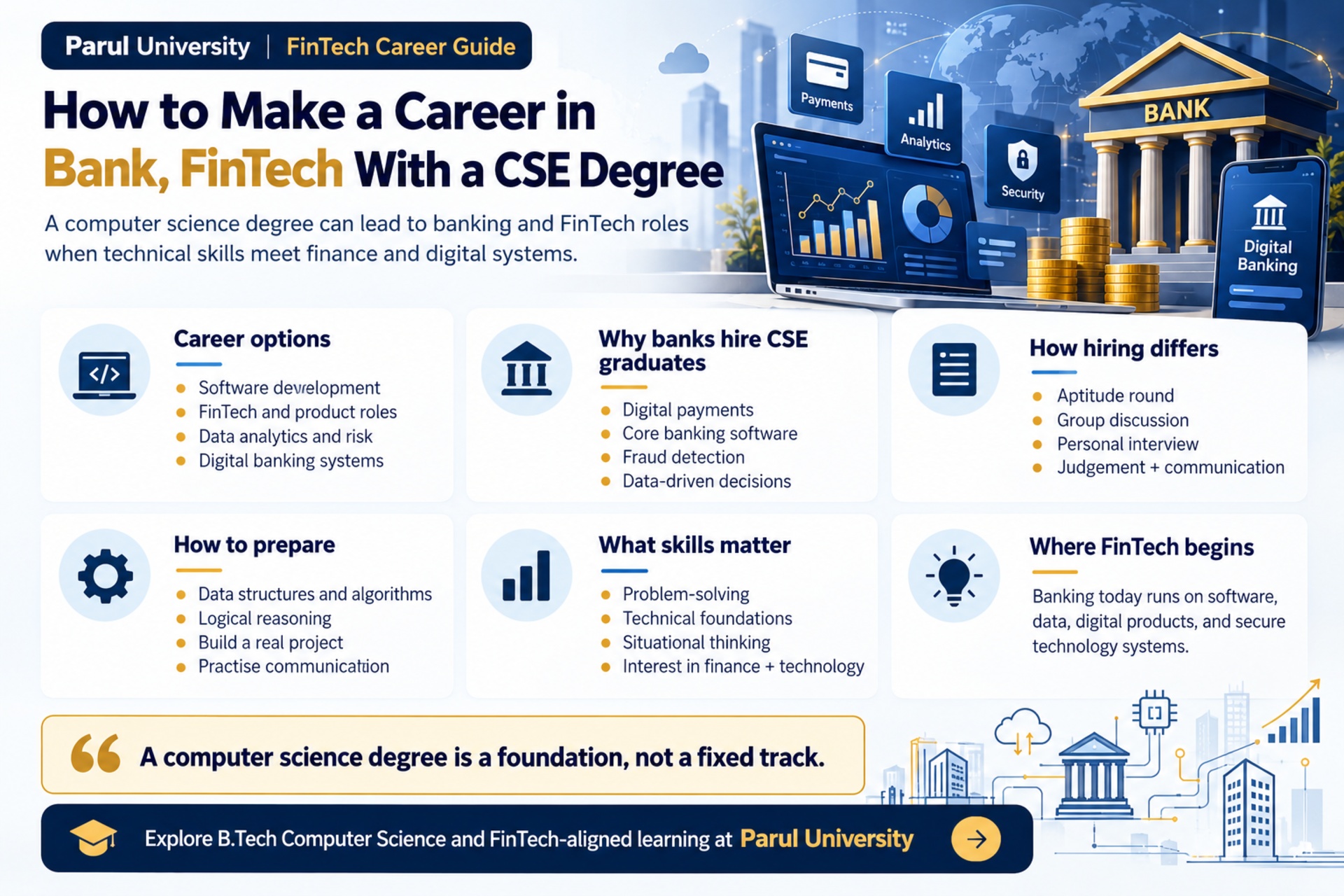
There is usually an assumption that a tech degree will lead to software fields only. But not anymore. Today with the growing technology various fields have emerged. Even banks have areas such as analytics, development, digital-banking and more. These roles demand for CSE graduates. Today banking has become technology-intensive industry. This means computer science jobs in banking are now a real and growing path rather than an exception. A computer science graduate can absolutely work in a bank, not as a workaround but as a deliberate career, and understanding how that path works, and how it differs from the usual IT route, is worth doing before placement season rather than after.
Why banks hire computer science graduates now
As mentioned above that banking is changing. The modern banking is based on technology. There are various ways of payments where technology is required. Like the digital payments. Then there is fraud detection and lending decisions. Tech is required for mobile apps, core banking systems, runs on software and data. This is what becomes the part of FinTech. In Fintech banking, finance and technology amalgamate to pursue the modern day goals of finance. When a banks needs system that matches the modern day demands, that is where a CSE that is computer science graduate is required. The system required to be digital,protected, analyse data, find mismatch and so on. For students or computer science graduates, this can be field of interest which they can pursue. Here the domain might change from product based to a financial one.
What roles actually exist
Technology careers in banking are broader than most students expect. They include:
- Software development and engineering for core banking, payments and digital platforms.
- FinTech and product roles that combine banking knowledge with technology to design financial products.
- Data analytics and risk using data to drive lending, fraud detection and decision-making.
- Digital banking and operations technology keeping the systems customers use running reliably.
The through-line is that a computer science foundation applies across all of them, and the finance knowledge can be built on top. That is exactly the convergence one Parul University graduate, Malay Raval, described when he chose Federal Bank over a conventional software route: combining the technological knowledge from his degree with banking and finance, something he said he had always wanted.
How bank hiring differs from IT product companies
This is where students get caught out. A typical product-company process leans heavily on data structures and algorithms, with coding rounds as the main filter. A bank’s campus process often tests a wider set of abilities. In one documented Parul University example, Federal Bank’s recruitment ran in three stages: an on-campus aptitude round using standard questions, an online group discussion weighted toward interpersonal and situational analytical thinking, and a personal interview. The group discussion is the tell. Banks care about judgement and communication, how you would act in a given situation, not only whether you can solve an algorithm, because banking roles sit close to customers, risk and decisions. A candidate who prepares only for a coding gauntlet can be surprised by a bank that wants to see how they think and speak under pressure.
How to prepare for a tech career in banking
The preparation overlaps with standard placement readiness but adds a layer. The fundamentals still matter: consistent practice on data structures and algorithms and logical reasoning, started early rather than in the final semester, remains the base. On top of that, two things help specifically for banking. First, build something that shows applied thinking, a project that solves a real problem, which gives an interview a concrete anchor. Second, develop the communication and situational judgement that group discussions and bank interviews test, because these are learnable and often neglected. Structured placement preparation, of the kind Parul University runs through its impact training, is where many students first move from scattered practice to a deliberate approach that covers both the technical and the interpersonal.
Where to study, and the FinTech angle
Someone who likes to go towards this field of computer science. They can research which colleges and universities offer a bachelor, diploma and masters degree. They should see whether it is industry aligned or not. Because a course with up to date curriculum will give a good exposure to the field. It will prepare them with all the in demand jobs. It will also make their technical foundation strong. Parul University offers B.Tech Computer Science degree, where the curriculum is designed in a way that it prepares students for the present and future demands. It includes project work, live projects, internships, placement preparation and theoretical knowledge.
The wider lesson holds regardless of where a student studies: a computer science degree is a foundation, not a fixed track, and banking is one of the more interesting directions it now opens.
Frequently asked questions
Can a computer science graduate work in a bank?
Yes. Banks are major employers of computer science graduates for FinTech, software development, data analytics and digital-banking roles, because modern banking runs on technology. A computer science graduate from Parul University, Malay Raval, was placed at Federal Bank through campus recruitment, choosing the banking route deliberately to combine his technical training with finance.
So what is FinTech, and is it a field for the finance graduates?
FinTech is a cross-over between finance, banking and technology, and refers to the digital payments, lending platforms, fraud detection and mobile apps that power banking today. It isn't a field for which one needs a finance degree to enter. One pathway into FinTech is for a computer science graduate to develop their understanding of banking and finance on top of their computer science background.
What are the differences between campus recruitment in a bank and in an IT company?
IT product companies generally put a significant emphasis on data structures, algorithms, coding rounds. There are some banks' campus processes that involve a wider range of skills, such as aptitude, group discussion and situational judgement, as well as technical skills. In one of the cases at Parul University, along with coding, candidates needed to be prepared to deal with aptitude, online group discussion (interpersonal and situational thinking), and personal interview.
A computer science student wants one of the tech jobs in a bank, what should he do?
Introduce early concepts of data structures, algorithms and logical reasoning, create a real project and show how it can be used to effectively solve problems, and develop communication and situational judgement for group discussions and interviews. Technical and interpersonal sides can be integrated by structured placement preparation like the impact training programme at Parul University. What makes a general computer science profile a good FinTech candidate is an interest in the intersection of finance and technology.