Most computer science students assume the degree points in one direction: a software job at an IT or product company. Malay Raval, a B.Tech Computer Science Engineering graduate from Parul University, took a different turn, into banking. He now works at Federal Bank, one of India’s established private-sector banks, having arrived there through a FinTech interest that pulled his technical training toward finance. What makes the Malay Raval Federal Bank placement worth reading is not only where he landed but how deliberately he got there, including a decision most students never face: continuing to apply after he was already placed.
Malay is from Surat, and his account of choosing computer science is refreshingly unromantic. He did not describe a childhood fascination with computers. He described reading the market.
“At that time, while choosing the college, the current market trends and everything I realised, it was more towards the tech industry. So it was on the booming side. I thought, let’s give it a chance and explore what it has in it.”
That framing, a considered bet on where opportunity was growing rather than a lifelong passion, runs through his whole approach. It is also, quietly, a more honest starting point than the one students are usually told to claim.
Choosing Parul and the Industry Embedded Programme
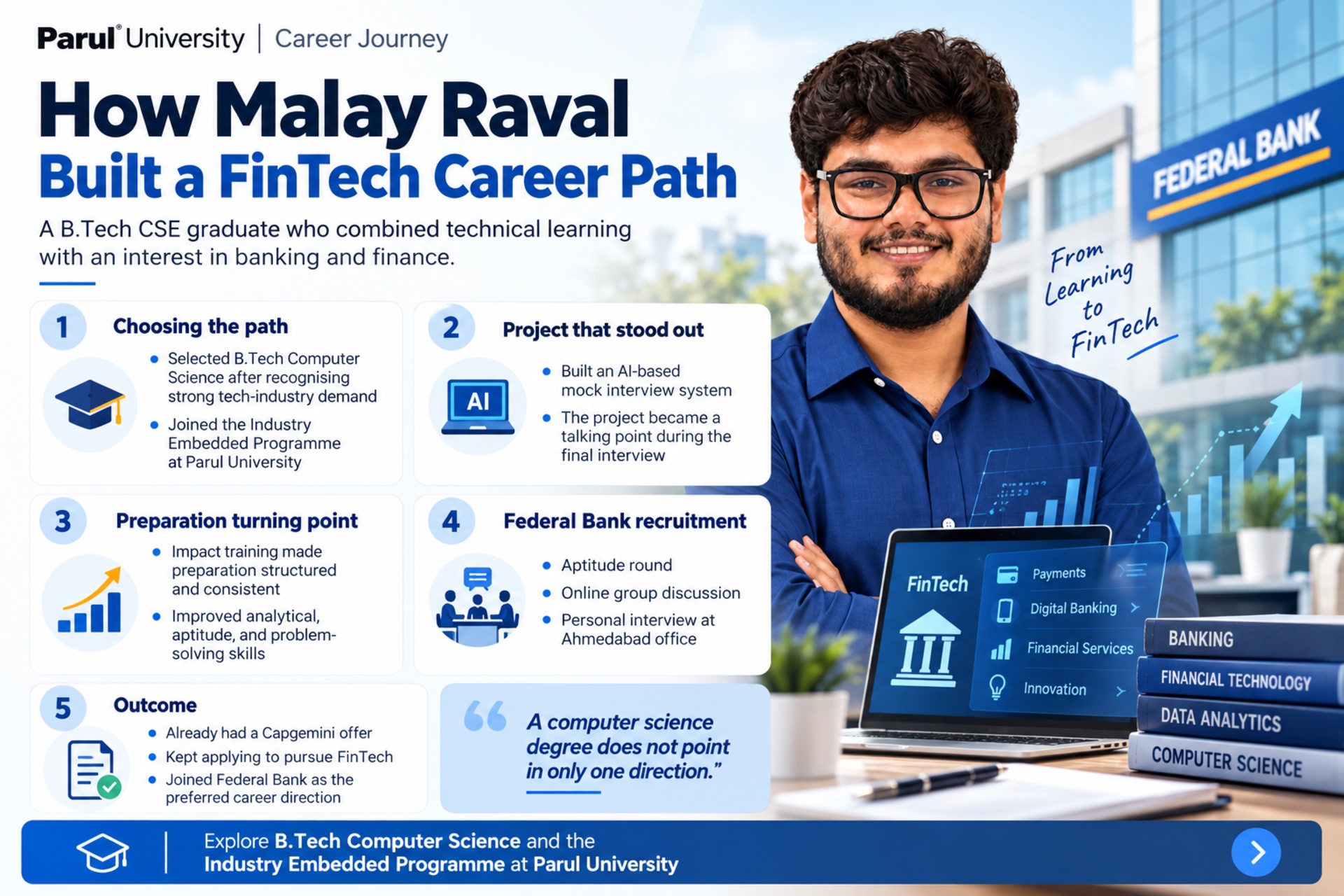
Being from Surat, Malay and his family looked for a well-regarded college within reasonable reach of home, and the decision involved an actual campus visit and conversations with faculty rather than a prospectus read from a distance. He enrolled in the Industry Embedded Programme, a certificate-linked track layered onto the standard B.Tech Computer Science degree, and completed the full four years within it. His reason for the field sharpened over time. What began as wanting to understand the tech industry became something specific by the end of the course.
“I realised I could not only do the back-end work of just doing some development, rather I could explore the FinTech industry and combine finance, banking and all with the technological knowledge I gained, which summed up to something I was always wanting.”
That is the clearest line in his account: his direction was not fixed on day one. It took shape through exposure during the degree and converged on something he says he had always wanted without initially having the words for it.
The project that followed him into his interview
The single most significant piece of work Malay points to is a group project built across his pre-final and final year: an AI-based mock interview system. The team integrated a large language model into a real-time, web-based application designed to give a candidate a close replica of an actual interview. It was not only an academic exercise. It resurfaced at the one moment that mattered most.
“Even in my interview the interviewers asked intentionally about the project and they were also impressed about it.”
A project that becomes a talking point in the interview it was meant to simulate is about as direct a payoff as student project work offers. It is also a small lesson in itself: building something real and specific gives an interview somewhere concrete to go.
From casual to serious: impact training as the turning point
Malay is precise about when his preparation changed gear. Before the university’s impact training, his effort was scattered, the occasional aptitude question without a defined structure. The formal training, scheduled as he moved from third year into fourth, made it deliberate and consistent.
“Just before I came into the seventh semester, I started preparing. Otherwise I was preparing here and there.”
He credits three things specifically: the schedule, the quality of teaching, and trainers with strong backgrounds and real expertise. What he says stayed with him is not the rote content but the method, the strategic and analytical approach to solving problems under pressure, which he says he still uses in his current job at Federal Bank, well outside the context of coding interviews. He named the people who supported him directly rather than thanking the institution in the abstract: Dr. Geetika Madan Patel, Vice President, whom he met a few times for guidance, and his Head of Department, Dr. Ankita Gandhi.
Already placed, still applying: the Federal Bank decision
By the time the Federal Bank opportunity arrived, Malay was not starting from zero. He was already placed with Capgemini and undergoing training there. Most students would have stopped. He kept applying, driven by the FinTech interest he had been carrying in the back of his mind, and it is that decision, more than any single interview, that defines his arc. Continuing to apply after a placement is secured takes a particular kind of confidence, and it is the thing that let him convert a safe outcome into the one he actually wanted. Notably, the opportunity partly found him: a representative from the placement cell reached out directly after noticing a post he had made on LinkedIn, a small sign of a placement operation paying attention rather than waiting.
Inside the Federal Bank process: aptitude, group discussion, interview
Federal Bank’s recruitment ran in three distinct stages, and Malay is clear that each tested something different, which is itself useful intelligence for anyone eyeing a bank rather than an IT firm.
- Aptitude round (on campus): standard aptitude questions, comparable to what most companies ask.
- Group discussion (online): weighted toward interpersonal skills and situational, analytical thinking, what a candidate would do in a particular situation, rather than rote knowledge.
- Personal interview (Federal Bank’s Ahmedabad office): for those who cleared the group discussion, and the stage where his AI mock-interview project became a genuine point of interest for the interviewers.
The contrast with a typical product-company process, which leans heavily on data structures and algorithms, is the point. A bank is testing judgement and communication alongside technical capability, and knowing that in advance changes how a candidate prepares.
Malay describes the moment of selection without understatement, and notably shares the credit:
“It feels so powerful, confident, and we feel so happy when we clear. When we see all our educational and technical learning getting converted into a professional journey, we feel proud of ourselves, and also thankful to our institute and all the supporting people.”
Where things stand, and his advice
Malay waited for the job role he was looking for. He had a Capgemini offer in his hand but still kept applying. He is now a full-time employee at Federal Bank. He was on a six-month probation period. He attended the training in Kerala for a week and then joined formally.
He does not treat the placement as a finish line, describing it instead as one milestone among many he expects ahead. His journey was not free of setbacks: he and his team entered an off-campus cybersecurity hackathon in Gandhinagar and did not clear it, a fact he states plainly without dressing it up. His advice to students is consistent with how he worked: explore widely while in college to find domains you did not know existed, and start early, solving more data structures and algorithms problems and building logical thinking, so you have an edge when others begin late.
Also Read: How to Make a Career in Bank, Fintech With CSE Degree: Explained
Frequently asked questions
Can a computer science graduate get placed in a bank?
Yes. A B.Tech graduate from computer science specialisation can get a placement in the bank. Like Malay Raval who got placed at Federal Bank through on-campus recruitment. Banks and fintechs are looking for computer science graduates for development, software management, digital banking, payment systems, analytics and many such roles.
What was the Federal Bank campus recruitment process?
For Malay Raval at Parul University, it had three stages: an on-campus aptitude round, an online group discussion for those who cleared it, and a personal interview at Federal Bank's Ahmedabad office for those who cleared the group discussion. The aptitude round used standard questions, while the group discussion focused on interpersonal and situational, analytical thinking, which differs from the data-structures-heavy process many IT product companies run.
What is the Industry Embedded Programme at Parul University?
It is a certificate-linked track layered onto the standard B.Tech Computer Science degree at Parul University. Malay Raval completed his four-year computer science degree within this Microsoft-linked Industry Embedded Programme, alongside the university's impact training, which he credits for moving his placement preparation from casual to structured.