The toughest part of any hackathon is the very first step-signing up. Aayush Yadav-a final-year B.Tech CSE student got selected at the Odoo x Parul University Hackathon. Here’s how he championed it, and here’s the most useful advice for aspiring techies!
Create a Mindset, not a Skill!
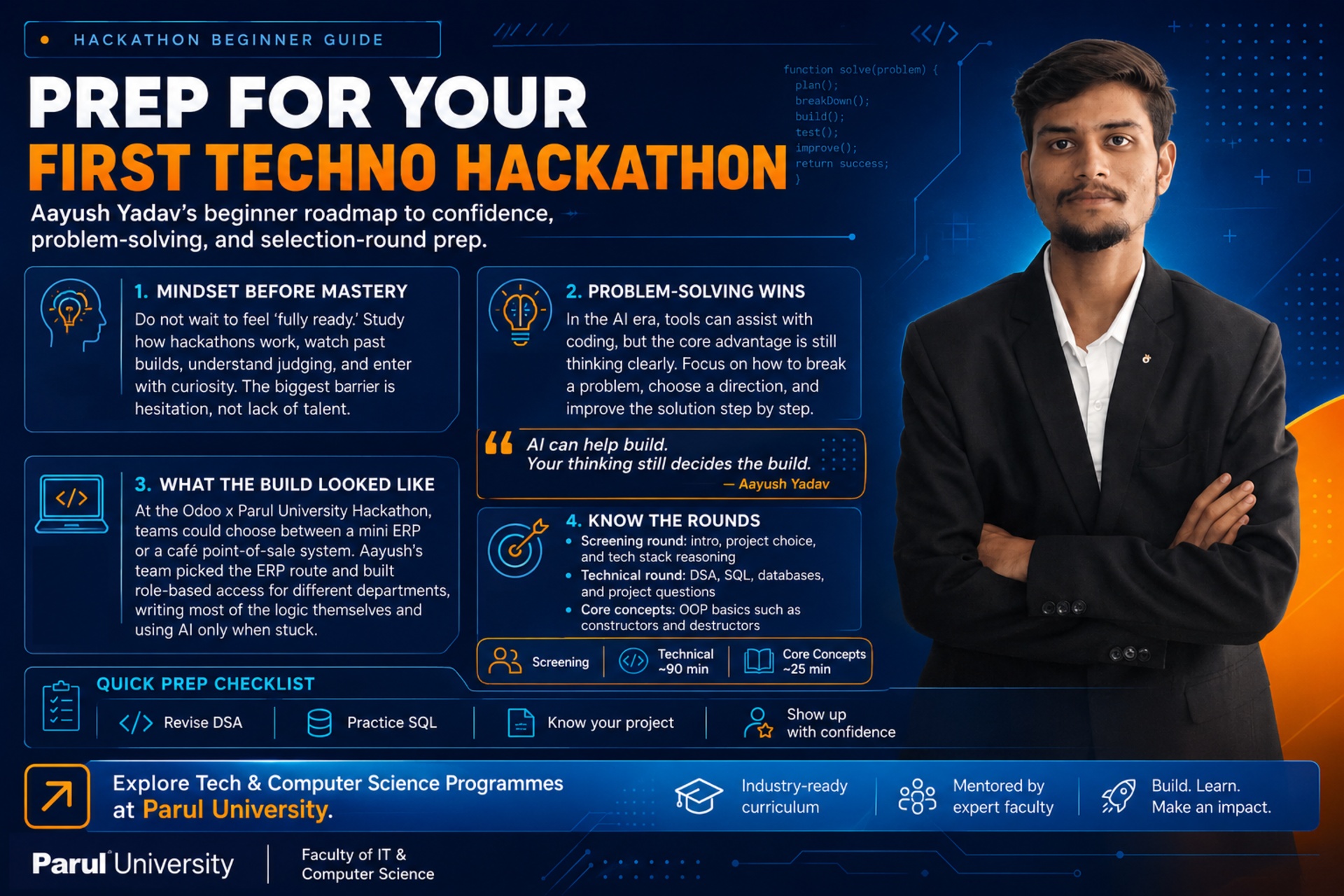
In Aayush’s experience, most students hesitate because they assume they lack the technical knowledge to build anything worthwhile. His core advice is to review the past functioning of hackathons, binge-watch their videos, and master the winning criteria. Pick up specific technologies and be fully prepared rather than just basic exploration, and that’s when a winning mindset comes into play!
Problem-Solving Beats Knowing Every Tool
His deeper point is well-suited to the current moment in software:
This is the AI era where you can solve any problem with the help of AI, but you need to think about the problem-solving: how we will tackle this problem.
– Aayush Yadav
With the rise of AI tools, technical knowledge is no longer the main differentiator. Now, anyone can learn and solve the problem, but a strong problem solver can sign up for the hackathon and can instantly solve any complex issue. So focus on building that problem-solving muscle instead of memorising everything!
What a Hackathon Build Actually Looks Like
At the Odoo hackathon, teams chose between two problem statements: a mini ERP (Enterprise Resource Planning) system or a Cafe Point-of-Sale system. Aayush’s team chose the ERP Problem, building a system for a manufacturing company with role-based access so each department could see only its own area. The team wrote most of the code themselves and turned to AI tools (they named Claude and ChatGPT) when they got stuck, a realistic picture of how modern builds actually happen: your own thinking first and AI as a helper when you hit a wall.
The Selection Process
Knowing what to expect removes much of the fear. The Odoo selection ran across three rounds:
- Round 1, a short screening: A conversational round covering your introduction and why the team chose its technology stack and problem statement.
- Round 2, the deep technical round (about 90 minutes): Problem-solving and DSA questions solved on the spot, SQL and database questions, and questions on the project itself, weighted toward practical demonstration, with answers written out on paper.
- Round 3, core concepts (about 25 minutes): Object-oriented programming fundamentals such as constructors and destructors to confirm understanding extends from theory to practical application.
In this case, there was no separate HR round; the process ended once the technical evaluation was complete. The clear takeaway: solid fundamentals (DSA, databases, OOP) and the ability to explain your own project are what carry you through.
Just Show Up: A Note on Perseverance!
Aayush is honest that hesitation is normal. At an earlier hackathon, nervous about the interview stage and without prior experience, he and his team nearly walked away, until friends convinced them to see it through regardless of the result. That decision to stay was part of what built the experience that later carried him to his Odoo selection. Sometimes the whole lesson is simply “do not leave before you have tried.” Campus platforms like the Tinkering Hub and student hackathons, and the wider startup and innovation events at Parul University, exist precisely to give students low-pressure first opportunities to do exactly that.