Most design students dream of eventually owning a studio; Krish Sompura got there fast. Originally from Rajasthan, he came to Gujarat to hunt for good design programmes, basing himself in Ahmedabad while he searched. Parul University was not even on his list; he did not know much about it until he heard of it during his stay and travelled to the campus just to look. A single long walk around the premises, observing the scale of the buildings and the creative environment of the interior and furniture design studios, changed his mind entirely; he stopped his search and enrolled.
Adjusting: Hostel Life and a Diverse Campus
Moving from another state into a massive, unfamiliar campus was a heavy cultural shock. Krish arrived extremely nervous, into a classroom packed with students from entirely different corners of the country, batchmates from the North-East, others from the Southern states, each with a different language, background, and way of thinking. It took him ten to fifteen days just to settle. He spent his first year in the Tagore C hostel, and, over time, mixing with such a diverse crowd changed his personality, he picked up new habits and absorbed the campus culture, building a strong foundation of friends before moving out after the first year.
The Foundation Year
Parul Institute of Design does not force students into a narrow lane on day one, and Krish found the foundation-year approach invaluable. Rather than studying interior spaces immediately, he explored the basics of every design department, the core concepts of visual communication, product design, and the fashion design industry, an exposure that taught him design principles remain the same across mediums. Only after that broad first year did he move into his specialisation, focusing on interior environments and the technical craft of furniture-making.
A Rare Start: A First-Semester Patent
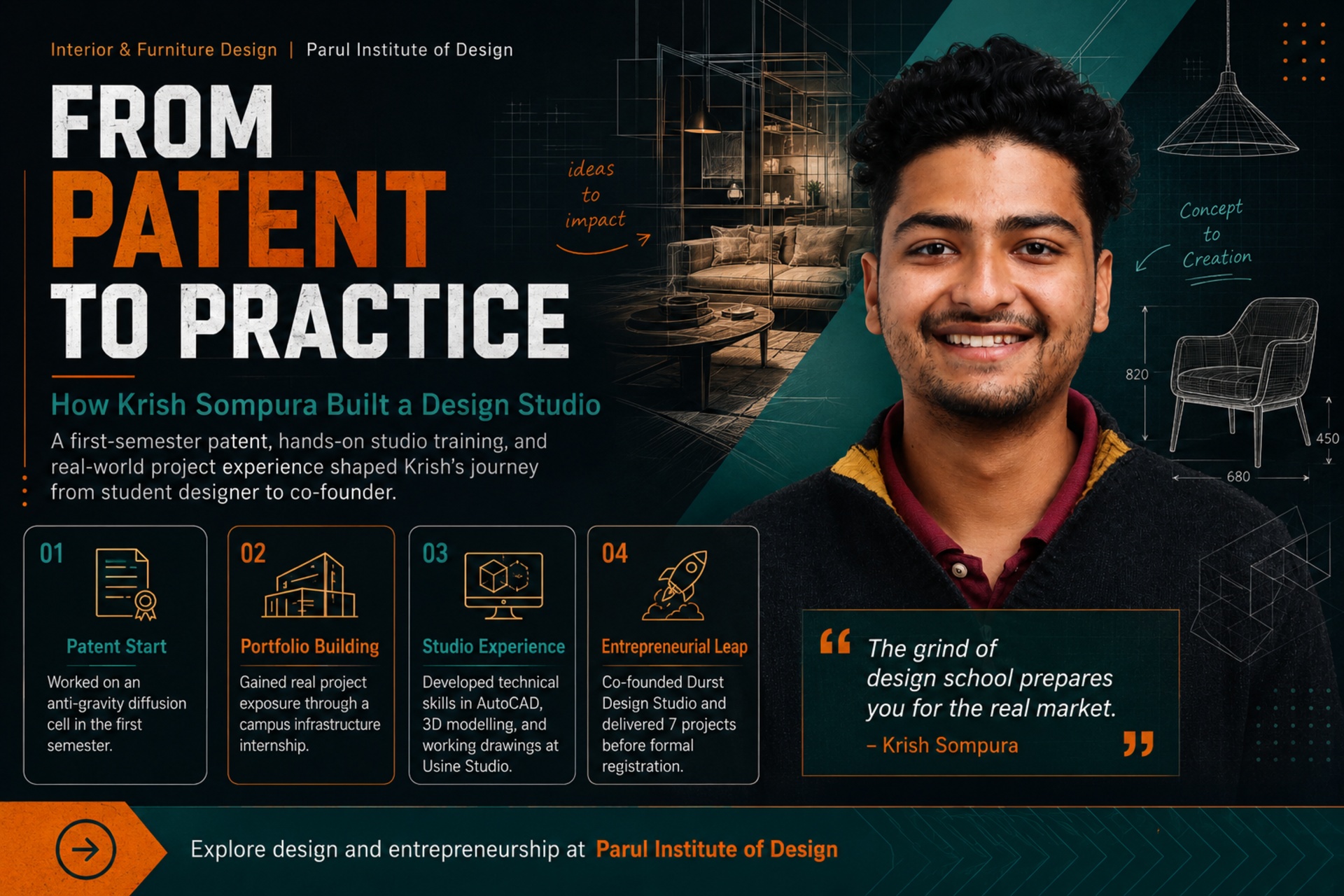
Krish’s standout milestone came absurdly early. In his very first semester, the university gave him the rare chance to collaborate directly with its research department. He worked closely with faculty member Sameer Bakshi, then head of the research department, and was mentored by Gopal Sir. The three took a standard piece of laboratory equipment, a French diffusion cell, and completely redesigned it into an innovative “anti-gravity diffusion cell,” a highly technical, pharmaceutical-adjacent project that led to a patent. For a fresh student newly arrived from Rajasthan, sitting in labs alongside department heads on a complex patent was an enormous milestone and confidence boost right at the start of his degree, and a demonstration of how much a genuinely exploratory foundation year can unlock.
The Mentors Behind Him
Krish is vocal that you cannot survive design school without good teachers. When early nervousness threatened to overwhelm him, faculty helped him calm down and eased him into a heavy academic environment. In his foundation year, Sameer Sir and Abhishek Sir, a guest faculty member with whom he stayed in touch long after classes ended, played major roles; in his senior years he drew constant guidance from Hanna Ma’am, Kushboo Ma’am, Ritu Ma’am, and Vinay Ma’am. He found the staff consistently accessible, supportive, and genuinely interested in pushing his limits.
Building a Portfolio, On Campus
Understanding that theory is useless if unapplied, Krish did his first internship inside the University itself, under the Parul University Infrastructure Department, mentored directly by Hanna Kumari Chauhan. The work was substantive rather than clerical: he actively created spatial layouts and developed design concepts for buildings the University planned to construct, a safe space to test his software skills on real architectural layouts and, importantly, to build a strong portfolio while still a student. That portfolio is exactly what unlocked his next step.
The Real Test: Usine Studio
On the strength of his campus work and his standard of output, the placement cell set up an official meeting for him with Usine Studio; he presented his portfolio, cleared it, and secured the internship. It was a massive reality check. Placed directly in the core design team, his daily tasks were intense and highly technical: hours of detailed AutoCAD drafting, preparing precise working drawings for contractors, and heavy 3D modelling. Beyond the software, he did deep research into how specific spaces should function and look, and the studio trusted him with real responsibility, he designed several interior spaces and even planned out water bodies for ongoing projects. This is where he learned how the industry actually operates day to day: the complicated process of building a house from the ground up, how to handle difficult vendors, and how to manage the entire material-selection process without costly mistakes.
The Leap: The 6 Design Studio
The intense grind of college is what prepares you for the actual market. All this pain eventually pays off.
– Krish Sompura
Where most graduates seek a stable junior role, Krish took the bigger risk. The hands-on experience from Usine Studio and the University gave him the confidence to resign and launch his own venture, and he did it strategically. He partnered with a senior from Parul, Pruthvi Bhagat, who had specialised in visual communication design, a deliberate move: by combining his interior expertise with a visual-communication partner, the firm, named Durst Design Studio, could offer clients complete design solutions rather than a single service. At the time of his interview the studio was still completing its formal legal registration, but that had not slowed the young duo, they had already completed seven actual projects and were actively taking on new clients and expanding their portfolio.
His Advice for Aspiring Founders
- Explore widely: do not get tunnel vision; even within interior design, study other creative fields and keep your outside interests.
- Justify the investment: parents pay a great deal for design school, so work like crazy and put in maximum effort to honour it.
- Expect dark phases: the workload will make you want to quit and cost you consecutive sleepless nights, but the grind is what prepares you for the market, so never lose hope.
- Protect your mindset: never design when sad or frustrated; work with a happy, calm mind, because good work and good mood reinforce each other.
Also Read: Product Design at Parul University and Material Understanding
Frequently Asked Questions
How do you start your own design studio after graduating?
Typically by building a strong portfolio through internships and real projects, gaining industry experience at an established studio, and then launching, often with a complementary co-founder. Krish Sompura interned on campus and at Usine Studio, then co-founded a firm with a visual-communication partner so they could offer complete design solutions, delivering seven projects even before formal registration was complete
Can a design student really get a patent?
Yes, particularly when a university enables collaboration with its research department. Krish Sompura, in his first semester, worked with the research department to redesign a laboratory diffusion cell into an anti-gravity diffusion cell, leading to a patent, an early achievement that gave him significant confidence and portfolio strength.
What technical skills does an interior designer need for industry?
Core industry skills include detailed AutoCAD drafting, preparing working drawings for contractors, 3D modelling, space planning, and the practical knowledge to manage vendors and material selection. Krish developed these through a campus infrastructure internship and hands-on work at Usine Studio, where he drafted, modelled, and designed real interior spaces.
Why partner with someone from a different design field?
Because complementary skills let a studio offer complete solutions. Pairing an interior designer with a visual-communication designer means one firm can handle spatial design and branding together. Krish partnered with a visual-communication specialist precisely so their studio could serve clients end to end.