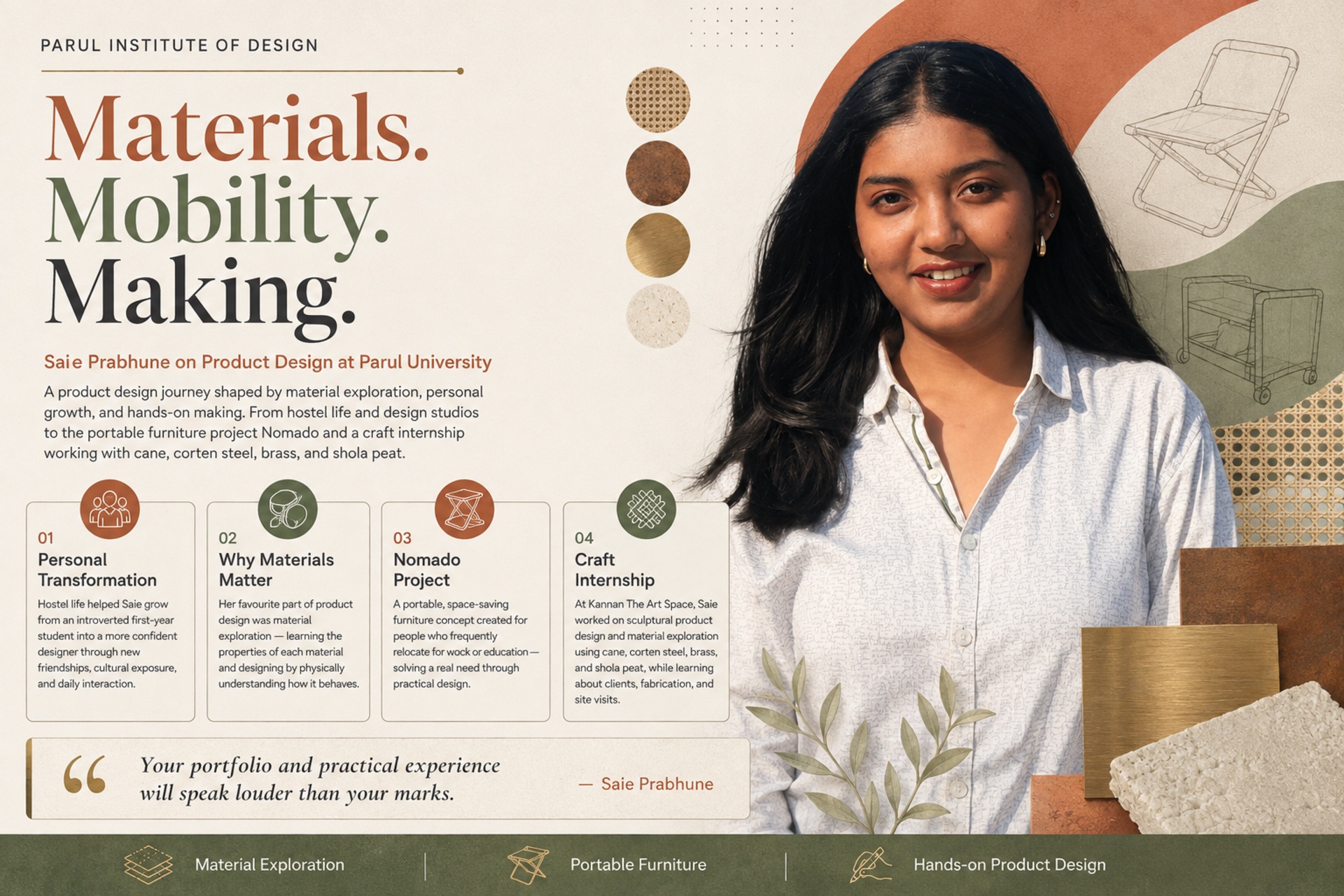
Ask Saie Prabhune what product design means to her, and the answer is material. From Satara in Maharashtra, from a business family – her father runs a management consultancy firm. She came to Parul University’s Institute of Design on the recommendation of a relative one-batch senior, whose accounts of campus life, combined with her own research, convinced her. Leaving Maharashtra for Gujarat brought the usual mix of excitement and homesickness, eased by faculty she found genuinely warm and a close group of friends who helped her settle.
Saie chose to live in the university hostel for her first three years before moving out in her fourth, and she credits that decision with reshaping her personality. She arrived introverted, struggling to speak up, finding it hard to make friends, and uncomfortable around unfamiliar people. Constant interaction with new roommates and peers from vastly different cultural backgrounds forced her out of that shell, and by her final year she describes herself as a much stronger, newer version of her former self.
Why Material Exploration
As a product design student, Saie’s curriculum was rigorous and specialised: core design studios, material manufacturing, ergonomics, and a distinctive nature-inspired design studio. Her clear favourite was material exploration, thrilling because every new semester meant designing a completely new product using an entirely different material, discovering its properties and figuring out how to physically work with it. That obsession with material would become the throughline of both her best project and her internship.
The Nomado Project
Design is not just what it looks like and feels like. Design is how it works.
– Saie Prabhune
Her passion for materials came together in her seventh-semester team project, Nomado. Conceived by Saie, it is a portable, space-saving furniture set, a sofa set and a centre table, designed for a specific modern problem: people who constantly move or relocate for education or work and struggle to transport heavy, unwieldy furniture. It is product design in its truest sense, a real user need met with a practical, portable solution. She worked alongside teammates Goirick Ghosh, Alfred Rabha, Sharvari, and Sagnik Das, and credits faculty members Sameer Bakshi, Shardul Phansalkar, and Deepak Vishwakarma for their support through such demanding projects.
The Craft Internship: Kannan The Art Space
Saie interned as a product design intern at Kannan The Art Space, a connection built over years; she had visited collaborators related to the studio in her first year, and seniors Umesh, Shraddha, and Samarth had interned there before her. Working alongside her former Nomado teammate Gaurik, she focused on material exploration and sculptural product design, gaining hands-on experience with a diverse range of raw materials, including cane, shola peat, corten steel, and brass. The internship was not just prototyping: she handled projects from initial concept development through to the final stage, successfully developing key pieces in cane and corten steel, and it gave her invaluable exposure to the business of design, working directly with clients, conducting site visits, understanding complex fabrication processes, and watching abstract ideas become tangible, real-world products.
Classroom Versus Industry
The move from university studio to professional art space revealed how differently design is evaluated. In the classroom, the process is insulated: a student develops a concept, receives feedback mainly from faculty and peers, and adjusts. In industry, the dynamics invert: a designer cannot simply follow one person or rely on site feedback, because the ultimate focus must remain on the actual client who will purchase the design, whose needs and purchasing power dictate the project’s direction. The industry also demanded a far deeper, hands-on understanding of materials than the classroom ever fully explored.
Looking Ahead
Having finished at Kannan, Saie is seeking new opportunities, aiming first to gain more practical experience at a reputable firm and then to pursue a master’s in product design, ideally abroad, intending to begin in September. Her advice to juniors is self-driven and clear: remain curious, never fear mistakes, and seize every opportunity without thinking twice, because, as she puts it, “your portfolio and practical experience will speak louder than your marks.”
Frequently Asked Questions
What is product design?
Product design is the discipline of designing physical products that meet real user needs, balancing form, function, materials, and manufacturability. It involves concept development, material exploration, ergonomics, prototyping, and an understanding of how products are made and used, captured in the idea that design is not just how something looks, but how it works.
Why is material exploration important in product design?
Because a product’s form, function, durability, and feel all depend on its materials. Understanding how materials behave and how to physically work with them lets a designer make informed, buildable choices. Saie Prabhune worked with cane, shola peat, corten steel, and brass, learning material properties a classroom alone could not teach.
What kind of internship suits a product design student?
Hands-on internships that expose students to real materials, fabrication, and clients are especially valuable. Working in a studio or art space on sculptural or functional products, from concept to finished piece, builds practical skill and business understanding. Saie interned at an art space working directly with materials, clients, and fabrication processes.
What makes a strong product design student project?
A project that identifies a genuine user need and solves it practically, with real attention to materials and function. Saie’s Nomado, portable, space-saving furniture for people who frequently relocate, is a good example: it starts from a real problem and answers it with a considered, buildable design rather than pure aesthetics.