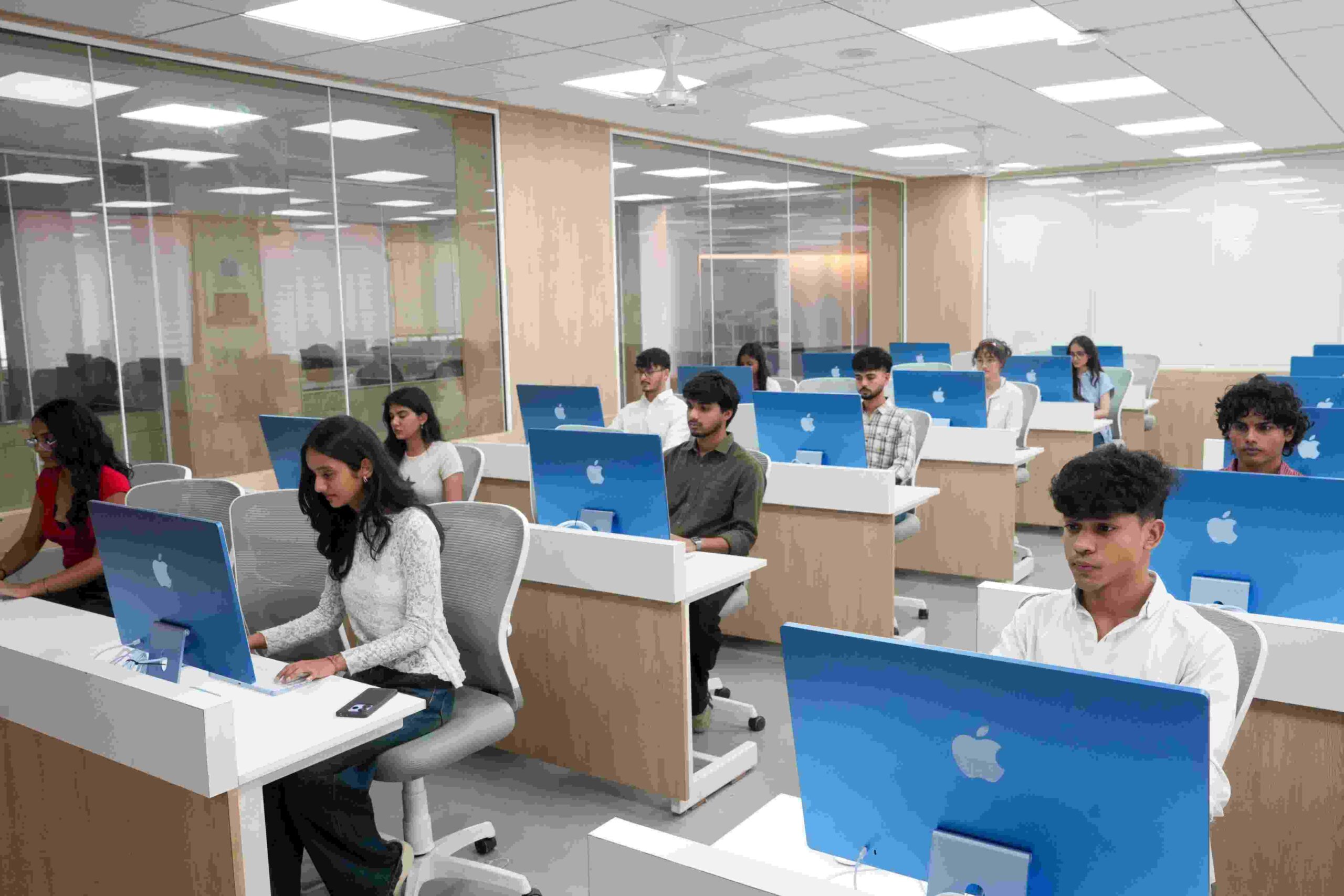
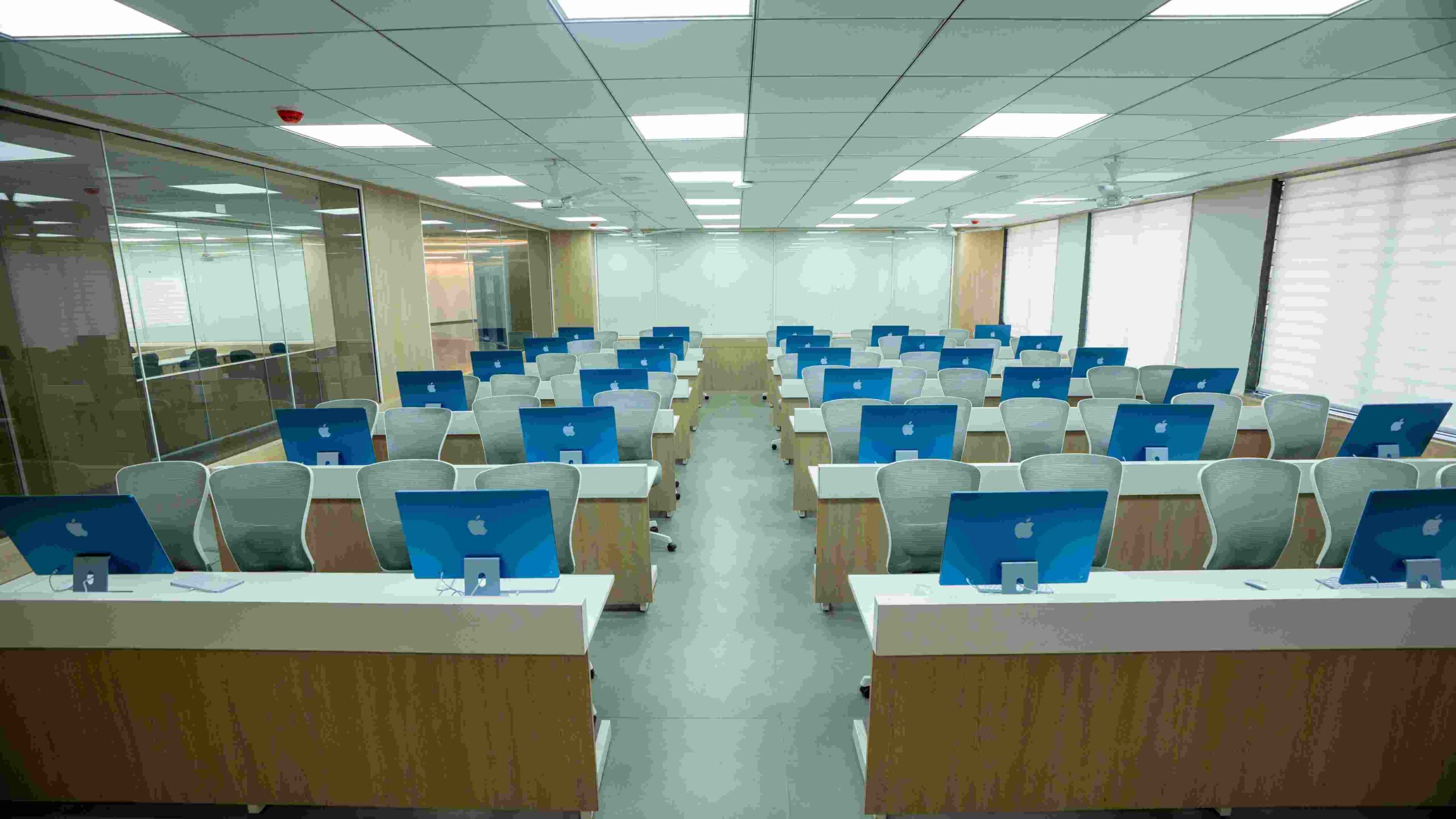
Walking into the Apple Lab inside Lakshya 2047 is entering the only environment where Indian engineering students can develop natively for Apple devices on Apple hardware, without leaving the country.
Lakshya 2047 – Centre for Future Skills is designed to provide techno-creative support to students, right from their degree phase. It was proudly inaugurated by our Union Minister, Dr. Jitendra Singh, on the 8th May 2026. This exclusive Apple Lab has 15 to 30 next-gen Apple Systems (computers) to code and perform iOS & macOS app framework & applications. Students will get hands-on training from Apple App Development with ACSP (Apple Certified Support Professional Certifications) and Swift, as both are issued and approved by the Apple ecosystem. This exclusive training is structured for students who want to build a career as iOS developers or macOS application engineers, UI/UX designers, or in a technical domain.
What is inside the Apple Lab
The Apple Lab’s hardware is what makes the rest of the work possible. Without native Apple machines, native Apple development is not possible. Most Indian university computer labs cannot offer it.
- 15 to 30 high-performance Apple-based systems. Each workstation is a native Apple machine with the computational capacity required for application development, software design, and rigorous application testing. The capacity range allows the lab to support different programme intake sizes and to scale up sessions for cohorts of different sizes.
- Apple development tools and platforms. The entire lab provides a toolchain of Apple Development, including Xcode, Swift programming and UI design. These add-ons allow students to ideate, test and analyse applications across the entire range of Apple devices.
- iOS operating system access. Students work natively in iOS, learning the structure and functionality of Apple devices from the operating system upwards. Native iOS access is what distinguishes serious iOS development training from the kind of cross-platform simulation that most non-Apple environments offer.
- macOS application development environment. Parallel to the iOS dimension, students learn macOS application development for the desktop and laptop Apple ecosystem. The pairing of iOS and macOS development is what positions Apple Lab graduates for the full breadth of Apple ecosystem careers rather than just for mobile development.
- Equipment-handling discipline. The lab follows equipment-handling guidelines designed to maintain the performance and security of the systems. Students are instructed to use the systems carefully, follow lab protocols, and respect the maintenance and update cycles that Apple hardware requires. Regular maintenance and system updates are conducted to keep the devices at their performance and security baseline.
Swift programming: the language at the centre of the lab
2014 is when Apple built Swift to replace Objective-C. A decade later, the question of which language to use for iOS and macOS development is settled. Swift. Not one option among several. The one that anyone serious about the Apple ecosystem has to know fluently.
The lab centres its training on Swift for exactly that reason. Foundational skill for iOS and macOS career pathways, designed for safety, performance, and modern programming patterns, and Apple’s investment in it has not slowed down. Students who come through the lab should expect to use it throughout their careers in the ecosystem. Practice builds on practice here, with projects getting progressively more complex until students are working at the level the Apple App Development with Swift certification examination actually demands.
What that looks like in practice runs across three areas, and each one is worth being specific about.
- Mobile application development. Full lifecycle, start to finish. Initial design, Swift code, iOS frameworks like UIKit and SwiftUI, the Apple-specific design patterns that separate a high-quality iOS application from a generic mobile build that happens to run on a phone, through to App Store deployment. The Apple-specific part is not a detail. It is most of the skill.
- Integration across the Apple ecosystem. A single application running on a single device is not what Apple development looks like professionally. Students learn cross-device synchronisation through iCloud, handoff patterns running between iPhone, iPad, and Mac, and the broader ecosystem features that distinguish Apple development from everything else. The point is fluency across the full device landscape, not just one form factor.
Prototyping, testing, and deployment as a cycle. Most university programming courses stop at building one application and calling it done. Real product development does not work that way. The lab runs students through the iterative cycle that working Apple developers actually use. Prototype, test, find what breaks, refine, deploy. That loop, repeated, is what the training is actually preparing students for.
The two certifications: Apple App Development with Swift and Apple Certified Support Professional
Two credentials & two distinct career directions. The lab’s certification structure is built around both, and choosing between them is essentially choosing which side of the Apple ecosystem to work in.
- Apple App Development with Swift is the developer credential. It demonstrates the holder can build applications for iOS and macOS using Swift, at the technical depth production development actually requires. Not prototype-level. Not coursework-level. Production-level. Graduates holding it are positioned for iOS Developer and macOS Developer roles at companies building for the Apple ecosystem.
- Apple Certified Support Professional, ACSP, goes the other way entirely. This one is about supporting macOS environments, troubleshooting Apple devices, and managing Apple deployments in enterprise contexts. The companies that need this credential are the ones where Apple hardware is part of standard issued equipment, and the roles it opens are IT Support, Mac Administrator, and Apple-specialist positions inside those enterprises. Both credentials come directly from Apple, verified through Apple’s own system, recognised by employers globally wherever Apple ecosystem work is being hired for.
Both credentials are issued by Apple and verified through Apple’s credential system, recognised by employers operating in the Apple ecosystem globally. Through the Lakshya 2047 Centre’s partnership architecture, each credential also carries NSDC alignment, positioning the credential inside India’s National Skills Qualifications Framework as well as inside Apple’s global recognition system.
UI/UX design inside the Apple ecosystem
The Apple ecosystem has long been associated with design quality, and the Apple Lab integrates UI/UX design training into its broader development work. Students learn the Apple Human Interface Guidelines, which are the design standards Apple maintains for applications on its platforms. The guidelines are not just aesthetic preferences; they are operational rules that shape how users expect Apple applications to behave. Students who can develop within these guidelines produce applications that feel native to Apple devices, which is what employers building for the Apple ecosystem look for in candidates.
The UI/UX training also extends into broader design competencies that prepare students for design-led product work, including the kind of cross-functional collaboration between developers and designers that modern product teams depend on. For students who pair the Apple Lab training with the Adobe Creative Design Studio inside the same Lakshya 2047 Centre, the combination produces a particularly strong design-and-development profile.
Apple versus Microsoft: the strategic ecosystem comparison
The Apple Lab inside Lakshya 2047 is not isolated. It sits alongside the Microsoft Lab, and the comparison between the two is part of what makes both labs useful as career-formation tools.
The Apple ecosystem is famously closed. Apple software runs on Apple hardware, with limited interoperability with non-Apple products. The Microsoft ecosystem is the opposite: open architecture, broad cross-vendor compatibility, used in approximately 90 per cent of college and corporate IT environments globally. In India specifically, the Apple penetration in enterprise IT is well below the global average, while the Microsoft penetration is at or above the global average. This market reality shapes what career options each lab’s training opens. The Microsoft Lab trains for the dominant enterprise ecosystem; the Apple Lab trains for the premium and design-led segments of the market.
The strategic argument for training in both is straightforward. Students who can develop natively for both ecosystems are positioned for the full breadth of mobile and desktop application development work, including the cross-ecosystem integration projects that most modern enterprises eventually need. Apple Lab graduates have the option to pursue Apple-specific career pathways or to add Apple capability to a broader engineering profile. The lab’s existence at Parul University gives students access to native Apple development training that most Indian universities cannot offer, which is itself an Atmanirbhar Bharat argument.
Career pathways the Apple Lab opens
Here are the four primary career pathways that flow from the Apple Lab’s training.
- iOS Developer. Builds iOS applications for the App Store and for enterprise distribution. Hiring demand is steady across product companies, IT services firms, and any organisation that maintains a serious mobile application presence on iOS. Apple App Development with Swift certification is the credential employers typically look for at the entry level.
- macOS Developer. Builds desktop applications for macOS, including productivity tools, creative applications, and enterprise software targeting macOS-using workforces. The pool of macOS developers in India is smaller than the iOS pool, which makes it a comparatively less crowded career pathway for graduates willing to specialise.
- UI/UX Designer with Apple ecosystem fluency. Combines design competence with deep familiarity with Apple’s design language and Human Interface Guidelines. The intersection of UI/UX design and Apple ecosystem fluency is a specialised competency that creative agencies, product companies, and design consultancies actively hire for.
- Mac Administrator and Apple Specialist. Supports macOS deployments in enterprise environments, including device management, application deployment, and user support. The Apple Certified Support Professional credential is the entry point for this pathway, and the role has expanded in importance as more enterprises have added Apple devices to their standard-issued hardware.
Cross-faculty access and innovation work
The Apple Lab is structurally accessible across faculties, following the cross-faculty design principle that defines Lakshya 2047. Engineering and Computer Science students are the heaviest users for development work, but Design and Architecture students access the lab for UI/UX work, and Management students with technical backgrounds use the lab for application prototyping in product management contexts. The lab functions as an innovation centre where students can experiment with the latest Apple technologies, including Swift, application prototyping, software and content testing, and mobile computing approaches.
The lab’s outputs include practical technical solutions that students develop with potential marketplace use. The practical-application emphasis is what distinguishes the lab from the kind of theory-heavy programming course that most universities offer, and it is what positions Apple Lab graduates for the application-development hiring market rather than just for entry-level coding roles. The PIERC startup pipeline connects the Apple Lab’s innovation work to commercial venture pathways for students who develop applications they want to take to market.
How the Apple Lab fits the broader Lakshya 2047 ecosystem
The Apple Lab is one of four labs inside the centre that together cover the full software development landscape. The Microsoft Lab covers the Microsoft ecosystem (Azure, .NET, C Sharp, Copilot). The AWS Cloud Computing Lab covers cloud-platform development. The NVIDIA Lab covers accelerated computing and AI. The Apple Lab covers native Apple ecosystem development. Together, the four labs cover roughly the full breadth of contemporary software career options.
The Atmanirbhar Bharat dimension is direct. Indian students who want to develop natively for the Apple ecosystem can now do that work inside India, with Apple credentials, on Apple hardware, in a Parul University lab. The Atmanirbhar Bharat in higher education article treats this thesis in detail across the full centre.
FAQs
What hardware does the Apple Lab at Parul University provide?
Fifteen to thirty high-performance Apple-based systems. That range covers cohorts of different sizes and programme structures without the lab becoming a bottleneck. Each system carries the computational capacity needed for native iOS and macOS development, software design, and rigorous testing. The full Apple development toolchain runs on all of them: Xcode, the Swift programming environment, Interface Builder for UI design, and simulators for testing across Apple device form factors. What makes the lab distinctive is simply that it has native Apple hardware at scale. Native Apple development requires native Apple machines, and most Indian university computer labs do not have them.
Which Apple-issued certifications can students earn through the Apple Lab?
Two credentials. Apple App Development with Swift is the developer-facing one, demonstrating competence in building iOS and macOS applications using Swift. Apple Certified Support Professional (ACSP) is the support and administration credential, covering macOS support, Apple device troubleshooting, and enterprise Apple deployment management. Both are issued by Apple, verified through Apple's own credential system, and recognised by employers operating in the Apple ecosystem globally. Through the Lakshya 2047 partnership architecture, both also carry NSDC alignment inside India's National Skills Qualifications Framework.
Which Parul University programmes can access the Apple Lab?
Cross-faculty by design. B.Tech students in Computer Science Engineering, Information Technology, and Artificial Intelligence and Machine Learning are the heaviest users for development work. Design and Architecture students use it for UI/UX work and Apple Human Interface Guidelines training. Management students with technical backgrounds use it for application prototyping in product management contexts. Access opens at diploma level and runs through undergraduate, postgraduate, and PhD, with technical depth calibrated accordingly.
How does the Apple Lab compare with the Microsoft Lab inside Lakshya 2047?
Two labs, two ecosystems, deliberately complementary. The Microsoft Lab covers an open ecosystem sitting in roughly 90 per cent of college and corporate IT environments globally, stronger in the Indian enterprise IT market. The Apple Lab covers a closed ecosystem tied to premium consumer devices, design-led product work, and creative industries, stronger in product companies, design agencies, and the macOS-using segments of enterprise IT. Students trained in both are positioned for the widest range of mobile and desktop development careers, cross-ecosystem integration work included. The labs sit alongside each other inside Lakshya 2047 because that cross-ecosystem fluency is part of what makes Parul University graduates competitive in the broader software hiring market.
Why is native Apple hardware important for iOS and macOS development training?
Because there is no real workaround. The development toolchain, Xcode, the device simulators, the App Store deployment workflows, all of it requires macOS. Cross-platform tools can approximate some development, but serious production-quality iOS and macOS work needs native Apple environments. Most Indian university computer labs do not provide native Apple hardware at scale because of the capital cost involved. The Apple Lab's fifteen-to-thirty-system capacity changes that. Parul University students develop natively for Apple platforms inside India, without workarounds, without travelling to find environments that have the hardware.