

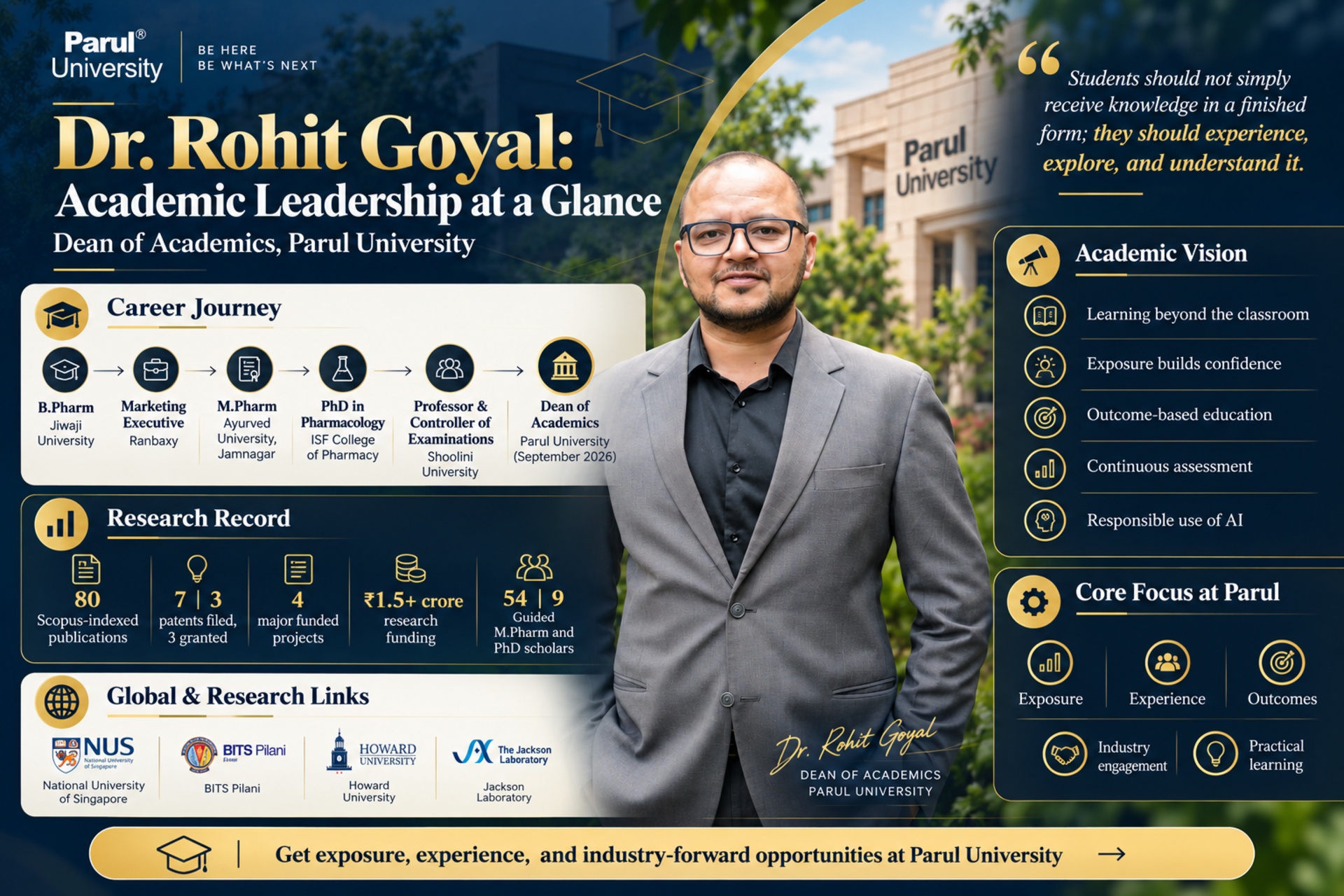
Dr. Rohit Goyal was born and raised in Varanasi and studied and worked in each of the cities named a new classroom, as he put it. As a beginner, he started his B.Pharm and pursued his studies at Jiwaji University, Gwalior, and then got a job as a marketing executive in Ranbaxy Laboratories, Delhi. Eventually, he secured another job at Ayurved University of Jamnagar, Gujarat, and got his Master’s in M.Pharm in pharmacology as well. Later, he went on to study for his doctorate (PhD) in pharmacology at ISF College of Pharmacy in 2011.
Academic Excellence & Milestones!
Dr. Rohit Goyal’s career has progressed steadily towards increasing responsibility. He served as an assistant professor at ISF College of Pharmacy, Moga, from 2007, and from 2012 became an associate professor at Shoolini University and was appointed professor at the School of Pharmaceutical Sciences at the same institute in 2018. In 2020 he expanded his work into academic administration as the Controller of Examinations and was deeply engaged in the systems that support higher education, beyond that of academic teaching and research. This is what he has come to bring to the Dean of Academics at Parul University.
A Serious Research Record
Dr. Rohit Goyal has a good scholarship. He has worked in pharmacology, toxicology, pharmacokinetics, pharmacodynamics, and research methodology and has research interests in natural-product drug discovery, circadian rhythm biology and Alzheimer’s disease, and neuropharmacology. He has published 80 papers in Scopus-indexed journals, filed seven patents (three granted), has four major funded research projects, and secured research funds of over Rs 1.5 crore. He has guided 54 M.Pharm scholars and nine PhD scholars and has built academic and research associations with institutions including the National University of Singapore, BITS Pilani, Howard University, and the Jackson Laboratory, giving him a broad, international view of research and collaboration.
Learning Should Be Connected to Real Life
Dr. Rohit Goyal’s philosophy is about the difference between education and learning, which is what a teacher gives to the student and what the student receives. There is no experience of trying, observing and choosing that can be gained by written instructions, he says, and this is where the deeper understanding comes. This thinking was honed during his assignment as Controller of Examinations, which encouraged him to promote continuous assessment and different assessment methods rather than one high-stakes examination. Students learn best when things are related to where knowledge is applied, he says, whether it is in the classroom or the work environment, whether it is in the pharmacy, the creative arts, engineering, or management.
Exposure as a Foundation for Confidence
For Dr. Rohit Goyal, exposure is also how students discover themselves. He recalls meeting a 19-year-old student from Iran at a conference in Melbourne, who had travelled abroad for an internship and was managing his own finances and plans and was driven by that independence and willingness to explore. His own life, moving across states and adapting to new languages, cultures, and institutions, taught him that what looks like ordinary experiences quietly build communication, decision-making, and people skills. His larger aim at Parul University is to help students develop the confidence and maturity to work across different environments, within Gujarat, across India, and internationally.
Outcome-Based Education, in Practice
Dr. Rohit Goyal’s vision is based around Outcome-Based Education (OBE). Having introduced OBE in NEP 2020 at Shoolini as well as various initiatives in SWAYAM, Coursera, and online learning, he believes that each academic discipline has an application aspect. A robotics student should know how robotics is used in industry, and a pharmacy student should understand the science of medicines and their application in real life. He would like to have courses at Parul University that are engaging and make the students appreciate the learning as it translates into real jobs. He doesn’t just ask himself what graduates will do after they graduate, but what they will do as professionals, researchers, entrepreneurs, and decision-makers many years after graduation.
Technology as a means of creating.
Dr. Rohit Goyal sees AI’s impact in education as transformative, but not without guidelines: “AI should be a tool for students to be guided in its responsible and purposeful use, not left to them to figure out on their own. With his background in biology and the brain, he discusses the difference between natural and artificial intelligence, human creativity as a tool for creating AI, and how AI can now be a tool for creating further. He says that for students, AI isn’t just about finding ready-made answers; it’s about grasping how it functions and using it to produce, explore, and generate new potential avenues.
A culture of respect and initiative.
In Dr. Rohit Goyal’s opinion, a healthy university brings students, faculty, and staff together with respect. Academic excellence is linked to institutional culture; respect is earned, not designated. His leadership approach is based on the premise that change starts with the individual: he does not trust others to do what he wants; he would rather own a constructive idea than wait for others to do it. He highlights his own self-chosen decision to become Controller of Examinations, a position that others had dissuaded him from taking on, and his attempt to make examinations more supportive, structured, and student-centered. It is a career of letting outcomes speak: sincere effort toward a clear goal, he believes, eventually produces results that need no defence.
Looking Ahead at Parul University
Dr. Rohit Goyal says he has followed Parul University’s growth for years and is drawn to its scale, its research and industry engagement, and its expanding global presence. His vision is to build on that foundation with more and richer practical experiences, using the university’s size and diversity to create many pathways for students to discover their interests and gain the confidence to work in different professional and global settings. Students, he insists, should not simply receive knowledge in a finished form; they should experience, explore, and understand it, and faculty, too, should keep learning, researching, and collaborating. It is a philosophy of exposure, experience, and outcomes, and a valuable addition to the university’s pursuit of future-ready education.
FAQs
Who is Dr. Rohit Goyal?
Dr. Rohit Goyal is the Dean of Academics at Parul University, appointed in September 2026. A pharmacologist from Varanasi, he holds a PhD in pharmacology and has held academic and administrative roles, including professor and controller of examinations at Shoolini University. His research spans neuropharmacology, Alzheimer’s disease, and circadian rhythm biology, with 80 Scopus publications and granted patents.
What is Dr. Rohit Goyal’s academic vision?
His vision centers on three themes: exposure, experience, and outcomes. He believes learning becomes meaningful when connected to real-world application and champions outcome-based education. He also focuses on the advancement of academic culture built on respect for knowledge and contribution.
What is Dr. Rohit Goyal’s research background?
Dr. Rohit Goyal’s research covers pharmacology, toxicology, and pharmacokinetics, with interests in neuropharmacology, Alzheimer’s disease, circadian rhythm biology, and natural-product drug discovery. He has 80 Scopus-indexed publications, seven filed patents (three granted), four funded projects, and research funding exceeding Rs 1.5 crore, and has guided 54 M.Pharm and nine PhD scholars.


