

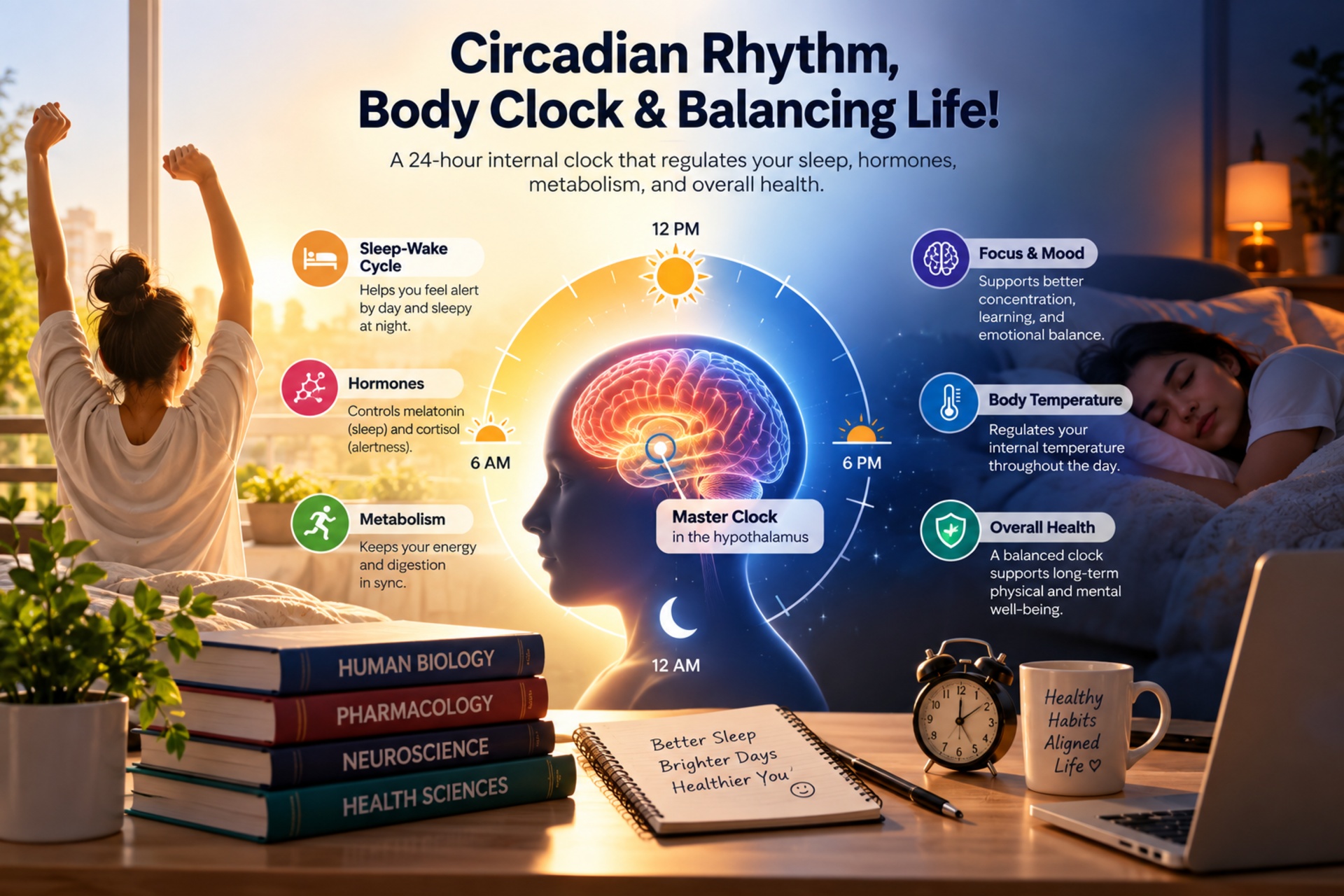
It is a research area that fascinates scientists, including Parul University’s Dean of Academics, Dr. Rohit Goyal, whose work touches on circadian rhythm biology. And it affects every one of us, every single day. Here is a clear, science-based introduction to your body clock.
What Is The Circadian Rhythm?
The circadian rhythm is a roughly 24-hour cycle that acts as your body’s internal clock, telling it when to feel awake and when to feel sleepy. The word comes from the Latin “circa diem,” meaning “around a day.” Far from controlling only sleep, this clock quietly regulates a wide range of processes: hormone release, body temperature, metabolism, and alertness, keeping them aligned with the natural cycle of day and night. It is one of biology’s most elegant systems, and its discovery earned a Nobel Prize in 2017.
How Does the Body Clock Work?
The “master clock” is located in the brain, in a small area of the hypothalamus, and it controls smaller clocks in the tissues and organs of the body. It’s light that is the most critical signal that it’s sensitive to. Light in the eyes tells the master clock what time of day it is, so bright light in the morning comes to help wake you up, and darkness in the evening comes to help you sleep. The two hormones that best demonstrate the rhythm are melatonin, which increases at night to help you fall asleep, and cortisol, which surges in the morning to get you going. If the clock is running correctly, these ups and downs coincide with the sun.
When the Clock Goes In!
There are so many things in modern living that disrupt the body clock, making its condition what scientists call “circadian misalignment.” They often include jet lag (travelling across several time zones too quickly for the body to catch up), shift work (working at night instead of during the day), and, more and more these days, exposure to bright screens during late-night hours that can fool the brain into thinking it is still daytime and cause a delay in sleep onset.
Sustained misalignment is not just a case of being tired; research shows that it’s associated with many health issues, and research (including in this field) investigates the possible link between misalignment and long-term health issues, such as sleep, metabolism, mood, and even brain health. In other words, any slippage in the clock can put a strain on the whole system. Subsequently, let’s check out what the more effective ways are of keeping your body clock in sync.
1. The moment you begin your day, get plenty of sunlight in the morning & keep taking in natural daylight during the daytime. It’s considered one of the strongest signals for setting the clock.
2. Instead of focusing on a different bedtime, keep a consistent one and follow it regularly. Follow the same one for waking up, and that’s how you can see significant changes!
3. Dim lights and a no-phone policy will save your energy during morning and evening hours. If followed well, it will not interrupt the melatonin rise at night.
4. Say no to coffee and heavy foods, as they can truly disrupt your clock’s flow.
By following all of these well-being habits, you will save yourselves from ongoing sleep difficulties, and if it’s disturbing you heavily, one should consult a qualified practitioner!
The Research Frontier.
Knowing the body clock is not just a wellness tip; it’s a major scientific frontier. It is transforming the understanding of health and even medicine, and the emerging field of “chronotherapy” is beginning to examine the optimal timing of drug therapy to enhance its effectiveness, in line with the body clock. That’s what makes the circadian rhythm so intriguing to researchers in pharmacology and neuroscience, such as those at Parul University, who are just starting to fully understand how it relates to sleep, hormones, metabolism, and brain health. Curious about how the human body works? Explore MBBS, B.Pharm, B.Sc. Nursing, and Biotechnology programs of Parul University and study the science behind it!
FAQs
What is the circadian rhythm in simple terms?
Your body's internal clock is referred to as your circadian rhythm. It regulates the hormones, body temperature, metabolism, and alertness, keeping them in harmony with the natural rhythm of day and night, and it informs your body when to feel awake or when to feel sleepy. 'Circadian' is derived from the Latin word 'circadian,' meaning ‘around a day.'
So what are the mechanisms by which the body clock is controlled?
The body’s internal clocks are regulated by a “master clock” in a small part of the brain (hypothalamus). Its most crucial signal is light: even light entering the eyes can send a signal of “day” or “night”; this is why one gets a feeling of awakening in the morning when the light is bright and ready for sleep when the light is dim at night. Hormones such as melatonin (at night) and cortisol (in the morning) exhibit this pattern.
What occurs if your body's clock goes off schedule?
Bright screens at night, shift work, and jet lag contribute to disruption, also known as circadian misalignment. In addition to fatigue, prolonged misalignment has been shown to have a negative impact on sleep, metabolism, mood, and brain health in research. Having a regular sleeping routine and exposure to daylight during the day and darkness at night keeps the clock in line.


![Child protection and juvenile justice, from a thematic session at Parul University’s ICGCV 2026. [H2] Juvenile Justice Protecting Children](https://www.paruluniversity.ac.in/wp-content/uploads/2026/10/DSC00099-1-300x200.jpg)


