Driver Monitoring and Safety Control System: A Student-Built Vehicle Safety Patent at Parul University!
- • What the Driver Monitoring and Safety Control System is and the problem it addresses.
- • How it screens a driver through several detection methods at once.
- • How it responds, from refusing to start to a graduated safe stop.
- • What the published patent records are, and what stage the prototype is at.
Application No. 202621061499 A:
Filed 14 May 2026; published 10 July 2026.
Applicant: Parul University:
Six inventors named, including Raj Soni.
21 pages, 8 claims:
Several detection and response components, not one sensor.
What’s the system?
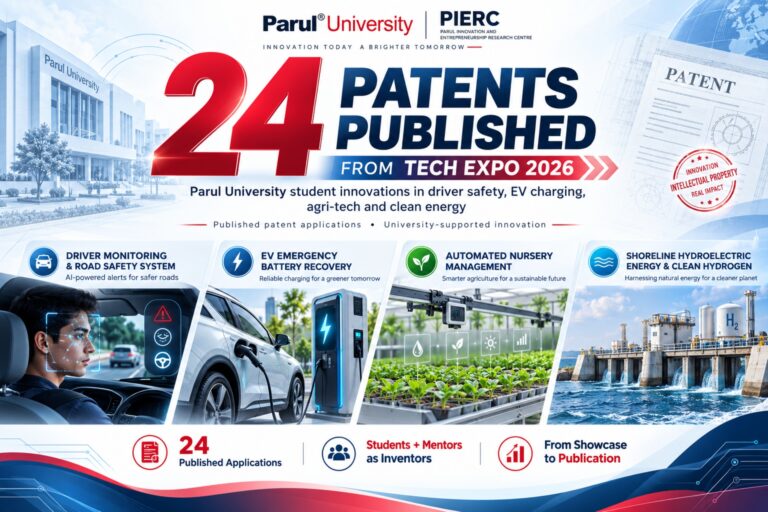
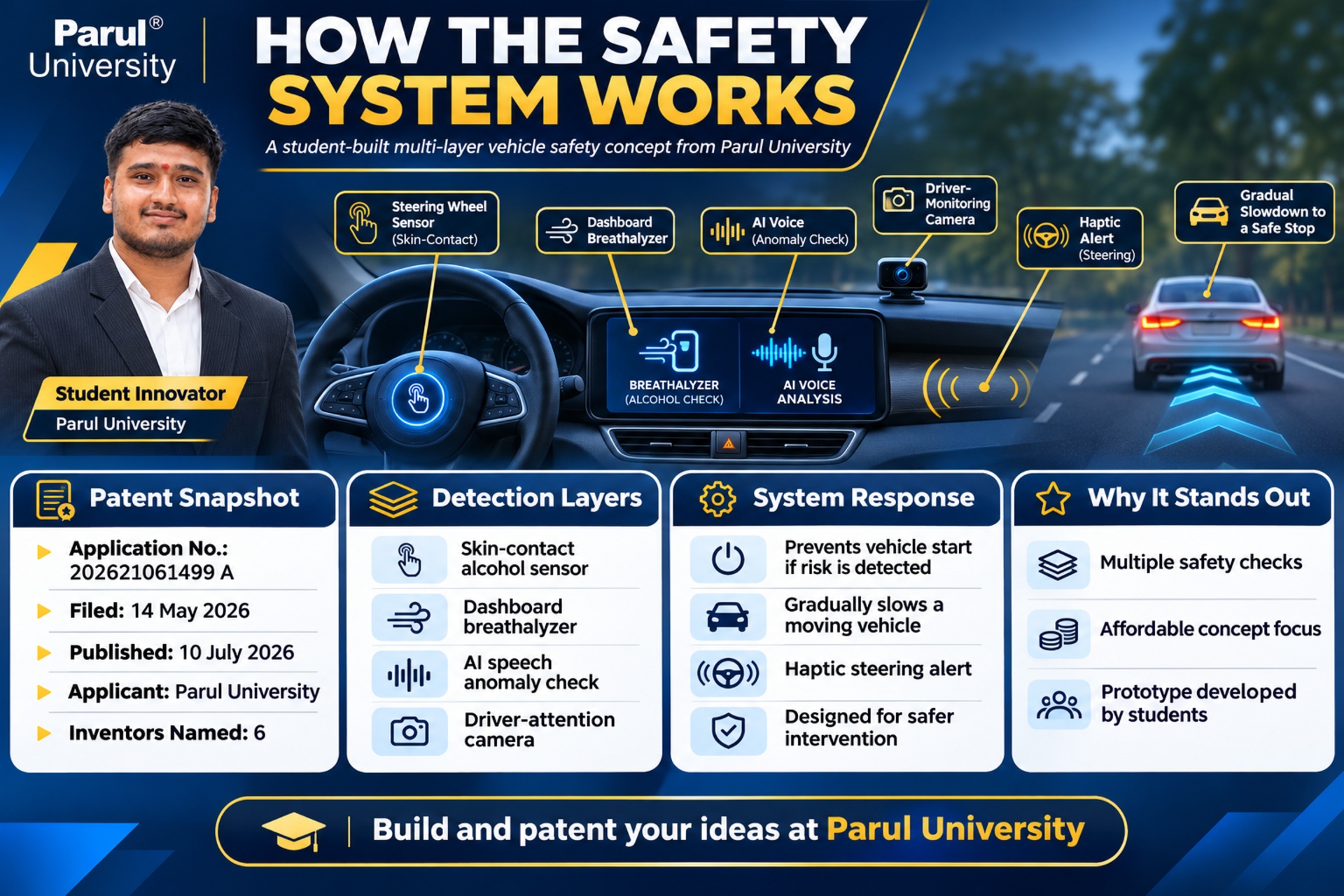
The Driver Monitoring and Safety Control System is a vehicle-safety design that attempts to accomplish three goals simultaneously: prevent an impaired driver from starting the car, slow or stop the car when the driver is in a condition to not safely operate it, and signal to the driver or the driver’s attention if a situation occurs on the road that is not safe for the operation of the vehicle. Students from Parul University first developed it and filed a patent application in July 2026, listing the university as the applicant and six inventors.
It’s worth looking at this unique juxtaposition with a number of sensors, not individually. Detecting alcohol in cars isn’t new, and the students who built this are no exception. They wanted a system that added detection and response without requiring an expensive buyer.
How does it screen the driver?
The published abstract describes several detection methods running in parallel, rather than a single sensor connected to an engine shutoff. A skin-contact alcohol sensor in an auxiliary steering wheel provides a preliminary reading when the driver touches the wheel. Multiple semiconductor-oxide sensors fitted in a breathalyser unit on the dashboard provide a more accurate alcohol measurement. The driver’s voice is recorded on an acoustic transducer, and the speech is compared to his or her baseline (stored in the same place as the voice) by a microcontroller with an AI module that looks at the anomalies. A dashboard camera monitors attentiveness and unconsciousness.
| Component | What it does? |
|---|---|
| Transdermal alcohol sensor (in an auxiliary steering wheel) | Detects alcohol through skin contact as an initial screen |
| Breathalyzer unit (dashboard, semiconductor-oxide sensors) | Takes a precise measurement of alcohol content |
| Acoustic transducer with an AI module | Records speech and compares it to the driver’s baseline to flag anomalies. |
| Dashboard camera | Monitors the driver for inattention and loss of consciousness |
| Self-driving unit | Gradually reduces speed and brings the vehicle to a safe stop |
| Vibration element (steering wheel) | Gives the driver a haptic alert |
What does it do when it reacts?
Response is the other half of the design; detection is half. If the system detects alcohol before the vehicle moves, it won’t start. If the driver has been drinking, a self-driving unit gradually slows the vehicle and brings it to a safe stop when the system detects the car is running. The slowdown is planned; sudden braking on a road creates a new hazard. A steering-wheel vibration provides the driver with a haptic warning in addition to the automatic response.
The students’ prototype added an extra layer of emergency protection, worth describing, with one caveat. The account says that an accident initiates an AI-assisted SOS: relatives are alerted, an ambulance and the police are contacted, and the location of a nearby hospital is provided; readings like the driver’s phone battery status, alcohol status, behaviour and temperature are then used to gauge whether the driver is fit to drive. They constructed and demonstrated an emergency-calling layer not included in the published patent abstract, which focuses on detection, warning, and vehicle operation.
What makes it different, and where does it stand?
There are 2 points for the team to make in their case for the design.
- Breadth: the system includes multiple safety features rather than a single alcohol detector, such as a speech check, camera check, and graduated stop.
- Cost: the students designed it to be accessible to middle-class families, who make up most of the nation’s drivers, on the premise that a safety device only rich buyers can afford has little overall value for road safety.
They do not take their word lightly. It is a prototype and won’t use the same sensors found in a model car, but will have other sensors in a road car instead. They say their next step is a government incubation center where the team can work with experts to build and certify a system suitable for the real vehicle, as this is something they don’t have experience with.
The published patent record!
The application is a matter of public record in the Patent Office Journal, and its particulars are set out below.
| Field | Detail |
|---|---|
| Title | Driver Monitoring and Safety Control System |
| Application number | 202621061499 A |
| Date of filing | 14 May 2026 |
| Date of publication | 10 July 2026 (Patent Office Journal No. 28/2026) |
| Applicant | Parul University, Waghodia, Gujarat |
| Inventors | Six, including Soni Raj Kiran (Raj Soni) |
| Specification | 21 pages, 8 claims |
The record names six inventors, among them Raj Soni, and lists Parul University as the applicant. For a project that began as a reassigned student minor project in early 2025 and was shown on exhibition floors before anyone considered a patent, filing under the university’s name is a notable step. Passionate about computer science and AI? Take the next step with a B.Tech CSE in AI & ML and unlock opportunities through global exposure!
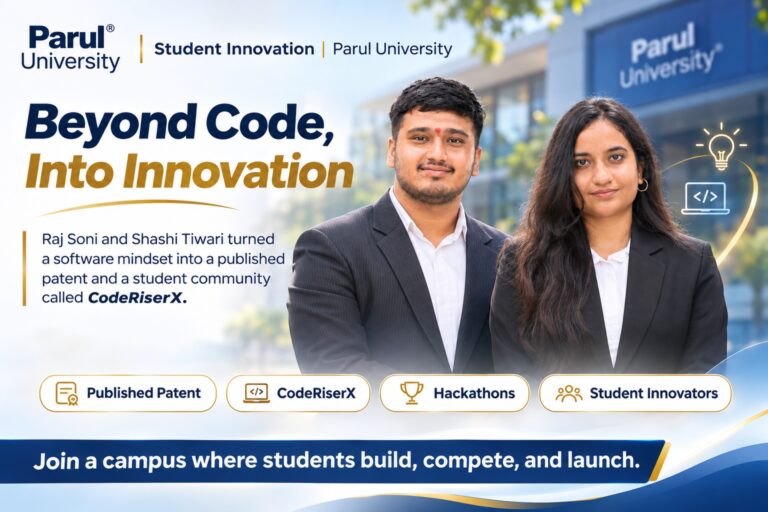
SOURCE AND CONTEXT. Based on an interview with Raj Soni and Shashi Tiwari, Parul University (interview by Abhishek, report by Janvi Singh), and the published patent record. The patent particulars are quoted from Patent Office Journal No. 28/2026. The record names six inventors, including Raj Soni; Shashi Tiwari contributed to and presented the prototype but is not a named inventor. The SOS and emergency-calling features described come from the students’ prototype and are not in the published patent abstract. The system is a prototype and not a finished product.