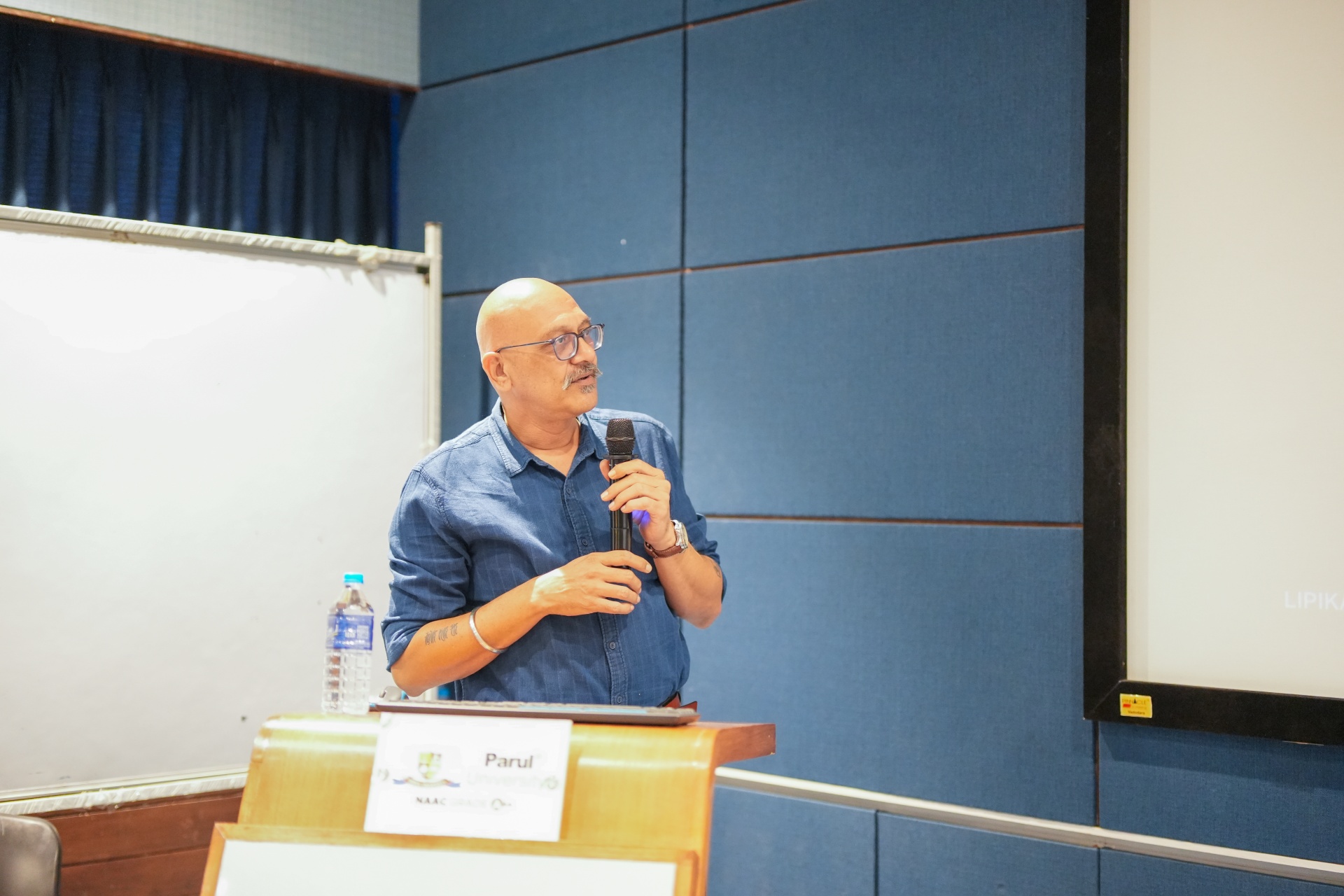
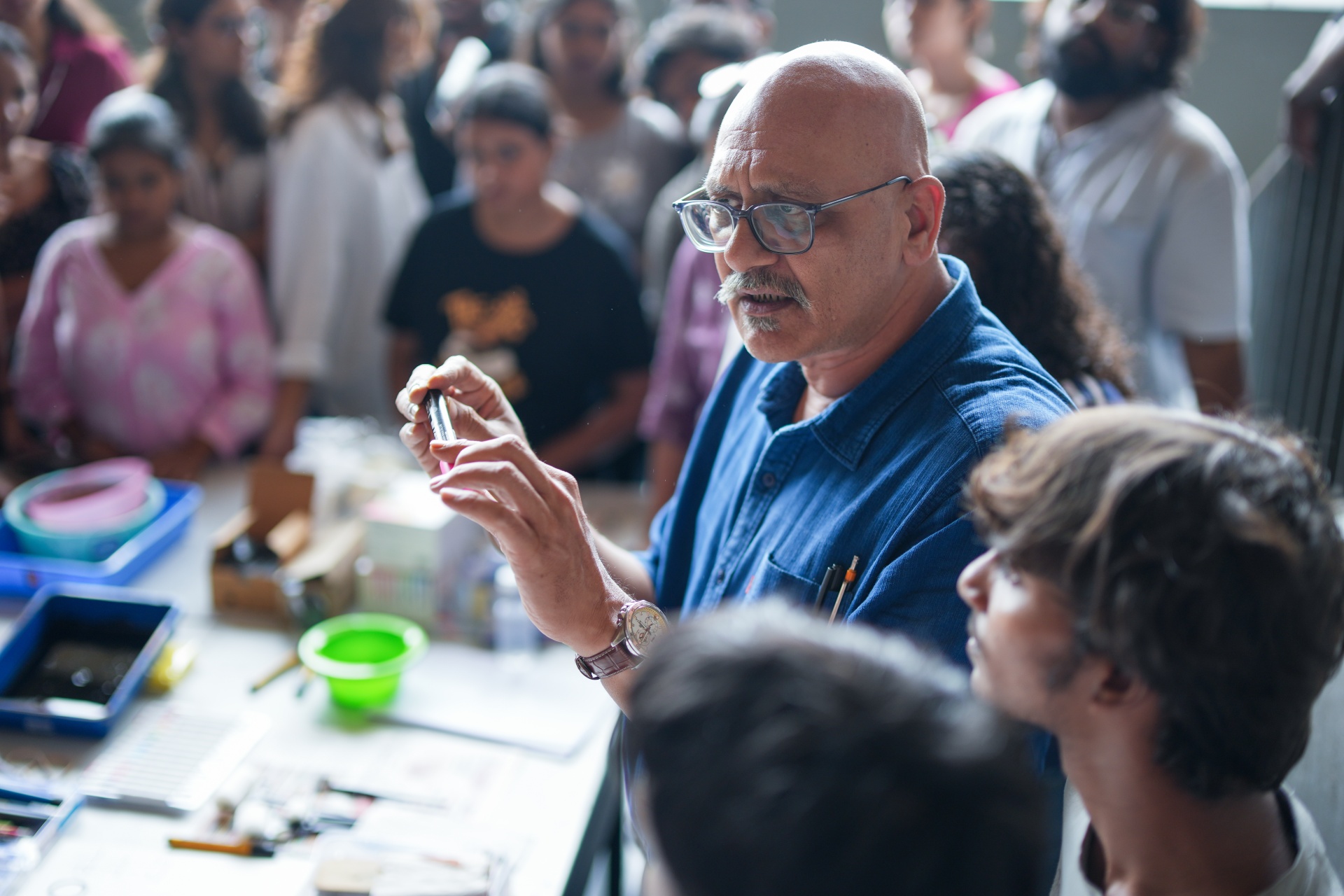
India has a great history of art, culture, and design. It is always interesting to learn about it, because there is still much unknown. The recent session of Lipikalpa 2026 at Parul University talked about it. Tarun Deep Giridhar, the Principal Faculty in Graphic Design at NID, Ahmedabad, was one of the guests. He discussed calligraphy. His real topic was identity. Identity is how a traditional script can help a person with language. It is about how a language gives you insight into culture. Then there is how design helps to preserve the culture, art and much more. He shared his journey too, which this article captures.
A Question That Would Not Go Away
Tarun Deep grew up in Odisha, but his family roots were in Punjab, a place he had never lived. Visiting his grandmother’s home as a child, he met relatives who spoke a language unfamiliar to him. Later, studying at NID (National Institute of Design) Ahmedabad, someone asked where he was from. He answered “Odisha” with confidence, yet a question lodged itself in his mind and refused to leave.
Ke tum kaise Punjabi ho? You can’t speak that language, you can’t write in that language, you can’t read what is written in that language.
– The question that changed Tarun Deep Giridhar’s life
In an age before the internet, he went looking, library to library, every Saturday, until he found a small 24-page booklet titled Learn Punjabi through Hindi. He still treasures it. It was the beginning of a lifelong pursuit.
Learning Languages, One at a Time
Learning was not linear. Juggling Punjabi and Gujarati at once proved too much, until a Gujarati teacher gave him advice that applies to any learner: build solid proficiency in one language first, then move to the next. He focused on Gujarati, and only years later, nearly 26 years after that first question, returned to Punjabi formally, enrolling in a course under a retired ONGC engineer, Lalit Sir, who had taken up teaching to give back. Eventually, the class had just the two of them, Tarun Deep sitting on a dari with a small table, a student once again.
It was an amazing feeling to be a student once again and get into that discipline.
– Tarun Deep Giridhar
His teacher’s guidance was simple and profound: “khule ho ke likho”, write openly, develop your own hand rather than copying a typeface. And above all, “practice, practice, practice.”
When a Script Opens a New World
Learning Gurmukhi did not just teach him to read; it opened doors he never expected. He began noticing the different names for colours across Indian languages, and the richness of vocabulary that lives not in dictionaries but in the memories of parents and grandparents. He wrote poems, rewrote Hindi verses in Gurmukhi, even made his grocery lists in the script. He discovered the literature of Amrita Pritam and Baba Farid, and was left astonished at how much lay just out of reach.
Itna sab kuch hai, hum logon ko pata hi nahi hai! The more you know, the more there is to know.
– Tarun Deep Giridhar
With no one to practise spoken Punjabi with, he improvised, playing Punjabi films in the background as he worked, absorbing rhythm and tone, a reminder that a language lives through use, and every chance to hear, speak, read, or write is part of learning it.
Design That Reconnects People With Their Roots
His journey soon transformed his teaching. He encouraged students who had grown up far from their ancestral regions to explore their roots through design. One student built teaching materials and a typeface for Gurmukhi; another, working on Bengali type, collected over 150 samples of handwriting from neighbours and teachers, and in doing so reconnected with her own community. Others turned a grandmother’s stories, or a mother’s recipes, into design projects.
The whole act of an opportunity of going back to the roots, or trying to rediscover one’s cultural identity.
– Tarun Deep Giridhar, on his students’ projects
Guiding students exploring Telugu, Malayalam, and Gurmukhi typefaces, he found he had to learn those scripts himself, because, as he put it, “to teach, you also need to learn.”
Letters as Shapes, Sounds and Systems
Studying multiple scripts revealed a deep design truth. Tarun Deep noticed that letters begin as shapes; only when a shape acquires an orientation, a sound, and a meaning does it become part of a writing system.
Shapes acquire a certain meaning, by way of sound, and that’s what we call alphabets.
– Tarun Deep Giridhar
He also had a memorable explanation for why many Indian scripts are rounded while Latin letters are more angular: Latin forms grew from stone inscriptions, while Indian scripts developed from writing on palm leaves with sharp styluses, where straight strokes would tear the leaf, encouraging curves instead. The tools shaped the letters. And on typography, his lesson was crisp: “information is just data if it is not designed properly.”
Experiment With Whatever Is Around You
Calligraphy, he showed, need not be confined to pens and brushes. He described writing with a thick wholesale-market marker meant for gunny sacks, and his students went further, forming Gurmukhi letters from icing and chocolate, pebbles, wire, and scrap wood. It led to one of his sharpest insights:
Letter forms are agnostic to material or tools.
– Tarun Deep Giridhar
What matters is the visual structure that keeps one letter distinct from another. The principle for any creative: change the tool, change the surface, and observe.
35 Days of Gurmukhi: A Community Built From Letters
The exploration spilt onto Instagram as “35 Days of Gurmukhi Type”, one letter a day, for the script’s 35 core letters, with participants interpreting each in their own way. Editions grew, and dozens of people, many who did not even know Punjabi, began building a shared visual repository around the script; one type designer’s Gurmukhi work grew from it. Most movingly, the challenge reconnected a family scattered across the United Kingdom, Canada, and Delhi, who began meeting on video calls each day to plan the next letter, a family that had never communicated so regularly, brought together by a script. For Tarun Deep, it captured social media’s real potential:
Social media is like fire. You can use it to cook, bake and share. Or you can get roasted. That choice is yours. I chose to cook and share.
– Tarun Deep Giridhar
From a Library Booklet to the World
That curiosity carried his work far. His Gurmukhi calligraphy featured in a legacy packaging project celebrating Indian scripts, travelled to an Indo-French exhibition from Ahmedabad to Orleans (drawing on the brutalist architecture of Chandigarh), reached the International Calligraphy Festival of Kerala before an audience of 400, and earned an invitation to the Jikji World Calligraphy Competition in South Korea. Each time, he became a medium through which an Indian script could travel into new spaces. He also raised a question worth carrying: as global companies redesign Indian scripts to fit digital systems, “at the cost of globalization, are we at risk of losing our original visual culture?”
Still a Learner: Share, Learn, Share
For all his achievements, Tarun Deep refused the title of expert.
I am not standing here as an expert. I am still a learner. Share, learn, share. It’s a loop.
– Tarun Deep Giridhar
His message to students was that finishing a course is a beginning, not an end, and that learning a language, exploring a script, asking questions, documenting the process, and sharing what you discover is a lifelong loop. In a world of easy typing and AI, he reminded them, young designers will help decide how India’s visual languages survive. From a 24-page booklet found in a library to international calligraphy stages, his journey is proof of what becomes possible when you let learning continue, and it is exactly the kind of curiosity a design and fine-arts education is meant to spark.
FAQs
How to know more about a new language or script as an adult?
As an adult, it is difficult to study or research everything at once. But you can start with one language at a time. Focus on it. Integrate it into your daily practice. With discipline, start your journey by reading, writing, and watching films, reading subtitles, and understanding the tone and rhythms of the language. Also try to understand cultural vocabulary from family and community, not just from dictionaries. Tarun Deep Girdhar emphasised consistency.
Why does learning a script matter for identity?
To understand culture, language and art, people read scripts. Scripts of different cultures. Learning scripts gives you insight into a language. When you get to learn about the language, you get to know about the culture. Their literature, small details of the language, vocabulary. It also keeps you rooted to your culture. Or reconnects you with it. It can also lead you to transform identity into a lifelong, meaningful creative practice.
Why are Indian scripts more rounded than Latin letters?
One explanation lies in the writing tools and materials. Latin letterforms developed partly from stone inscriptions, which suited angular shapes, while many Indian scripts developed from writing on palm leaves with sharp metal styluses, where straight strokes could tear the leaf, encouraging more rounded forms. The tool and surface shaped the script.