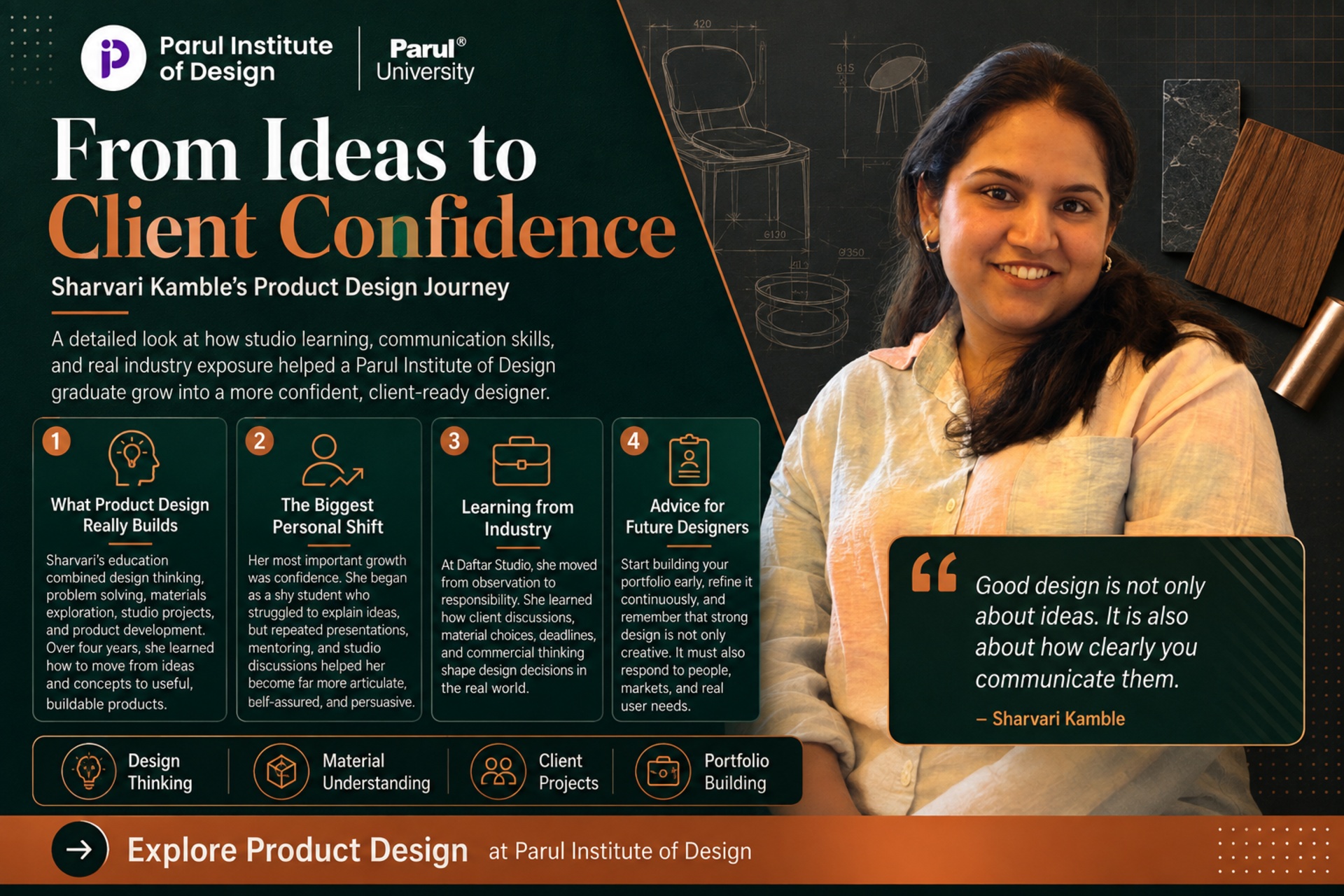
Ask Sharvari Kamble what four years of product design gave her, and the answer is not only skills; it is a transformation. Her journey was harder at the start than most. From Pune to Vadodara, she travelled and reached Parul University through BRDS. A design studio that prepares students for entrance exams, where she got to know about Parul Institute of Design from her friends. She arrived a month late, missing initial sessions that are usually the preparatory lectures that make new students comfortable. She had to jump straight into the middle of things. What she built from there is a case study in design thinking, communication, and professional growth.
Sharvari’s education combined theory with heavy practical work. It grounded her in design thinking and problem-solving, the discipline of approaching tangible objects the right way and turning ideas into useful products, and put a design studio in almost every semester, where she had to consider real-world concerns, including merchandising, and worked extensively with materials such as wood to learn their characteristics first-hand. Her final year turned to contemporary concepts, designing smart products and engaging with the latest trends, culminating in a major graduation project. Yet she is clear that the most valuable thing the four years gave her was not any single technique but a psychological transformation.
From Inward-Looking to Confident Speaking
Now I know what I need to say, and how to say it so people like the ideas and concepts.
– Sharvari Kamble
In her first year, Sharvari would have described herself as shy, overwhelmed by the need to communicate, and barely able to find words for her ideas, a real disadvantage in a design studio, where communication is essential. Over four years, that changed completely. She learned not only to speak and convey her ideas but also to read people, to understand what they need and want, what she calls the psychology of positioning. Today she is confident in conversation, clear about what to say and how to say it so that others engage with her concepts. She credits a visiting faculty member who taught her in her first two or three semesters, whose approach and encouragement began her transformation, and Deepak Vishwakarma, a constant presence across all four years who helped her transition into the profession.
The Degree Project
Her graduation project remains the most remarkable one, a group project with five members where the project is focused on addressing real needs and real problems: furniture that is easy to move, light, easy to assemble and dismantle without tools, and something that mainly helps those who travel or relocate. The team worked on making a modular sofa and table designed in a way that two or three people could assemble it easily, move it and dismantle it, presenting it as a working prototype to demonstrate the concept. It was a demanding, collaborative exercise in taking an idea through to a resolved, buildable design.
Crossing Into Industry: Daftar Studio
The internship market was tight; only one position was available, but Sharvari landed the spot at Daftar Studio, invited to apply by her mentor Deepak sir, who had contacts there. It took her a month or two to learn how the workplace functioned; early duties were observational and supportive, watching senior designers, preparing materials, working on draft projects, and communicating with clients. Then came the decisive step: two or three months in, she was given a large project to manage on her own, identifying what the client needed, discussing the design in full, selecting materials, and handling the entire process from scratch. It was the moment her studio training became real professional responsibility.
Academic Idealism Versus Commercial Reality
Daftar Studio delivered Sharvari’s most eye-opening lesson: the chasm between creative thinking and commercial thinking. In an academic setting, she had been trained to build a solid theoretical foundation and to perfect a project, developing an elegant, beautiful solution to a defined need. In the professional world, she found, is highly commercialised and fundamentally different; a designer must first understand what the market demands and what the specific client needs, then create something appropriate and pleasing to them, rather than designing what one assumes the market should want. Crucially, she does not dismiss her education; her academic preparation gave her a solid foundation of hard skills, and the software skills she learned proved integral, used every single day at work. She found the curriculum taught the right things at the right time, and she plans to build on it, targeting a master’s in design within a year, seven or eight years of experience across firms, and eventually her own design studio.
Her Advice to Juniors
Sharvari’s advice is pointed and practical: for anyone who wants a strong placement or a valuable internship, the design portfolio is critical, and it must be started early. Specifically, she recommends beginning to compile and refine portfolio work right after the second year, carrying that momentum into the third, because in a crowded, competitive design market, an early, well-built portfolio is what makes a graduate stand out.
Also Read: Fashion Design at Parul University: How Sangita Dhola Grew From a Shy Student to a Boutique Designer
FAQs
What is design thinking in product design?
Design thinking is a structured, problem-solving approach to design that starts from understanding a real user need and works toward a useful, resolved solution. In product design it guides how a designer approaches tangible objects, from problem definition through materials and prototyping. Sharvari Kamble describes it as a core foundation of her Parul University education.
What is the difference between creative thinking and commercial thinking in design?
Creative thinking focuses on developing the most elegant or beautiful solution to a design problem, while commercial thinking focuses on what the market demands and what a specific client actually needs and will pay for. Industry rewards designers who can do both, understanding the client and market first, then designing to meet those needs, a lesson Sharvari learned at Daftar Studio.
When should a design student start building a portfolio?
Early. Sharvari Kamble recommends starting to compile and refine portfolio work right after the second year and into the third, rather than leaving it to the final year. An early, well-built portfolio is often the decisive factor in securing strong placements and internships in a competitive market.
How does a design internship build professional skills?
A good internship moves a student from observation to real responsibility. At Daftar Studio, Sharvari began by assisting senior designers and, within a few months, was managing a full client project herself, defining needs, selecting materials, and handling the process end to end, which built both her commercial understanding and her confidence.