For an international student, the leap to a foreign country to study is both demanding and formative.
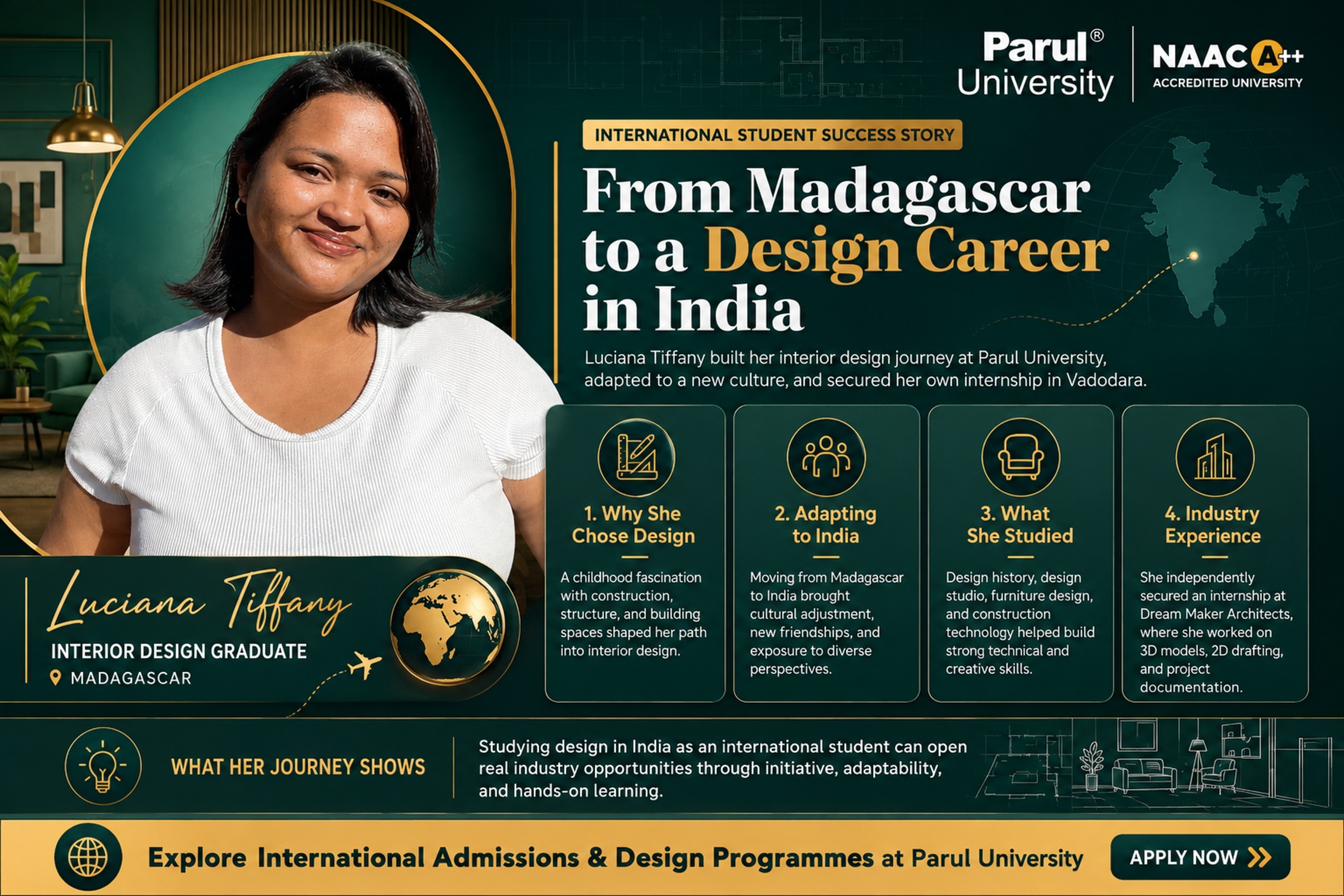
The student Luciana Tiffany came from Madagascar, from an entrepreneurial family. Inspired by design, construction and building structures, she was drawn to interior design. Her early education was in the science field; she was clear that her passion for structural designs was strong enough to motivate her. She joined Parul University for a career path she dreamed of.
Luciana’s interior design programme balanced theory and real skill. It began with the study of design history, a theoretical grounding in past design principles that anchored the hands-on work, and centred on a sequential Design Studio sequence she progressed through from level one all the way to level five, steadily refining her spatial planning and design thinking. She went deep into furniture design and, fittingly, into construction technology, the structural and technical side of interior design that tied directly back to her lifelong fascination with how things are built. Studying it let her blend that childhood interest with modern professional design skills. She credits Rutu Bhatt, her dedicated mentor in her final year, as helpful across every facet of her education and found the curriculum genuinely relevant to industry; by the time she entered professional practice, she had already learned the vast majority of the skills and concepts she needed.
Learning Beyond the Classroom
Much of Luciana’s learning happened outside lecture rooms. She and her friends built a project for a Tech Expo, where she led the aesthetics while teammates handled the technical side, and she especially loved furniture design projects that took the whole class off campus into the city of Vadodara, working and collaborating in a real-world setting rather than sitting in a classroom, something they did often and always enjoyed. As an international student, she also sought out India’s culture directly, attending international-student events with music, dance, and hostel activities, and taking pride in representing Madagascar.
Cultural Adaptation in India
At first it felt strange to live in a foreign environment. Then I discovered a multitude of cultures I had never known, and it opened new horizons.
– On Luciana’s experience
The move from Madagascar to India brought a real, initial culture shock, the strangeness of an unfamiliar environment and constant interaction with new people. It subsided quickly as she immersed herself, discovering a multitude of cultures she had not known and finding new perspectives in them. What smoothed the transition most, she says, was the welcoming atmosphere around her: the people were consistently kind and genuinely helpful whenever she needed assistance, and that support eased the anxieties of being a newcomer. It is the part of her story most relevant to any international student weighing a move to India.
Securing Her Own Internship
Luciana’s internship shows her independence clearly. In her eighth semester she completed a three-month internship at Dream Maker Architects in Vadodara, but the path there required rapid adaptability. Her original plan was to return home to complete her internship requirement; when her circumstances changed at the last minute and she had to remain in Vadodara, she did not wait for the administration to place her. She took independent action, searched for opportunities herself, and applied to numerous design and architectural firms in the area until Dream Maker Architects accepted her, exactly the proactivity she now urges on other international students.
Professional Responsibilities and Real Pressure
At Dream Maker Architects, Luciana was integrated straight into the firm’s core design processes. Her daily work blended technical and creative skills: creating detailed 3D models, executing precise 2D drafting, and drafting comprehensive project manuals, essential documentation for the firm’s work. She was trusted beyond basic execution, allowed to offer her own professional advice and creative input on ongoing designs, and she deliberately engaged with every project the firm handled internally rather than isolating herself, gaining a well-rounded understanding of how a design practice runs day to day. The pace was demanding, with real deadline pressure and extra hours, and projects often expected a day before they were due, a sharp contrast to the freedom of college schedules. That pressure, she says, changed how she worked and thought: she took everything more seriously, paid closer attention to the smallest details, and understood that her daily work now had real consequences for the firm’s projects.
Looking Ahead: A Return to Madagascar
With her degree and internship complete, Luciana plans to pursue a master’s to deepen her expertise, though she has not fixed the timing or location. Her long-term ambition is entrepreneurial and rooted in home: after completing her education and professional preparation, she intends to return to Madagascar to open and run her own independent design company. Her advice to junior students, especially fellow international students seeking internships in India, is drawn straight from her experience: do not passively wait for the University to hand you a placement, take the initiative to search and apply on your own, cast a wide net across many firms to maximise your chances, and enjoy your time at university, because you will miss it once it is gone.
Also Read: Product Design at Parul University: Sharvari Kamble on Design Thinking and Industry Reality
Frequently Asked Questions
What is it like to study design in India as an international student?
It involves an initial cultural adjustment, adapting to a new environment and meeting people from many backgrounds, that typically eases with immersion and a welcoming campus community. International students can access dedicated events and activities, represent their home countries, and study an industry-relevant curriculum. Luciana Tiffany, from Madagascar, describes a supportive environment that smoothed her transition at Parul University.
Can international students do design internships in India?
Yes. International students can secure internships at design and architectural firms, often by applying independently rather than waiting for a placement. Luciana Tiffany applied to numerous firms herself and interned at Dream Maker Architects in Vadodara, working on 3D modeling, 2D drafting, and project documentation.
What does an interior design curriculum in India cover?
It typically covers design history, a sequential design studio sequence (for example, levels one through five) building spatial planning skills, furniture design, and construction technology, the structural and technical side of interiors. This combination builds both theoretical grounding and hands-on, industry-relevant skill.
What advice do international design students give newcomers?
To be proactive, especially in finding internships: search and apply independently rather than waiting to be placed, apply widely to maximise chances, and choose roles that fit your needs. They also advise embracing the local culture and enjoying university life fully, since those experiences are missed after graduation.