A route from campus into a pharma company
- A route from campus into a pharma company
- Who is eligible for internships
- From internship to apprenticeship to employment
- A doctoral pathway for working professionals
- Learning beyond the classroom
- What the agreement does and does not promise
- FAQs
M.Sc + B.Tech
Streams eligible for industry internships
Sponsored Ph.D.
Route for working professionals
Performance-based
How internships can lead to jobs
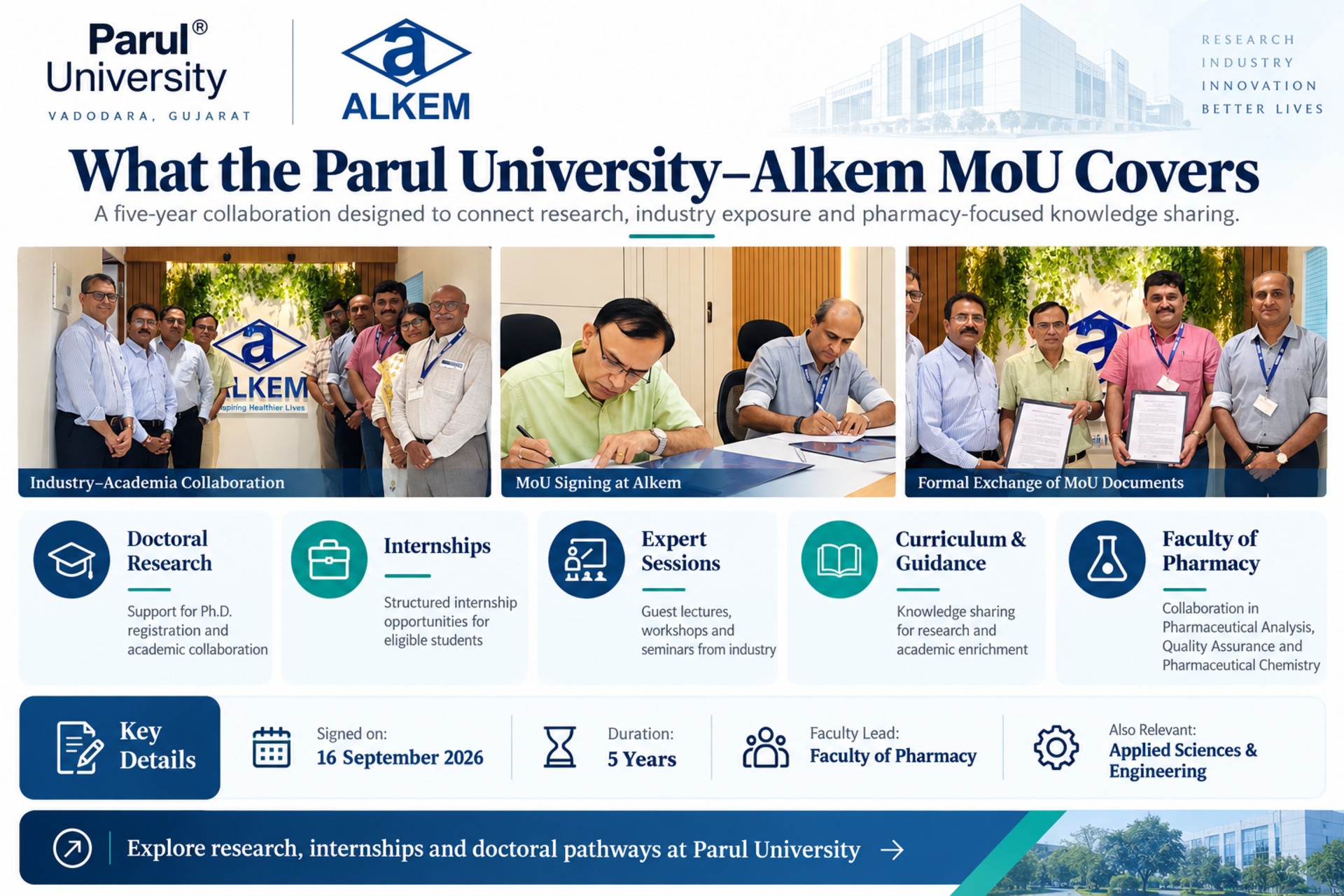
One of the clearest benefits of an industry partnership for a student is access. When the work is approved or done with such partners it country level approved. The collaboration for Parul University will create a managed route. It will turn the route into real working environments. Recently, the MoU with Alkem Laboratories Limited, signed in September 2026. It will help the university with structured research, publications, internships, expert sessions and a doctoral pathway.
The value of a placement in a pharmaceutical plant is the exposure: an organised, regulated work environment where students see how medicines are actually made, tested and documented. That is learning a classroom cannot fully reproduce.
Who is eligible for internships
Under the Alkem collaboration, internships are open to two groups of students.
Applied Sciences
M.Sc. students specialising in Chemistry, Environmental Science and Microbiology.
Engineering and Technology
B.Tech. students specialising in Mechanical, Electrical, Chemical, and Fire and Safety Engineering. The number of positions, their duration, location and any stipend are set by the company and communicated before each internship cycle.
From internship to apprenticeship to employment
The pathway is designed to progress. An internship may be converted into an apprenticeship under applicable law, including the Apprentices Act, 1961. Interns and apprentices may then be considered for full-time employment, based on their performance and the company’s business need.
This is a performance-based route, not a guarantee. Students placed at a company must follow its policies, code of conduct, safety rules and confidentiality requirements, and those who complete their placement successfully receive a certificate. The students who treat the internship as an extended interview are the ones who tend to convert it.
A doctoral pathway for working professionals
The collaboration also opens a doctoral route. Candidates nominated or sponsored by a partner company, including its own employees, can register for the university’s Ph.D. programmes, provided they meet the university’s eligibility rules and the University Grants Commission’s conditions, and pay the applicable fees.
What makes this route distinctive is co-supervision. With both sides in agreement, qualified professionals from the company may serve as co-supervisors or external experts, within university regulations. For a working professional, that means a doctorate that stays close to real industry problems rather than running parallel to them.
Learning beyond the classroom
When you understand the field beyond the classroom. It helps you getting more insight into it, how it works, what rules and regulations are followed, what things require to be taken care of. Apart from placements, the university happens to bring expertise at the campus through collaborations. Professionals of the field come to campus, might deliver the lecture, take workshops and hold seminars. They as well contribute to curriculum design. It helps with project evaluation and academic bodies, subject to their availability.
For the Faculty of Pharmacy, the collaboration is a great achievement. The partnership includes Executive Development Programmes on Good Manufacturing Practice, Good Laboratory Practice, regulatory requirements and quality management. The aim to built this was, it was for working professionals. But also for the standards that pharmacy students are being prepared to meet.
What the agreement does and does not promise
It is worth being precise, because it protects students from false expectations. An MoU of this kind records intent. It is largely non-binding, with only its confidentiality and intellectual property terms binding, and it does not commit the company to a minimum number of internships, apprenticeships or jobs.
What it does is create a framework. The real opportunities, how many internships, which cycles, which doctoral candidates, follow as each activity is agreed in writing. For a student, the sensible reading is that the door is open and the rest depends on turning up prepared.
SOURCE AND CONTEXT. This article draws on the Memorandum of Understanding between Parul University and Alkem Laboratories Limited, signed 16 September 2026, used as a current example of an industry pathway. The MoU is a statement of intent, non-binding except for confidentiality and intellectual property, and commits no fixed number of internships or jobs.
Connect and continue
Students interested in pharmaceutical and science careers can explore the Faculty of Pharmacy and the university’s postgraduate and doctoral programmes.
Faculty of Pharmacy: paruluniversity.ac.in/faculty/pharmacy
All programmes: paruluniversity.ac.in/all-programs
People and organisations
- Parul University Multidisciplinary private university, Vadodara, Gujarat
- Alkem Laboratories Limited Pharmaceutical company, current industry partner
- Faculty of Pharmacy, Parul University Leads pharmacy internships, EDPs and research collaboration