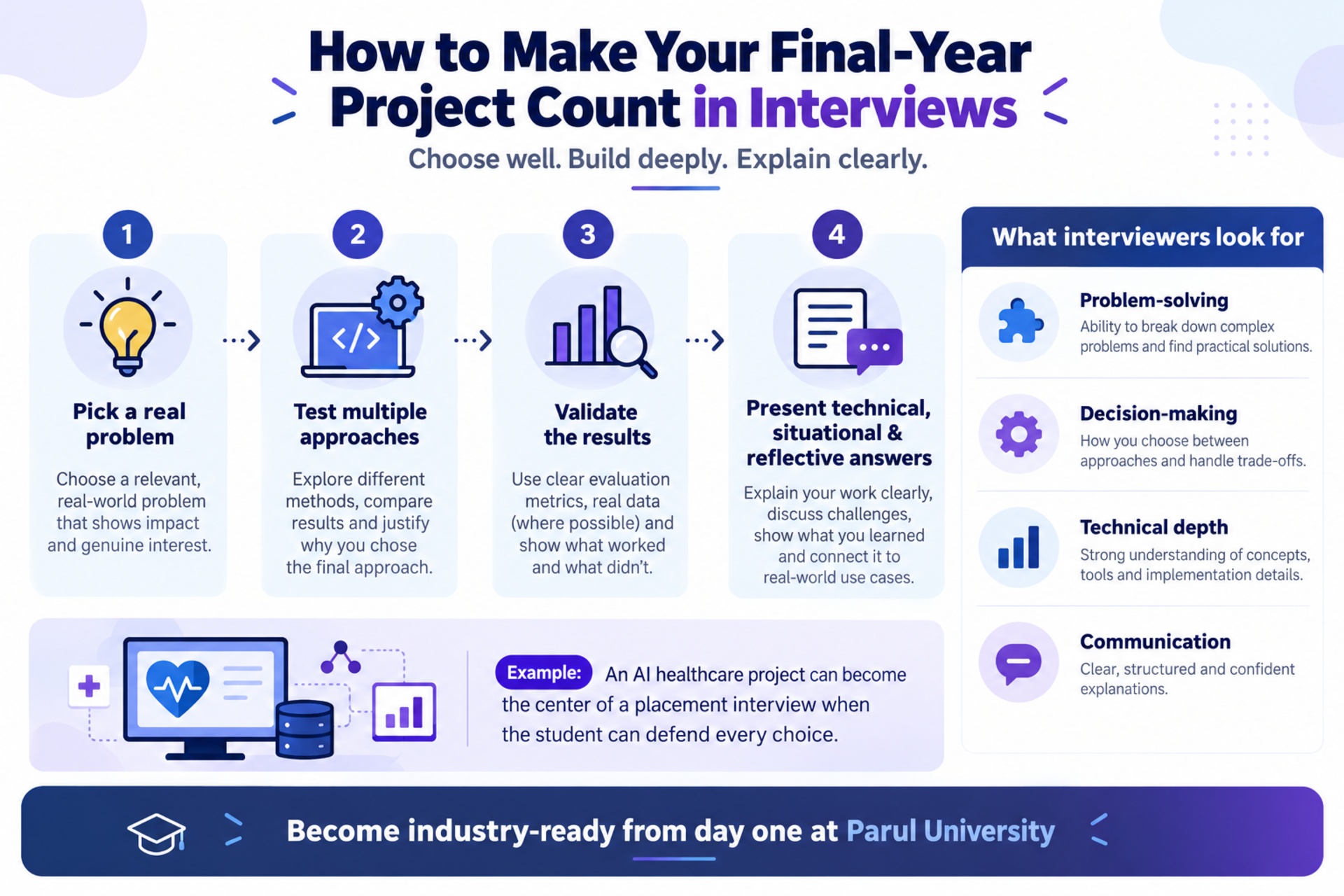
The final year project is a box to tick that is typically used only to earn a degree and is mentioned on a student’s CV as just another line under their experience. That’s a missed opportunity, as a placement interview is most likely the last thing you need in the room if it is your final year project. Are placement interviews affected by your final-year project? It’s the single most important element on the page for many candidates, as it’s the only area where you can provide real depth and not memorised responses. Interviewers can only ask questions as deep as your project will take them, and a project that you completely understand is a good thing; one that you only half-built is a bad thing when it comes to the questions getting specific.
Interviews & your final project!
The best indicator an interviewer can have is a project. Anyone can list skills on a resume; a project demonstrates application of skills and, more importantly, an understanding of why a project’s decisions were made. Therefore, a good project prevails in technical interviews. It allows the interviewer to observe two things simultaneously: the how, or your understanding of the techniques and tools you used, and the what-would-you-do, or how you coped with challenges, compromises, and setbacks throughout the development process. Both are present in a real project, which is why interviewers take to it. When you can respond equally at ease to both types of questions about your own work, you’ve accomplished more than any list of certifications.
Depth over breadth: choosing the right project
Every hackathon, workshop, short project, and so on has been common across the board. Often the opposite is more effective. A proud student of Parul University, Kancharla Sankeerthana, who placed at SAP Labs India, didn’t go to any hackathon. She focused instead on basics and a single machine learning project that she knew from the ground up, a cardiovascular disease prediction machine, and it became the topic of discussion in her interview. The principle extends: One project that should be defended from all sides is better than 5 projects that can only be described. Carefully select a project that has real-world applicability, sufficient technical depth to make comparisons and evaluations possible, and a problem that is of personal interest; interest will sustain depth, and an interview will test.
Design and construct it to stand up to scrutiny.
A project that stalls in an interview is different from a project that is constructed just to pass an interview. There are a handful of habits that make the difference:
- Do not rule out solutions until you find one that works. Attempt multiple approaches and select based on evidence. For the above example, the student first ran the three classifiers. Random Forest, SVM, and KNN, and then chose the best one, thus justifying her selection.
- Make proper validation of results. Supporting the outcome with the right evaluation (e.g., confusion matrix and cross-validation) demonstrates that the outcome is credible and not down to chance or overfitting, which is evident to interviewers.
- Use real-life scale and data. If the data set is sufficiently big that real preprocessing is required, then the dirty aspects inevitably must be addressed, something that situational questions are probing.
- Save the real issues you come across. Embarrassments are not data problems, nor are they disagreements within a team or dead ends. Situational questions, which determine your chance of getting a job, are built out of them.
The one thing that is common with a project that is done in a very real and raw way is the choice of decisions. From how you’re presenting yourself to the work you have done, each decision makes a real impact. Inspired already? Explore your potential in AI and computing with a B.Tech in Computer Science & Engineering, a B.Sc. IT in Artificial Intelligence Systems, and a Master of Science (M.Sc. IT) in Artificial Intelligence at Parul University.
How to describe your project flawlessly?
Practice your project from three different angles before an interview. The technical angle is what you built, why you made all the choices, how you did it, what tools you used, and what happened. The situational angle is about what you did and didn’t do when problems arose, what you would do differently, and how you dealt with your team.
The reflective angle includes what you learned from the project and its limitations. Interviewers switch from one to the other without warning, so practice making a calm transition from one to the other. The objective isn’t to memorise a pitch but to be able to go wherever an interviewer leads the conversation, which means that you have actually experienced the work. Many students begin to express their ideas in an under-time-constraint way and not just say the answer on a structured placement course like the impact training run at Parul University.
FAQs
Does your final-year project matter for placements?
Yes, often significantly. Finally, the project (final year) is most discussed in technical interviews, as it gives the interviewers a chance to test out how technically savvy you are and how you judge situations as well. If you know a project inside and out, you can carry it, but if you don't know it, then it's a liability when questions become specific.
How do you explain your project in a placement interview?
Rehearse it from three angles: technical (what you built and why you made each choice), situational (how you handled problems and worked with your team), and reflective (what it taught you and its limitations). Interviewers move between these, so practise switching calmly. Prepare a genuine speech, and recruiters will focus on your pitch instead of a memorised one!
Is it better to do many projects or one strong project for placements?
One strong project you understand completely is usually more valuable than many shallow ones. Interviewers probe depth, and a project you can defend from every angle demonstrates more than a long list you can only describe.