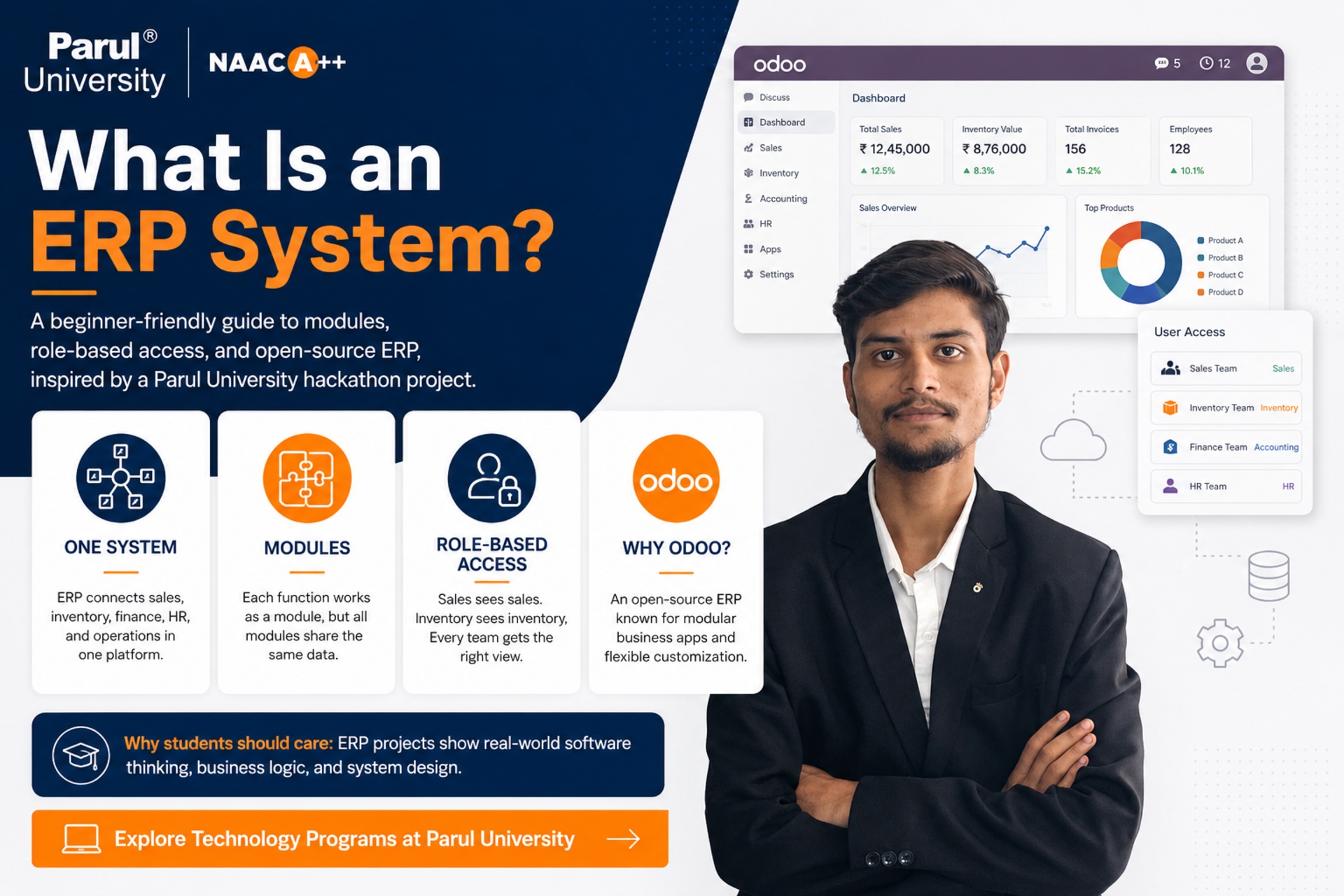
When a Parul University team at the Odoo x Parul University Hackathon chose to build a mini ERP system, they picked a problem that sits at the heart of how real businesses run software. ERP systems are everywhere in industry and rarely explained simply. Here is what an ERP system actually is, using that hackathon project as a worked example.
The ERP System!
ERP means Enterprise Resource Planning. Plus, it’s a single integrated software platform that a company can use for its processing, such as sales, inventory, purchasing, manufacturing, finance, and human resources-everything in one place. The value is integration: when the sales team records an order, inventory and finance can see the effect immediately because they all work from the same system. ERP is, in effect, the central nervous system of a modern business.
From Java Basics to a Job Offer – Aayush Yadav’s Roadmap to Mastering DSA!
A Worked Example: An ERP for a Manufacturer!
The hackathon team built an ERP aimed at a manufacturing company, using the example of a furniture manufacturer. Such a system ties together the departments involved in making and selling a product: sales, inventory, and the rest. The core challenge, as the team framed it, was not any single flashy feature but structuring a management system properly so that each part of the business has the right view of the right information.
A Central Access to All the Roles!
The most important design idea in their project, and in real ERP systems, is role-based access control. Not everyone in a company should see or change everything. As the team put it, the system had to ensure that a sales department could access only sales and the inventory team only inventory.
A sales department can access only sales, and the inventory team has access only to inventory.
– The hackathon team’s ERP design
Role-based access control (RBAC) means permissions are granted according to a person’s role, so each user sees only what their job requires. This matters for two reasons: security-sensitive data is not exposed to people who do not need it, and clarity; each team works within a focused, uncluttered view. Getting this structure right is often the hardest and most important part of building any business system.
What Is Odoo (and Open-Source ERP)?
The hackathon was run with Odoo, a company well known for its open-source ERP and business-management software. Open-source ERP means the underlying software is freely available and can be studied, customised, and extended, which is why it is popular with businesses that want flexibility and with students who want to learn how such systems are built. Building an ERP-style project is genuinely valuable experience, because it teaches how real companies model their operations in software, a skill that transfers directly into industry.
Why ERP Skills Matter for Students?
For a computer-science student, understanding ERP is more useful than it first appears. ERP systems are among the most widely used enterprise software in the world, and the concepts behind them-integrated data, modular design, and role-based access-appear across almost all serious software. Building even a small ERP, as this team did, is a strong portfolio project precisely because it demonstrates an understanding of how software serves a real business, not just how to write code.
From ERP systems and software development to solving real business challenges, build industry-ready IT skills at Parul University. Explore our B.Tech in Information Technology, B.Sc. in Information Technology, or Diploma in Information Technology programs and start building technology that businesses rely on.