

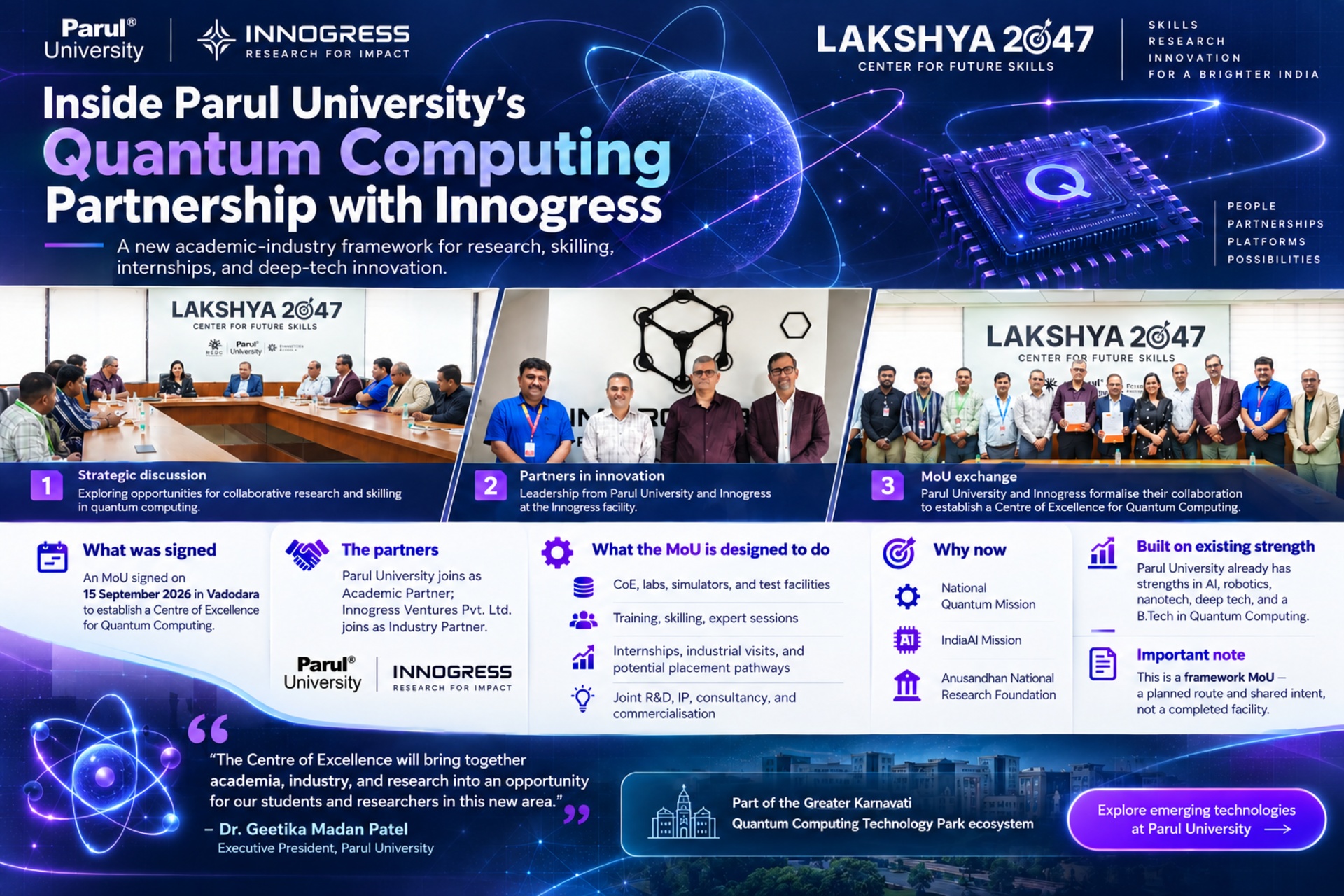
Parul University has signed a Memorandum of Understanding (MoU) with Innogress Ventures Pvt. Ltd. to establish a Centre of Excellence (CoE) for Quantum Computing and to join the Greater Karnavati Quantum Computing Technology Park, a developing national ecosystem in which more than thirty startups and firms are working toward a deep-tech future. Signed in Vadodara on 15 September 2026, the agreement makes Parul University an academic partner and Innogress the industry partner. Importantly, it is a framework of shared intent: a direction and a set of commitments to build on, with the specifics to follow.
A Partnership of Breadth!
What makes this notable is its scope. Rather than a single lab or course, the MoU is intended to run through almost every layer of how a technical university works, spanning research and development, training and skilling, joint conferences and workshops, internships and placements, curriculum review, industrial visits, intellectual property, consultancy, and joint applications for government funding. The pairing is logical: a university with an established campus, faculty, and laboratories on one side, and a project developer with a pipeline of deep-tech ventures and government engagement on the other. The agreement was signed by Prof. Manish Pandya, Registrar, on behalf of Parul University, and Sumant Parimal, Founder and Director of Innogress.
Quantum computing is the future of technological development, and with this MoU, the Centre of Excellence will bring together academia, industry, and research into an opportunity for our students and researchers in this new area.
– Dr. Geetika Madan Patel, Vice President, Parul University
Why Quantum, and Why Now?
The timing follows a clear national direction. Consequently, India has made quantum technologies and advanced research a top priority with the launch of the National Quantum Mission, the IndiaAI Mission, and the Anusandhan National Research Foundation, all of which are mentioned in the MoU as areas of potential collaboration. Infrastructure is required for experimentation, people must be trained to use it, and industry partners are needed to take research products into the real world. The MoU addresses these needs, ranging from quantum hardware and software to quantum security, quantum AI, and AI robotics. It is designed to be broad enough for the collaboration to evolve based on actual funding opportunities and market demand.
What the Partnership Is Designed to Do?
The MoU describes three mutually reinforcing strands of intended collaboration:
- Infrastructure and Centres of Excellence: The parties intend to set up R&D, training, and test facilities, including laboratories, simulators, and the Centre of Excellence for Quantum Computing on campus, with shared access to resources on mutually agreed terms.
- Human capital: The agreement provides for training and skilling, expert sessions, and, for students, a pathway of industrial visits, internships (from the pre-final year), and potential placement routes within the Innogress ecosystem (as opportunities arise, not as guarantees).
- Research and commercialisation: The parties intend to pursue joint R&D and consultancy, and Innogress is intended to help commercialise research, intellectual property, and know-how originating from the university, the step at which many good ideas usually stall.
Built on Existing Strength
Importantly, Parul University will not be beginning from scratch. The MoU aims to develop the existing facilities for AI, robotics, nanotechnology, and deep tech on campus, and the university has established quantum computing as a priority subject. It offers a B.Tech in Quantum Computing, which is said to be one of the first of its kind in the region, and is home to faculty members who publish in leading international journals. The new Centre of Excellence can build on existing strengths in quantum computing, alongside broader expertise in classical computing, materials research, and engineering.
What is an MoU?
It’s worth being clear-eyed, like the agreement is. An MoU of this sort outlines an intent of partnership and not a commitment to any actual investment, a right for exclusive use, or a specific division of the profits or intellectual property. There is still no final determination as to the exact location of the parks or the data centers, and the internship and placement pathways are described as “to be determined” rather than “likely.” What will really tell the true story of the partnership will be how quickly these broad commitments turn into scheduled, resourced, and specific activities. The MoU is not a completed building but a planned route for Parul University and a valuable role within a nationwide initiative that is just beginning to be defined, and that’s a valuable role to have.
FAQs
What’s the partnership between Parul University and Innogress in the field of quantum computing?
It is an MoU dated 15 September 2026 between Academic Partner Parul University and Industry Partner Innogress Ventures to set up a Centre of Excellence for Quantum Computing and linkage in research, training, internships, and commercialisation. It also makes the university a part of the Greater Karnavati Quantum Computing Technology Park ecosystem. It is an MoU, a document of intent - there are activities to be carried out.
What will the Centre of Excellence for Quantum Computing do?
The Centre of Excellence is expected to be the platform for research, training, and industry collaboration in the field of quantum computing and will feature various labs and simulators built on the existing AI, robotics, and DeepTech infrastructure of Parul University. It seeks to provide students and researchers with opportunities to learn about quantum computing, to undertake research, and to connect with industry. This is a framework agreement, and further arrangements will be made to determine the actual facilities and timelines.
Is quantum computing taught at Parul University?
Parul University has introduced a B.Tech in the field of Quantum Computing, which is one of the first of its kind in the region and is based on a national model curriculum with faculty members publishing in prestigious international journals. The new COE with Innogress is set to build on this with research facilities, industry partnerships, and internship/placement opportunities.


