Taavi Rõivas at Parul University: Lessons on Digital Governance, AI and Leadership!
- • Who Taavi Rõivas is, and why Estonia's former prime minister spoke at Parul University.
- • How Estonia built a digital state, from a national digital ID to a digital health register
- • His warning about AI-era misinformation and how to keep a critical mind.
- • His advice to students and his one-line parting message.
21 October 2026
Central Auditorium, Parul University
17th PM of Estonia
In office 2014 to 2016
"Master the use of AI,"
his parting message to students
Taavi Rõivas, Former Prime Minister of Estonia
Taavi Rõivas led Estonia as its 17th Prime Minister from 2014 to 2016, taking office at 34 as the youngest head of government in the European Union at the time. He studied international economics and marketing at the University of Tartu, and before becoming Prime Minister, he served as Estonia’s Minister of Social Affairs from 2010 to 2014. He is now out of politics, running Overtech, a company building autonomous shuttles, and investing in technology.
He arrived with a compliment the university will be glad to keep. Having visited, in his words, tens if not hundreds of universities, he called Parul University impressive and said its compact campus, for such a large student body, leaves room for synergies between faculties.
A lot of synergies can be built out of here.
Estonia, the digital state!
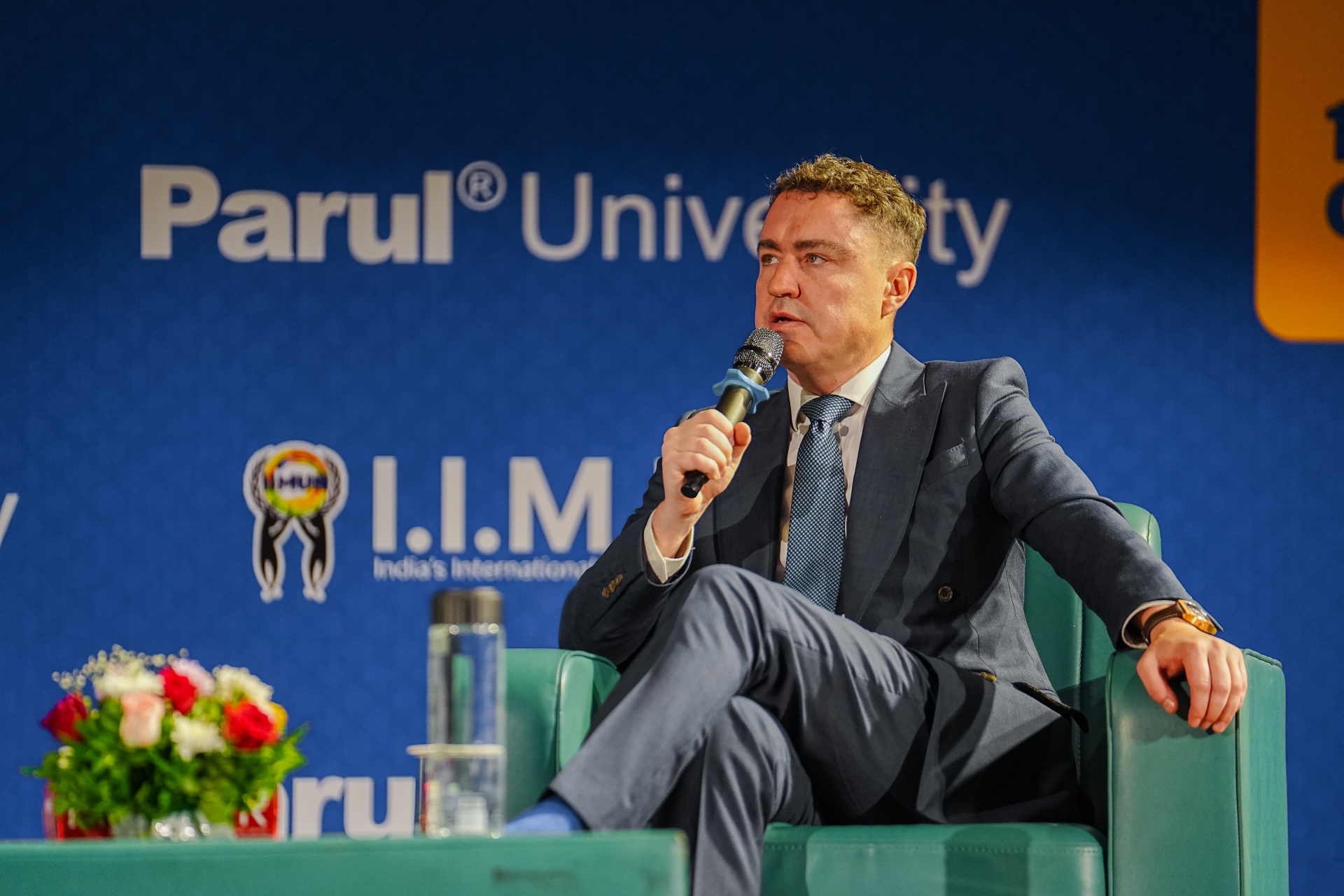
The substance of the talk was Estonia’s transformation. A country that regained independence in 1991 chose, in Rõivas’s telling, to become a digital nation from the start, because the Soviet occupation had left heavy bureaucracy behind and the new government wanted to run as cheaply and effectively as possible. The centrepiece is the digital ID, introduced in 2000 as the default identification. It is a physical card with a chip and a PIN, and a mobile SIM registered in person with the police can do the same job. Together they work like a long encrypted passkey for private services such as internet banking and for government services. He compared it to an Apple ID or a Google account, verified by the state, and said Estonians sign contracts worth millions this way. Nobody, he noted, has ever seen his handwritten signature.
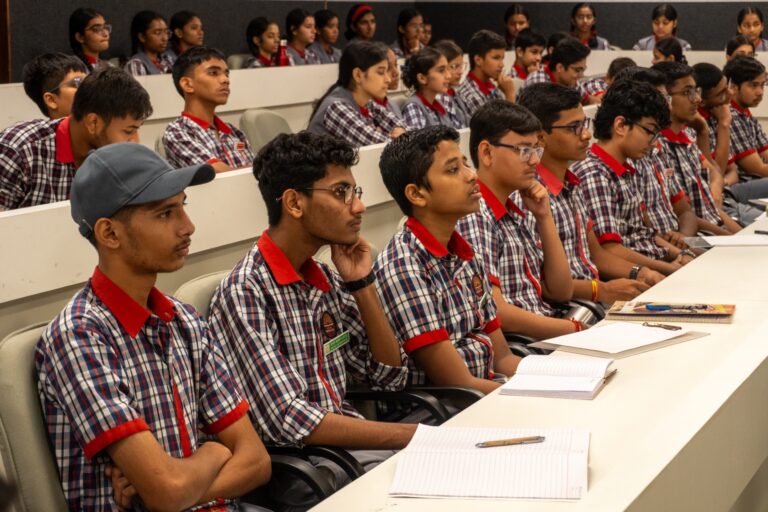
He used the national health register to answer the privacy question, with the many medical students in the hall in mind. A family doctor records a diagnosis and prescription, and a specialist higher up can see them. A doctor can open a record only with the patient’s permission; every access leaves a log the patient can read, and a dentist browsing unrelated data could face a criminal charge. Patients can lock away their most sensitive data, though most do not, he said, because a hospital seeing the full history at once saves repeated tests and questions.
His case for digitalisation, and his warning
Rõivas called himself a believer in digitalisation as a global equaliser of living standards. A person in a remote part of India, he said, can work for a company in London without paying to live in central London, which almost no one can afford. He paired it with a warning about information. Newspapers once had editors, so a reader knew the content was at least checked. Social media has no such filter, and AI makes it harder still to tell what is real. His advice was practical: stay a little skeptical and recheck, even running a piece of content past a second AI model to test whether it came from a different one. Basic critical thinking, he said, is harder to practice than to preach, but it remains the skill to keep.
His message for the students!
Much of the session was students asking and a former head of government answering. His throughline was that curiosity and activity, not grades, move a career. He entered politics at 16, by his own account, with zero connections, through a youth organisation that brought him closer to the leadership, and he told students that student leadership and leaving the comfort zone matter more than a perfect score. Estonian politicians, introverts by nature, find handing out leaflets at a shopping centre deeply uncomfortable, he said, and doing it anyway is what makes a person stand out.
His parting message was a single line.
Master the use of AI.
Humankind, he said, uses perhaps one or two percent of what large language models can do. Anyone who reaches five, ten, or twenty percent will stand out and make their own work more productive, and some will build companies that change a country. If you’re passionate about technology and AI, pursue a B.Tech in CSE at Parul University and prepare for a future shaped by AI and emerging technologies!
The series and why the university runs it!
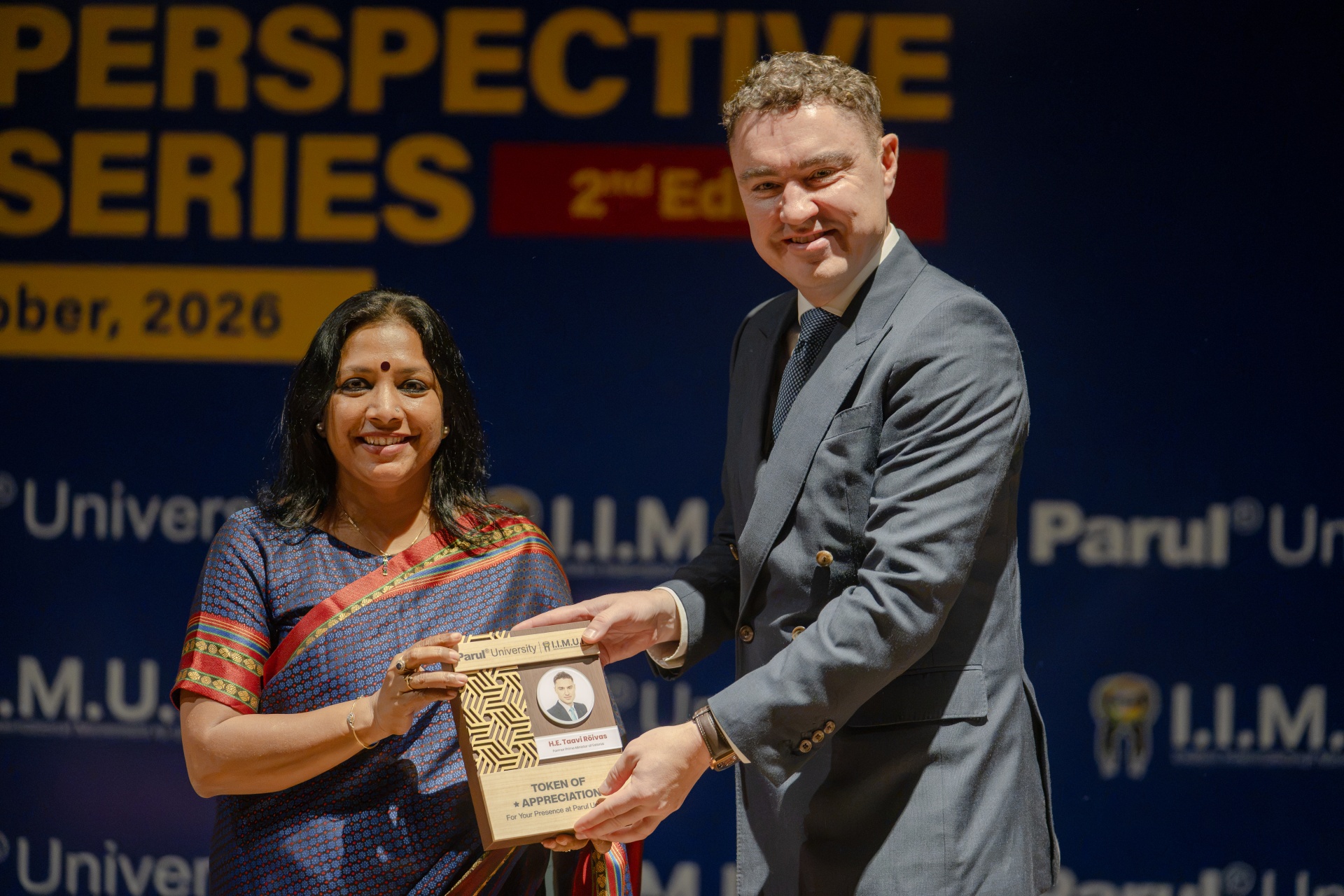
The evening was the second edition of Parul University’s Global Perspective Series, run in collaboration with IIMUN, India’s International Movement to the United Nations, and moderated by RJ Kshitij, the university’s Chief Public Engagement Officer. Dr. Preeti Nair, Director of the Centre of International Relations and Research, felicitated the guest. For a campus with students from more than 75 countries, the point of the series is plain: a student can introduce themselves to, and put a question to, someone who has run a country and get an answer.
SOURCE AND CONTEXT. Based on the report of the Global Perspective Series second edition at Parul University, 21 October 2026. Statements about Estonia, its digital systems, and geopolitics are Mr. Rõivas’s own, as made during the conversation, and his remarks about the campus are his personal impression. Quotations are reproduced as given. LinkedIn profiles are linked with tracking parameters removed.
People and organisations
- Taavi Rõivas 17th Prime Minister of Estonia (2014 to 2016); guest speaker
- RJ Kshitij Chief Public Engagement Officer, Parul University; moderator
- Dr. Preeti Nair Director, Centre of International Relations and Research, Parul University
- IIMUN India’s International Movement to the United Nations; series partner
- Parul University Host: Vadodara, Gujarat