

Every good startup begins with a real, nagging problem, and ends, if it is lucky, with a room full of judges nodding. Between those two points lies weeks of research, doubt, and iteration. At the Young Entrepreneur Exchange Program (YEEP) 2026 at Parul University, one team travelled that whole distance in two and a half weeks and came out on top. This is the story of Team ZYNX, and the electrolyte chewing gum that won.
The Team
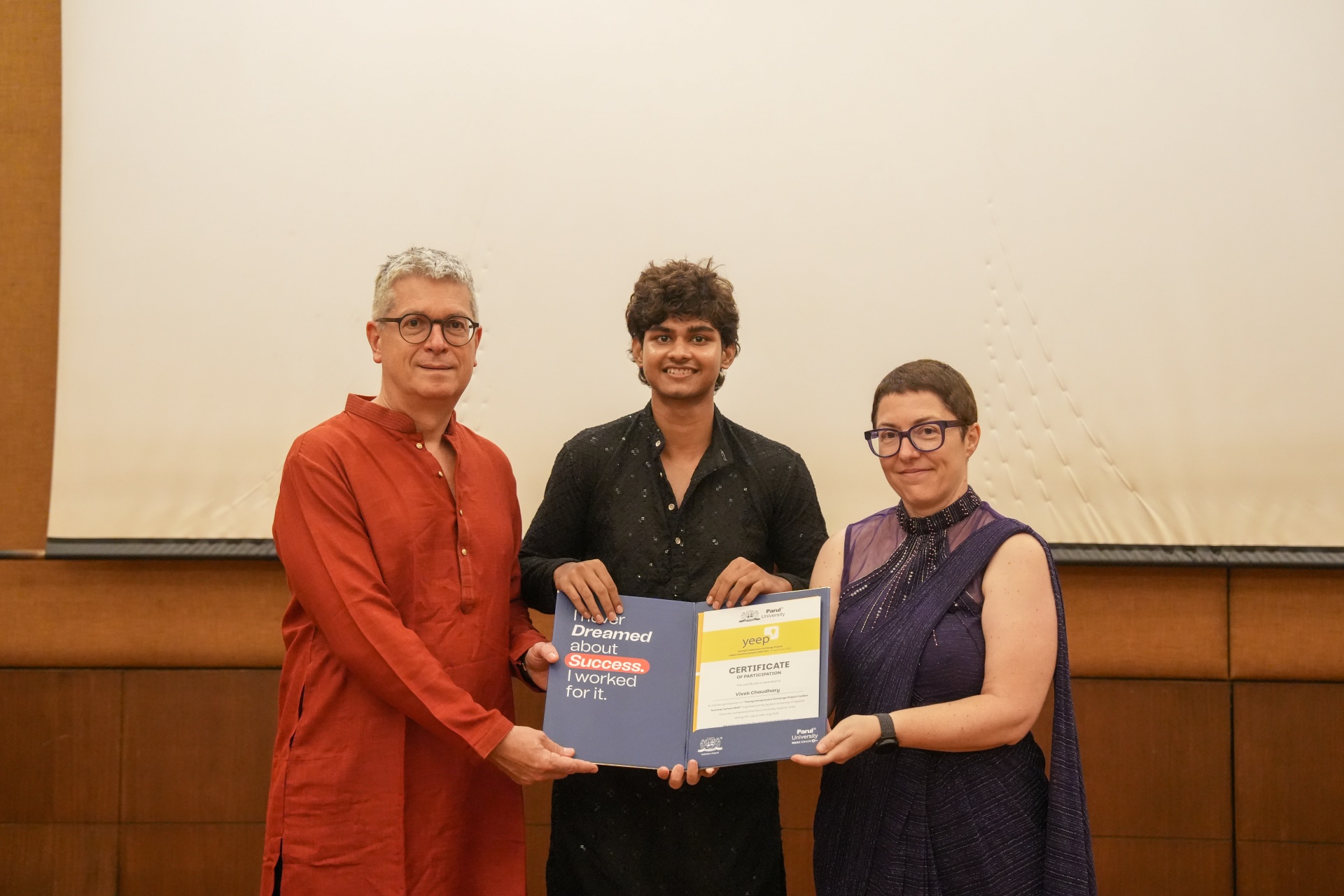
ZYNX was a genuinely international team, exactly the kind YEEP is built to create. It brought together two Parul University students, Vedant Sharma and Vivek Chaudhary, and three students from Bern University of Applied Sciences, Switzerland, Fabienne Dominique Ruch, Erik Ramseier, and Nicole Gray. Indian market intuition met Swiss structure, and the combination proved potent. (Vivek, for what it is worth, had already shown his reflexes earlier in the programme, winning a fast-paced ice-breaker game on day one.)
The Problem: Athletes Lose More Than Water
The team started with a problem they understood from sport itself. When athletes sweat, they lose more than water; they lose crucial electrolytes, sodium, potassium, magnesium, and calcium, whose depletion causes muscle cramps, fatigue, and dry mouth. The catch is behavioural: right after intense exercise, people often feel neither hungry nor thirsty, so they do not replenish those minerals. And conventional sports drinks are inconvenient, they are bulky to carry, take time to consume, and can leave an athlete feeling full and heavy mid-game.
The Idea: Minerals You Can Chew
ZYNX’s answer was disarmingly simple: put the electrolytes in a chewing gum. Their pitch line captured it well.
Zynx is a chewing gum that puts minerals directly into your body quickly.
– Team ZYNX, YEEP 2026
The science was thought through. Sodium forms the base of the gum, managing fluid balance and hydration; potassium supports muscle movement and fights fatigue; magnesium aids muscle relaxation after exertion. The pitch to the athlete is convenient: no water needed, no heavy drinks to carry, no bloated feeling, and no need to leave the field. As the team put it, just pop one and keep playing.
Validation: From the Kitchen to the Chemistry Lab
This is where YEEP’s learn-by-doing method showed. Rather than assume, the team tested. Their first prototype was humble: one member melted ordinary gum in his home kitchen, mixed in salts, and tasted the result. Then, because this was a product people would ingest, they sought serious scientific counsel, visiting Parul University’s Faculties of Physiotherapy, Medicine, Homoeopathy, Biotechnology, Bioengineering, and Biochemistry to consult professors on the chemistry and safety of their formula.
The experts gave two warnings the team took seriously. First, a safety hazard: a player running and shouting in a fast sport could accidentally swallow the gum. Second, a research discipline: you cannot guess a formula for something people eat. As one professor advised, they would need to test many different quantities, 60 milligrams, 70, 80, to find what is both safe and effective. Real validation, in other words, meant lab work, not luck.
The Business Model
ZYNX had a grounded plan to earn its first rupee. They would produce an initial batch of 1,000 packs and sell them exactly where the need is sharpest, at sports grounds, gyms, and athletic clubs across the Parul University campus and Vadodara’s fitness hot spots. Their competitive edge was cost: the only comparable products, American brands such as Electrogum and Revgum, are expensive, while ZYNX would be made in India at a far lower cost. As they noted, no single brand in India was making electrolyte chewing gum, an open lane in a market crowded with powders and liquids. Their roadmap set the hardest task first: finalise a safe chemical formula, then test flavours, run a small pre-launch, and scale from there.
Surviving the Jury
A winning pitch is not one without hard questions; it is one that answers them well. The ZYNX team faced sharp challenges. One evaluator pressed the core logic: athletes lose water and electrolytes together, so why address only replenishment and not hydration? The team held its ground, explaining that ZYNX was not trying to replace water but to restore strength without the fullness a drink causes. Asked why gum beats a slow-release pill, they had a crisp answer: a pill can take around 40 minutes to act, too slow for fast-paced sport. The jury also coached them on storytelling, urging them to benchmark against familiar sports drinks rather than explain in the abstract, and on rigour, telling them to research food-licensing rules and study the economics of the American incumbents as proof of demand. It was a masterclass in taking feedback under pressure.
The Win
Team ZYNX was declared the winner of the YEEP 2026 pitch competition.
– YEEP 2026 final result
ZYNX won not because its idea was flawless, its formula was still unfinished, but because the team did the entrepreneurial work well: they found a real problem, tested their assumptions with actual experts, built a cost plan, and responded to criticism with clarity rather than defensiveness. That is exactly what YEEP, and PIERC, set out to teach. ZYNX is one of a wave of student ventures taking shape in Parul University’s startup ecosystem, and a reminder that a good idea plus honest testing can travel a long way in a short time.
Frequently Asked Questions
Who won YEEP 2026 at Parul University?
Team ZYNX won the YEEP 2026 pitch competition with an electrolyte-infused chewing gum for athletes. The team combined Parul University students Vedant Sharma and Vivek Chaudhary with Bern University students Fabienne Dominique Ruch, Erik Ramseier, and Nicole Gray.
What is the ZYNX startup idea?
ZYNX is an electrolyte-infused chewing gum designed for athletes. It delivers sodium, potassium, and magnesium quickly, without water, so athletes can replenish minerals lost through sweat, and avoid cramps and fatigue, without the inconvenience or fullness of a sports drink.
How did Team ZYNX validate its idea?
The team built a first prototype at home, then consulted professors across Parul University’s medicine, physiotherapy, biotechnology, and biochemistry faculties on the formula’s chemistry and safety. Experts advised rigorous quantity testing and flagged safety concerns, turning a rough idea into a research-backed plan.
Why did ZYNX win the pitch competition?
ZYNX won by doing the core entrepreneurial work well: identifying a real problem, validating assumptions with genuine experts, building a cost go-to-market plan, and responding to tough jury questions with clarity rather than defensiveness, even though its formula was still being finalized.


