Here is how you can study this program

Diploma in Semiconductor Technology
Semiconductor technology is the backbone of modern electronics, driving innovations in computing, power systems, and communication. Power Semiconductor Devices focus on high-efficiency switching components essential for power electronics applications. VLSI for Computer Arithmetic explores the design of optimized arithmetic circuits used in processors and digital signal processing. VLSI Design covers Integrated Circuit (IC) design, fabrication, and System-on-Chip (SoC) integration. Analog CMOS VLSI Design emphasizes low-power analog circuits for mixed-signal applications, Introduction to Semiconductor provides fundamental knowledge of semiconductor physics and device operation. Digital Electronics delves into logic circuits, sequential design, and FPGA-based systems. Semiconductor Device Fabrication introduces key manufacturing processes like wafer processing, lithography, and doping. Optoelectronic Devices study light-emitting and sensing components used in communication and imaging technologies. Semiconductor Packaging and Testing ensures the reliability of integrated circuits through advanced packaging techniques and quality control methods. These subjects equip students with the essential skills required for careers in semiconductor design, fabrication, and testing, Shaping the future of electronic technology.
Secure your place
12th August 2026
Applicable deadline
12th August 2026
Batch Commencing
8th July Onwards
Duration
1 year
Credits
180
Seats
60
Fee
₹ 25,000/-
Language
English
Eligibility Criteria
Candidates must have passed their 10+2 (or equivalent) examination from a recognized board.
*Tuition Fees may vary depending on the Country/State in which the candidate has passed their qualifying examination.
Why study this program
Be a part of a engaging learning atmosphere that gives you the tools to excel in the career of your choice.
Explain principles and techniques involved in designing, simulating, and testing both analog and digital semiconductor-based circuits, including their components and functionalities,
Describe the key concepts and processes in the design, simulation, and testing of analog and digital semiconductor circuits, recognizing interaction between their components to achieve desired circuit behavior.
Relate the operation and characteristics of semiconductor devices such as diodes, transistors, and MOSFETs, focusing on their behavior, applications, and performance under varying conditions.
Retrieve various testing techniques, such as I-V characterization and failure analysis, used to evaluate the performance and reliability of semiconductor devices.
Examine the key operating principles and characteristics of semiconductor devices, including diodes, transistors, and MOSFETs, and evaluate their performance in different electronic circuits and systems.

What you can become after studying this program?

Semiconductor Design Engineer
VLSI Design Engineer
Process Engineer
Semiconductor Test Engineer
Packaging Engineering
Semiconductor Engineer
Here is the Important Information you need to Know
Find out if this is the right course for you.
Find out if this is the right course for you.

Download Curriculum
Explore the detailed course structure, subjects, and learning methodologies.

Launch your career with our leading placements
We provide you with leading placement opportunities before you graduate, with the best career training and an exposure to leading recruiters.
4-6 LPA
Average Package
2,200+
Recruiters
60* LPA
Highest Package Offered

Give your future career a head start
Stay Up to Date with latest Trends
How Do Diploma Engineering Students Prepare for Careers in Modern Industries?
Diploma students become industry-ready by combining practical engineering knowledge with digital tools, safety awareness, communication and regular workplace exposure.


Technical Interview Questions for Freshers: What Actually Gets Asked, from a Parul University Graduate’s Ninety-Minute Interview
A project presentation that turned into a ninety-minute technical interview with no warning. SQL joins, object-oriented principles, Docker, git fetch versus pull, and a debugging question that wanted a method rather than a definition. Here is what was asked and how to be ready for it.
Java Backend Developer Roadmap: What to Learn and in What Order, from a Parul University Graduate Who Used It
Most backend roadmaps are lists of technologies. The useful part is the order, and the decision underneath it: stop sampling everything, pick one stack, and learn it by building rather than watching. That is what took one student from scattered first-year exploration to a software developer offer.
Getting Hired Through a Hackathon: How Rapolu Venkatesh Satyanarayana Turned an Odoo Competition Into a Job Offer at Parul University
Ten to twelve interviews, several rejections, no offer. Then a hackathon he entered alone, an ERP system he had never built before, and a presentation that turned without warning into a ninety-minute technical interview. The offer came through the route he was not looking at.
From Diploma to Degree: Choosing the Right Engineering Path for Your Career
A diploma offers an early start in practical engineering, while a degree can later deepen technical knowledge and open wider career options.
How Coding, Design, and Hardware Come Together to Build Complete Engineering Solutions
Complete engineering solutions are built when coding controls the system, electronics connect its parts, and mechanical design gives it a useful physical form.

The AI Tools Every Engineering Student Should Learn Before Graduation
Engineering students should learn AI tools for studying, coding, data analysis and simulation, but must always check the output using their own technical knowledge.
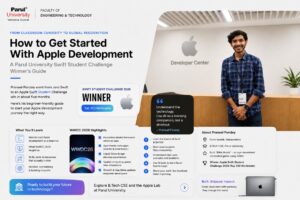
How to Get Started With Apple Development: A Parul University Swift Student Challenge Winner’s Guide
Praneel Pandey went from zero Swift to an Apple Swift Student Challenge win in about five months. Now a student lead of the Swift Coding Club at Parul University, he guides with how to start learning, what to learn, in what order and what WWDC 2026 signalled about where building for Apple is heading.
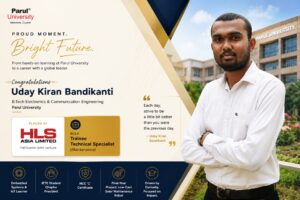
Uday Kiran Bandikanti: A Parul University ECE Placement, From an Electronics Curiosity to HLS Asia Limited
Uday Kiran Bandikanti wanted to know how electronics worked, not just how to use it. That curiosity carried him through a B.Tech in Electronics and Communication Engineering at Parul University and into a full-time role at HLS Asia Limited, a Halliburton joint venture, converted from his internship.
Dr Sanjiv Kumar Mishra of Sea Pearl Biotech Delivers Industry Session at MNRDC Parul University on Blue-Green Innovation in Algal Manufacturing for Health, Nutrition, and Sustainability: From Spirulina’s Resource Efficiency Advantage at 10 Times Less Land Water and Energy Through the Global Market at 65,000 Tonnes Annual Production and 5 Billion Dollar Five-Year Projection to India’s 2,000 Tonne Position, Sea Pearl Biotech’s Pond-to-Powder Turnkey Approach, and Emerging Spirulina Applications Across Anganwadis, Indian Poultry, and Hydroponics
Dr Sanjiv Kumar Mishra, the Director of Sea Pearl Biotech, attended a 3-day workshop on Microbial Cell Factories at MNRDC, Parul University. As held on 13th June 2026, he spoke on Spirulina’s nutritional & resource-based profile, how the global market is positioned at 65,000 tonnes, and Sea Pearl Biotech’s pond-to-powder approach and applications.
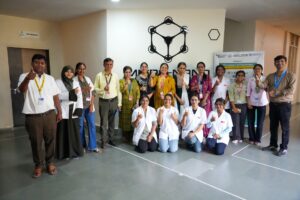
Meet Dr Puja Sandhbor from Tata Memorial Centre ACTREC, she visited MNRDC at Parul University for delivering an expert session on Emerging Applications of Nanomedicine and Biopolymers in Precision Cancer Challenge of Tumor Heterogeneity & ABC Transporter Drug. She even explained 2 success stories.
Meet Dr Puja Sandhbor from Tata Memorial Centre ACTREC, she visited MNRDC at Parul University for a 3-day workshop on Microbial Cell Factories. On the 2nd Day, the session covered how nanomedicine and biopolymers in precision cancer therapy works at all levels. Read the entire coverage on liposomal DOXIL, mRNA COVID vaccines, glioblastoma research, biopolymeric hydrogels, and translation pipeline of bench to bed!
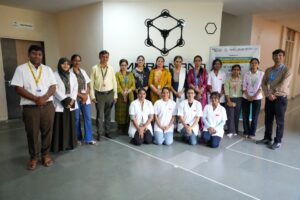
MNRDC of Parul University takes a sheer pride in hosting a workshop on Microalgae Cultivation. 3 days of non-stop hands-on experiential learning with BG-11 media preparation, chlorella vulgaris, chlorella minutissima cultivation via autotrophic heterotrophic and mixotrophic modes and the research list is endless.
Read ahead a detailed coverage on how a 3-day workshop on Microalgae Cultivation went. As exclusively hosted by MNRDC of Parul University on 11th to 13th June 2026, Dr Anwesha explained to students via BG-11 media preparation, chlorella vulgaris and chlorella minutissima cultivation across all the modes.
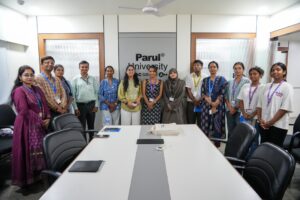
MIC Antimicrobial Assay Workshop was hosted by the MNRDC of Parul University and PIAS -during 3 constant days of hands-on testing, experimenting and gaining new knowledge. From 96-well plate two-fold serial dilution, Mueller-Hinton broth preparation, UV-Vis spectrophotometric analysis to the percentage of inhibition calculation, read ahead for the full coverage!
MIC (Minimum Inhibitory Concentration) Antimicrobial Assay Workshop at MNRDC Parul University, 11-13 June 2026: Dr Juhi Saxena led students through Mueller Hinton broth preparation, 96-well plate two-fold serial dilution from 32 to 0.0625 micrograms per ml of Cefixime and Azithromycin, inoculation with E. coli and S. aureus, 18-24 hour incubation at 37 degrees Celsius, UV-Vis spectrophotometric OD measurement, and percentage inhibition calculation.
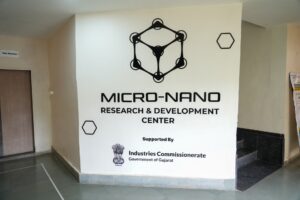
MNRDC at Parul University Delivers Three-Day Hands-On Workshop on Microbial Cell Factories From Lab to Public Health Solutions: MIC Antimicrobial Assay With Cefixime and Azithromycin, Microalgae Cultivation From BG-11 Media to Bligh and Dyer Lipid Extraction, Expert Sessions From Dr Puja Sandhbor of Tata Memorial ACTREC on Nanomedicine in Cancer Therapy and Dr Sanjiv Kumar Mishra of Sea Pearl Biotech on Spirulina Manufacturing
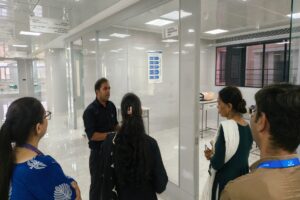
Micro Nano Research and Development Centre (MNRDC) at Parul University conducted a three-day hands-on workshop on Microbial Cell Factories from 11 to 13 June 2026 in collaboration with Shri B V Patel Education Trust. Led by Dr Juhi Saxena and Dr Anwesha, the workshop covered MIC antimicrobial assays, Chlorella microalgae cultivation, lipid extraction, and expert sessions from Tata Memorial ACTREC and Sea Pearl Biotech.
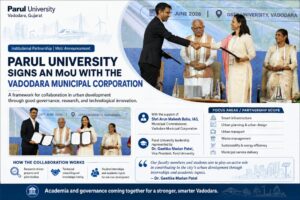
Parul University Signs an MoU with the Vadodara Municipal Corporation for Urban Development!
Parul University has signed an MoU with the Vadodara Municipal Corporation to support the city’s development, spanning smart infrastructure, urban planning, sustainability and municipal services, and bringing the University’s faculty and students into real civic projects across Vadodara


