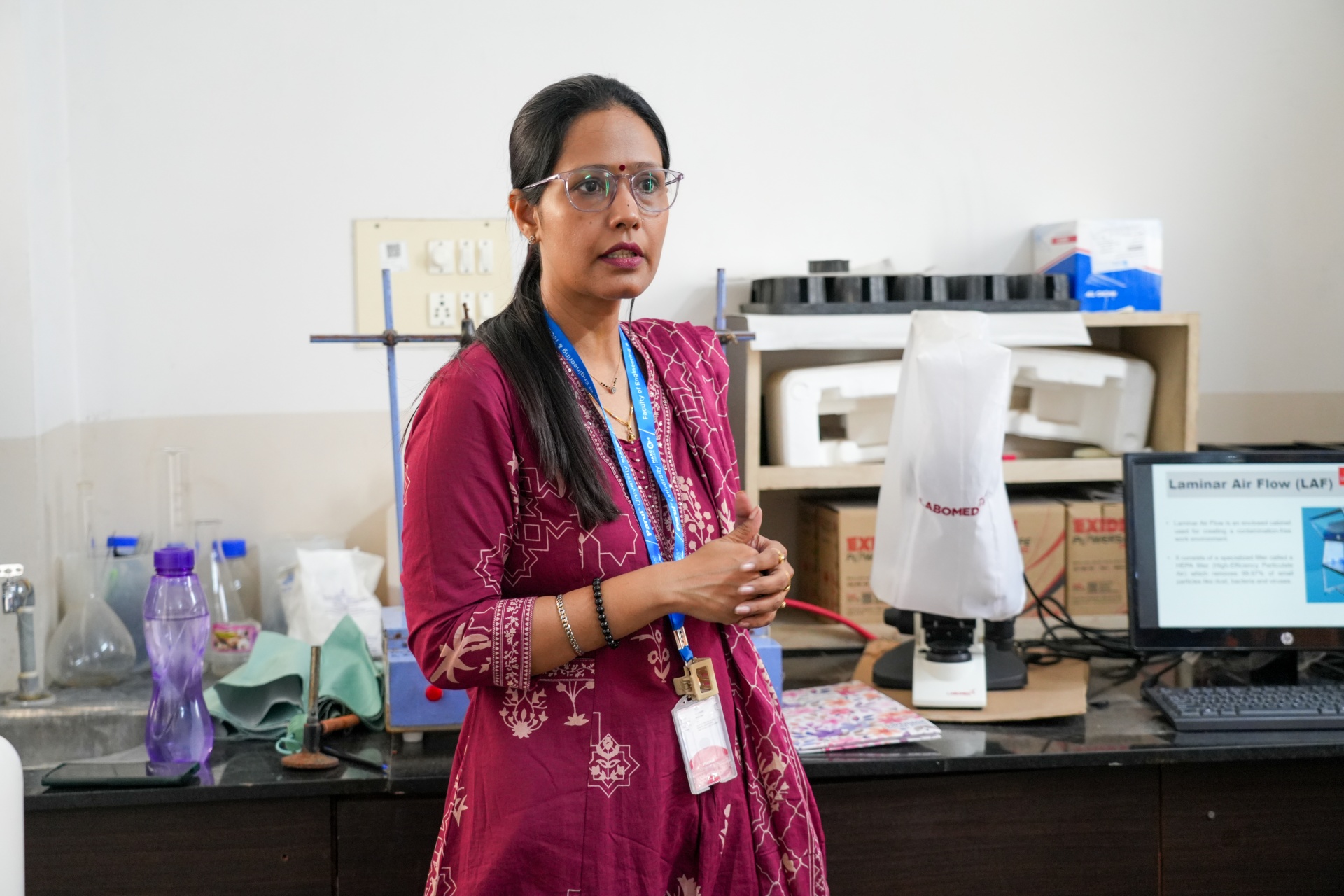
The Micro Nano Research and Development Centre (MNRDC) at Parul University conducted a three-day hands-on workshop on Microbial Cell Factories: From Lab to Public Health Solutions from 11 to 13 June 2026. The workshop was sponsored by Shri B V Patel Education Trust. Across the three days, participants engaged in two parallel technical tracks: a Minimum Inhibitory Concentration (MIC) Antimicrobial Assay track led by Dr. Juhi Saxena, Associate Professor in the Department of Biotechnology, and a Microalgae Cultivation and Downstream Processing track led by Dr. Anwesha. The programme also featured two expert lectures by Dr. Puja Sandbhor, DST INSPIRE Faculty at Tata Memorial Centre ACTREC, on nanomedicine in precision cancer therapy, and Dr. Sanjiv Kumar Mishra, Director of Sea Pearl Biotech, on algal manufacturing for health, nutrition, and sustainability.
The workshop formed part of Parul University’s broader research ecosystem, bringing together the Micro Nano Research and Development Centre, the Department of Biotechnology, and the Faculty of Engineering and Technology. Dr. Juhi Saxena is among Parul University’s faculty members recognised in the Stanford-Elsevier Global Top 2% Scientists list, reflecting the university’s growing research profile in biotechnology and applied sciences.
Detailed coverage of the workshop’s individual components is available in the articles on the MIC Antimicrobial Assay workshop, the Microalgae Cultivation and Downstream Processing workshop, and the two expert sessions at the Tata Memorial ACTREC nanomedicine session, and the Sea Pearl Biotech Spirulina session coverage.
The Micro Nano Research and Development Centre (MNRDC) and the workshop format
The Micro Nano Research and Development Centre (MNRDC) at Parul University houses advanced characterisation facilities for nanoscience and materials research alongside biotechnology laboratory infrastructure. The Centre’s equipment supports research across pharmaceutical sciences, biotechnology, environmental science, materials engineering, and applied chemistry. Research activities conducted by the Department of Biotechnology within the Faculty of Engineering and Technology intersect with MNRDC infrastructure in areas such as drug delivery, microbial cell factories, biofuel research, and antimicrobial development.
Sponsored by Shri B V Patel Education Trust, the three-day hands-on workshop, Microbial Cell Factories: From Lab to Public Health Solutions, was designed to bridge theoretical concepts with practical laboratory training. Students from the Faculty of Medicine, Faculty of Pharmacy, the B.Tech Biotechnology programme, and other disciplines participated in the workshop. The programme introduced participants to the research framework of microbial cell factories, exploring how microorganisms can be engineered to produce biopolymers, biofuels, nutraceuticals, pharmaceuticals, and other high-value biomolecules.
- Workshop dates and venue: The workshop was conducted on 11, 12, and 13 June 2026. The MIC Antimicrobial Assay track was held in the PIAS Third Floor Forensic Chemistry Laboratory, while the Microalgae Cultivation track was conducted in the MNRDC laboratories using the V-770 spectrophotometer and centrifuge facilities.
- Batch structure: Participants were divided into multiple batches to ensure effective hands-on learning and avoid overcrowding in the laboratories. Practical sessions were conducted in scheduled time slots across all three days.
- Sponsorship: The workshop was sponsored by Shri B V Patel Education Trust, which supports educational and research initiatives in higher education institutions.
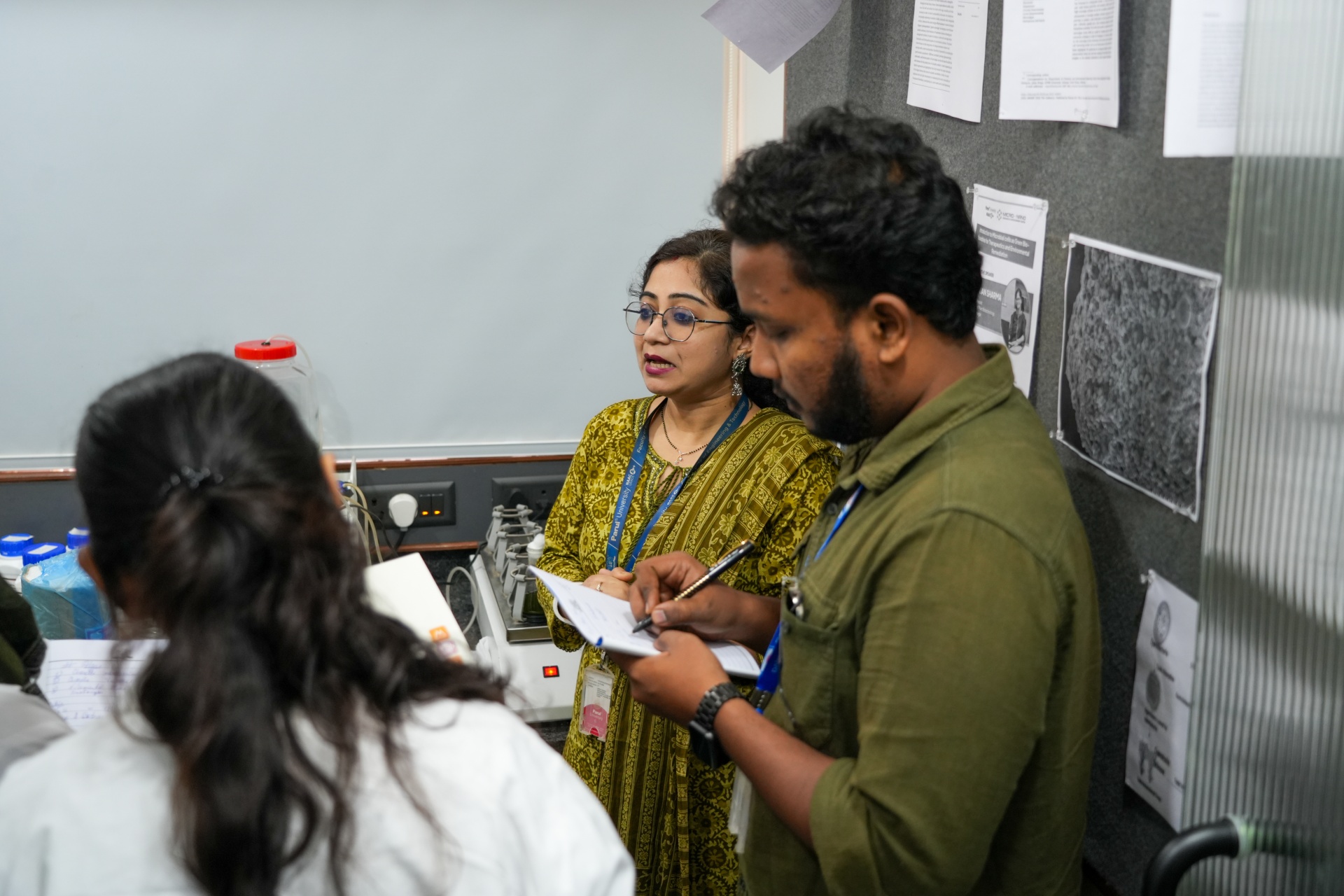
- Faculty leadership: Dr. Juhi Saxena, Associate Professor in the Department of Biotechnology, led the MIC Antimicrobial Assay track. Dr. Anwesha coordinated the Microalgae Cultivation track, while Mohit Sir conducted the Day 2 training session on operating the V-770 spectrophotometer.
Day 1: MIC assay foundation, microalgae media preparation, and the microbial growth curve
Day 1 introduced participants to the fundamental laboratory protocols for both technical tracks. In the MIC Antimicrobial Assay track, students prepared Mueller Hinton broth, learned autoclave sterilisation procedures, practised sterile handling inside a Laminar Air Flow (LAF) cabinet, and carried out the inoculation of E. coli into the prepared medium. The session guided participants through the complete sterile workflow, from media preparation and cotton-plug sterilisation to inoculation using a 100 µL micropipette, reinforcing the precision required for reproducible antimicrobial testing.
The Microalgae Cultivation track introduced participants to the preparation of BG-11 (Blue-Green 11) medium for cultivating cyanobacteria and microalgae. Students prepared the medium by dissolving 0.9762 grams of BG-11 powder in 600 ml of distilled water, following the standard concentration of 1.627 grams per litre. The session also explained three cultivation strategies: autotrophy, where algae grow using light and atmospheric carbon dioxide; heterotrophy, where organic carbon sources such as glucose, glycerol, or starch support growth in darkness; and mixotrophy, which combines both approaches.
Participants were introduced to the microbial growth curve comprising the lag, log, stationary, and death phases. The stationary phase was highlighted as the preferred stage for harvesting microalgae for lipid extraction because nutrient limitation during this phase encourages cells to accumulate energy-rich lipid droplets.
- Chlorella species cultivated: Students worked with Chlorella minutissima and Chlorella vulgaris, two species widely used in industrial biotechnology. Chlorella vulgaris is particularly recognised for pigment production and research involving Multi-Walled Carbon Nanotubes (MWCNTs) for advanced material applications.
- Inoculation precision: Each culture was prepared by adding 5 ml of live algal culture to 50 ml of BG-11 medium, maintaining a 1:10 inoculation ratio. Participants monitored culture growth by measuring Optical Density (OD) at 685 nm using a spectrophotometer at regular intervals over a 24-hour period.
- Solid media plating: Students prepared four Petri plates containing 2–3% agar and practised streak plating techniques to isolate individual microbial colonies for subsequent laboratory analysis.
Day 2: Antibiotic serial dilution, pigment extraction, and the V-770 spectrophotometer
Day 2 extended both technical tracks into quantitative laboratory analysis. In the MIC Antimicrobial Assay track, participants learned antibiotic serial dilution using sterile 96-well microplates. Students prepared a two-fold serial dilution series for Cefixime and Azithromycin against E. coli and Staphylococcus aureus, with concentrations decreasing sequentially from 32 µg/ml to 16, 8, 4, 2, 1, 0.5, 0.25, 0.125, and 0.0625 µg/ml. Each plate also included Growth Control and Sterility Control wells before incubation at 37 °C for 18–24 hours.
The Microalgae Cultivation track progressed to quantitative pigment analysis using the V-770 spectrophotometer. Mohit Sir conducted the instrument operation and calibration session, with measurements performed across a wavelength range of 300–800 nm. Chlorophyll A and Chlorophyll B were analysed around 665 nm, while carotenoid pigments were measured at approximately 470 nm. Participants compared optical density readings from five experimental conditions: Control, Mixotrophic Glucose (MG), Heterotrophic Glucose (HG), Mixotrophic Sucrose (MS), and Heterotrophic Sucrose (HS). Among these, the Mixotrophic Sucrose condition produced the highest absorbance values, recording 0.847194 at 665 nm and 0.833241 at 470 nm, indicating that sucrose supported greater pigment production under combined light and organic carbon conditions.
Day 2 also featured an expert lecture by Dr. Puja Sandhbor, DST INSPIRE Faculty at Tata Memorial Centre ACTREC, titled Emerging Applications of Nanomedicine and Biopolymers in Precision Cancer Therapy. The session connected the workshop’s laboratory exercises with clinical applications by demonstrating how nanotechnology-based drug delivery systems, including liposomes, polymeric nanoparticles, and biopolymeric hydrogels, are being developed to improve targeted therapies for diseases such as glioblastoma and breast cancer.
Day 3: MIC observation and analysis, lipid extraction, and the Spirulina industry session
Day 3 concluded both technical tracks with experimental analysis and interpretation of results. In the MIC Antimicrobial Assay track, participants examined the incubated 96-well plates to identify the lowest antibiotic concentration that prevented visible bacterial growth. Students measured optical density using UV-Vis spectrophotometry and applied the Beer-Lambert law to calculate percentage growth and percentage inhibition for E. coli and Staphylococcus aureus treated with Cefixime and Azithromycin. The Minimum Inhibitory Concentration (MIC) was identified as the lowest antibiotic concentration that successfully inhibited visible microbial growth.
The Microalgae Cultivation track concluded with the Bligh and Dyer lipid extraction protocol, a widely recognised method for extracting total lipids from biological samples. Participants prepared a methanol and chloroform working solution in a 2:1 ratio, mixed 20 ml of the solvent with 2 grams of harvested algal biomass, and performed centrifugation at 6,000 rpm for 10 minutes. A biphasic separation was then achieved using water and ethanol in a separating funnel, producing a lower chloroform layer containing lipids and chlorophyll, while the upper aqueous phase was discarded. The extracted sample was analysed using the V-770 spectrophotometer at 554 nm, producing an optical density reading of 0.2697.
The final day also featured an industry lecture by Dr. Sanjiv Kumar Mishra, Director of Sea Pearl Biotech, Ahmedabad, titled Blue-Green Innovation: Algal Manufacturing for Health, Nutrition, and Sustainability. The session placed the workshop’s laboratory techniques within the context of the global Spirulina industry. Dr. Mishra discussed the current production landscape, noting an estimated global output of approximately 65,000 tonnes annually, with China contributing around 90% of production. India currently produces about 2,000 tonnes per year, representing only a small share of global demand, while the worldwide Spirulina market is projected to expand significantly over the coming five years.
Translational research bridge: from microbial cell factories to clinical applications
The workshop curriculum was designed around a translational research pipeline that connected laboratory techniques with real-world healthcare and industrial applications. The upstream phase focused on microbial cultivation through media preparation, inoculation, aseptic techniques, and growth monitoring. The midstream phase introduced metabolite production by exploring different trophic cultivation modes, pigment extraction, and lipid accumulation under nutrient stress. The downstream phase centred on analytical techniques, including spectrophotometric quantification, biphasic solvent separation, and the calculation of antimicrobial inhibition using quantitative laboratory methods.
The two expert lectures extended this research pipeline beyond the laboratory. Dr. Puja Sandhbor demonstrated how nanoparticles, biopolymers, and biological materials similar to those explored during the workshop are applied in precision cancer therapy through targeted drug delivery systems. Dr. Sanjiv Kumar Mishra illustrated how laboratory-scale microalgae cultivation can be translated into industrial Spirulina production for applications in nutrition, pharmaceuticals, natural food colourants, animal feed, and aquaculture.
The Times Higher Education Sustainability Impact Ratings 2026 recognise Parul University among the Top 10 institutions in India for SDG 3 (Good Health and Well-Being). Research and training initiatives such as this workshop, which focus on antimicrobial development, nanomedicine for cancer therapy, and microalgae-based health applications, directly support the objectives measured under SDG 3. The university is also ranked 7th in India and joint 46th worldwide for SDG 4 (Quality Education), with a Quality Education score of 81.1, reflecting its emphasis on experiential learning through hands-on research and laboratory training.
Research infrastructure that supported the workshop
The workshop was supported by Parul University’s wider research and healthcare ecosystem. The university’s network of seven NABH-accredited hospitals, including the Parul Sevashram Hospital with more than 750 beds, provides a clinical environment that complements research in antimicrobial development, nanomedicine, and translational healthcare. The university’s NABL-accredited clinical research laboratory further supports quantitative biological testing and analytical research.
Spread across a 250-acre campus, Parul University houses more than 250 technology laboratories, with the Micro Nano Research and Development Centre (MNRDC) providing advanced characterisation facilities for nanoscience, biotechnology, and materials research. Among the university’s faculty recognised in the Stanford-Elsevier Global Top 2% Scientists list are Dr. Juhi Saxena, who led the MIC Antimicrobial Assay track, and Dr. Bhupendra Gopalbhai Prajapati from the Faculty of Pharmacy (h-index 34), whose research in pharmacology and oncology aligns with the precision cancer therapy themes discussed during Dr. Puja Sandbhor’s expert session.
Parul University’s research ecosystem is supported by more than Rs. 58.31 crore in government-funded research projects and Rs. 4.37 crore in privately funded research across 315 funded projects. Its Research and Development Centre is recognised by the Department of Scientific and Industrial Research (DSIR) as a Scientific and Industrial Research Organisation (SIRO). The university also maintains a Springer Nature Licence Agreement that supports open-access publication of research outputs, with Article Processing Charges funded by the institution, enabling researchers to disseminate findings from projects such as those explored during the workshop.
FAQs
Define the coreness of MNRDC’s 3-day workshop on Microbial Cell Factories?
This 3-day hands-on workshop was based on Microbial Cell Factories, hosted by Parul University. As conducted from 11 to 13th June 2026 by the MNRDC in collaboration with Shri B V Patel Education Trust, this exclusive workshop ran in two ways. The very first was a minimum inhibitory concentration known as MIC, which was led by Dr Juhi Saxena, and another one was a Microalgae Cultivation & Downstream Processing track, which was led by Dr Anwesha. Besides this, two expert sessions were taken by Dr Puja Sandhbor from Tata Memorial Centre ACTREC and by Dr Sanjiv Kumar Mishra!
Who led the MNRDC Microbial Cell Factories workshop at Parul University?
Dr Juhi Saxena is an Associate Professor in the Department of Biotechnology at the Faculty of Engineering & Technology at Parul University. She spoke on the MIC and Antimicrobial Assay Track; she was among the top 7 faculty members who were listed in Stanford-Elsevier’s global top 2% of scientists, with an accreditation of an h-index of 18 & i10-index of 29 across general clinical medicine. Besides this, Dr Anwesha even led the microalgae cultivation & downstream processing session wherein she guided students via BG-11 preparation, Chlorella cultivation, end to end pigment analysis, and lipid extraction. The most impactful part was Mohit Sir delivered an operations training on V-770 spectrophotometer wherein two speakers even contributed - Dr Puja Sandhbor & Dr Sanjiv Kumar Mishra.
What is MNRDC at Parul University?
The Micro Nano Research and Development Centre (MNRDC) is the dedicated nanoscience and materials research infrastructure at Parul University. The Centre houses advanced characterisation equipment including scanning electron microscopy, atomic force microscopy, X-ray diffraction (Bruker D6 PHASER), V-770 UV-visible-NIR spectrophotometer, centrifuge stations operating between 5000 and 6000 RPM, autoclaves, laminar airflow hoods, and the broader instrument suite supporting nanoscience and biotechnology research. MNRDC operates alongside the Department of Biotechnology at the Faculty of Engineering and Technology and the Faculty of Pharmacy, with research activities spanning drug delivery, microbial cell factories, biofuel research, antimicrobial development, and characterisation services. The Centre's research output contributes to the Rs 58.31 crore government-funded research portfolio and the 315 funded projects at Parul University. The R&D Centre at Parul University holds Department of Scientific and Industrial Research (DSIR) recognition under the Scientific and Industrial Research Organisation (SIRO) framework.