When comparing private universities in Gujarat, students and researchers typically evaluate programme offerings, fees, placement records, and campus facilities. What they rarely evaluate systematically but which determines actual research quality is the answer to one specific question: does this university have the instruments, the funded projects, and the faculty supervision capacity to support research that gets published in international journals and recognised by national funding agencies?
For materials science, nanotechnology, mechanical engineering, chemical engineering, and related fields, answering this question requires examining what instruments the university operates, whether those instruments are being used for funded research, and what the publication record from that research looks like. These are all verifiable facts.
The Funded Project Comparison — No Gujarat Private University Has This
No other private university in Gujarat simultaneously holds: an active project funded by ISRO India’s premier space research organisation; an active project funded by CSIR India’s largest R&D organisation, with 37 constituent laboratories and a national mandate for scientific and industrial research; and an active project funded by the Royal Academy of Engineering, United Kingdom one of the UK’s most prestigious scientific bodies, whose grants require peer reviewed evidence of research excellence.
Parul University holds all three. The ISRO project “Development and Characterisation of Processed Shape Memory Alloy Components for Space Applications” connects Parul University directly to India’s space technology pipeline. The CSIR project Metamaterial Based Massive MIMO Antenna Using Machine Learning for Beyond 5G positions the university in India’s 6G communications research. The
The Instrument Portfolio — Verifiable, Not Brochure-Listed
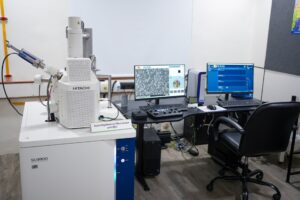
Gujarat’s private universities typically offer undergraduate and postgraduate teaching laboratories. Advanced research grade instruments SEM systems costing ₹12 crore, X Ray Diffractometers, Atomic Force Microscopes are rare in private university settings. The MNRDC at Parul University operates 10 such instruments, funded by ₹2.66 crore in Government of Gujarat grants: the Hitachi SU3800 SEM ₹1.9 crore, Japan, 897+ samples, Bruker D6 PHASER XRD ₹1.06 crore, Germany, 600+ samples, and Nanosurf Core AFM ₹76 lakh, Switzerland, 145+ samples as the flagship three, plus Pin on Disc Tribometer, LCR Meter, RF/DC Magnetron Sputtering System, Piezo based Dynamometer, CNC Micro Machine Tool, Stir Casting Machine, and Compression Molding Machine.
These instruments are not display pieces. At 897+ SEM samples and an average of 45 samples per day, the Hitachi SU3800 is producing research data at a rate comparable to national level testing facilities. At 60% repeat client rate across 15+ named industry partners including BDR Pharmaceuticals, AMI Lifesciences, Gujarat Metal Cast, and SEASHORE NANOTECH the MNRDC has demonstrated industry grade reliability that no brochure claim can substitute.
The Partnership Comparison - IIT + International
The Research & Development Cell holds a strategic research partnership with IIT Ropar (Indian Institute of Technology, Rupnagar) – enabling shared research resources and potential PhD co-supervision.
The Rankings — Verifiable, Multi-Framework
Parul University holds NAAC A++ fewer than 5% of NAAC accredited institutions hold A++ and holds QS Diamond Rating Gujarat’s first private university at this tier. In the Times Higher Education Interdisciplinary Science Rankings 2026 it is ranked 501600.
The Publication Record — Quality, Not Just Quantity
The MNRDC has enabled 14 research publications in under two years of full operation. The most significant “Vertically aligned NiFeP@Ni nanotubes for efficient electrochemical production of green hydrogen and sulfur” in Renewable Energy carries an Impact Factor of 9.1 and is ranked Q1 in its field. One Q1 publication in two years of operation, from a government funded private university research centre, is a research productivity metric that most established university research centres would be proud to claim. It also happens to be the most honest indicator available of what a PhD scholar can expect to achieve with MNRDC infrastructure and supervision.
The Honest Perspective
Parul University is not IISc, IIT Bombay, or IIT Madras. Total research output and citation counts are not comparable to India’s premier government funded research universities with decades of accumulated investment. The relevant comparison is within the specific segment of Gujarat private universities, where the question is: which private institution offers the best research infrastructure, supervision, and opportunity for externally recognised research output in materials science, nanotechnology, and engineering? The MNRDC’s verifiable track record funded projects, sample counts, publication record, industry partnerships, and rankings trajectory makes the case.
FAQ
Which is the best private university for research in Gujarat in 2026?
Based on verifiable research metrics — funded projects, instrument portfolio, publications, and rankings — Parul University is Gujarat's leading private university for research in 2026. Its MNRDC has enabled 14 publications including a Q1 Renewable Energy paper (Impact Factor 9.1).
Does Parul University have a research collaboration with IIT in 2026?
Yes. Parul University's RDC has a formalised strategic research partnership with IIT Ropar (Indian Institute of Technology, Rupnagar, Punjab), enabling shared research resources, faculty collaboration for publications, and potential PhD co-supervision. This is the only documented IIT-private university research partnership of this kind among Gujarat private universities.
What government-funded research projects does Parul University have?
Parul University's MNRDC holds three active externally funded research projects: ISRO-funded Shape Memory Alloy characterisation for space applications; CSIR-funded Metamaterial-Based Massive MIMO Antenna for Beyond 5G; and Royal Academy of Engineering UK-funded Green Hydrogen Production. Total government and international research funding: approximately ₹2.66 crore in Gujarat government grants (MNRDC + CoE) plus Royal Academy UK international funding.
How does Parul University compare to other private universities in Gujarat for engineering research?
Parul University differentiates on research infrastructure through the MNRDC's 10-instrument portfolio (₹2.66 crore government-funded), three active multi-agency funded projects (ISRO, CSIR, Royal Academy UK), 14 enabled publications including a Q1 paper, and 15+ industry clients with 60% repeat rate. Students should evaluate universities against their specific research interests and programme requirements; rankings and funded project portfolios provide the most honest basis for comparison.