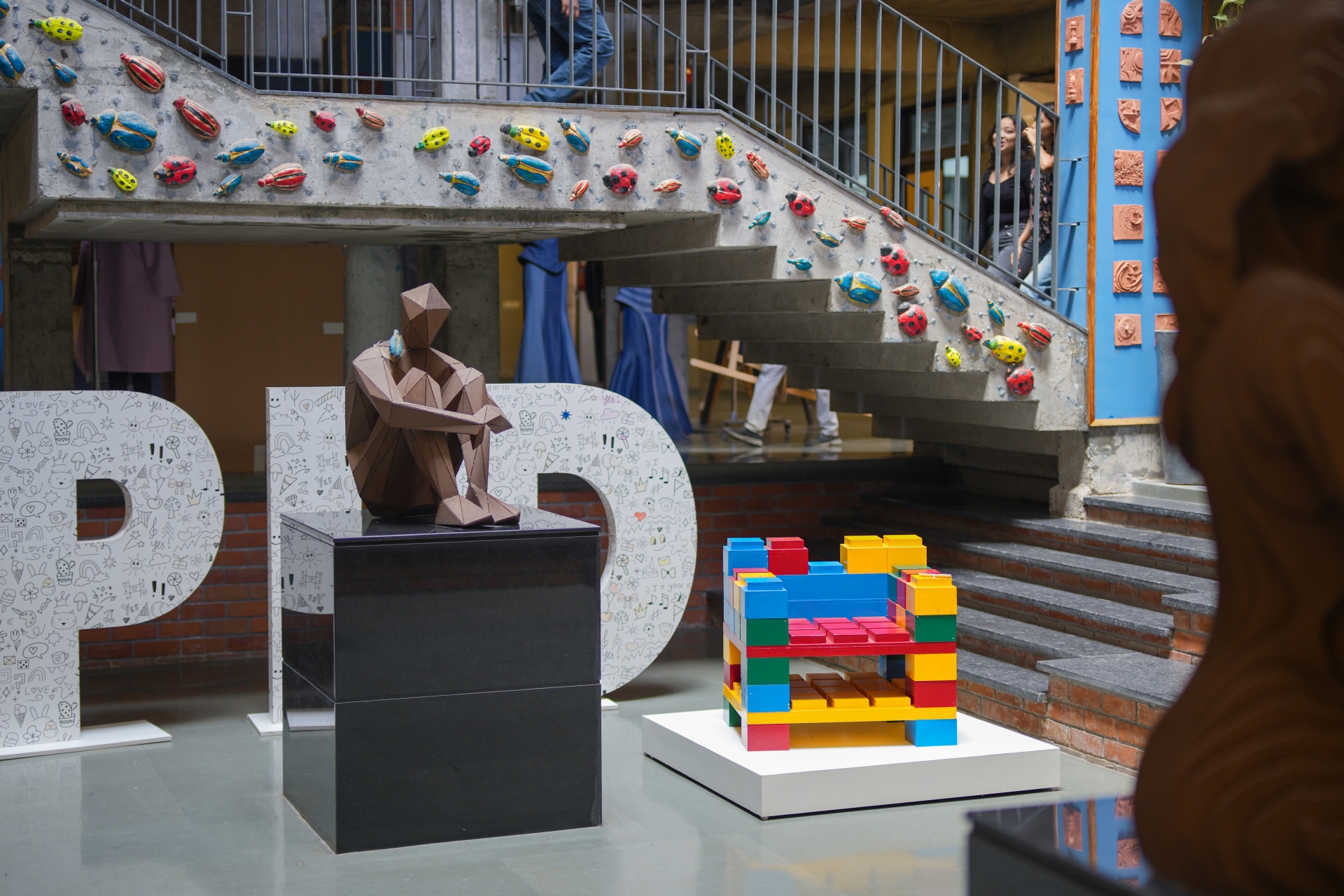
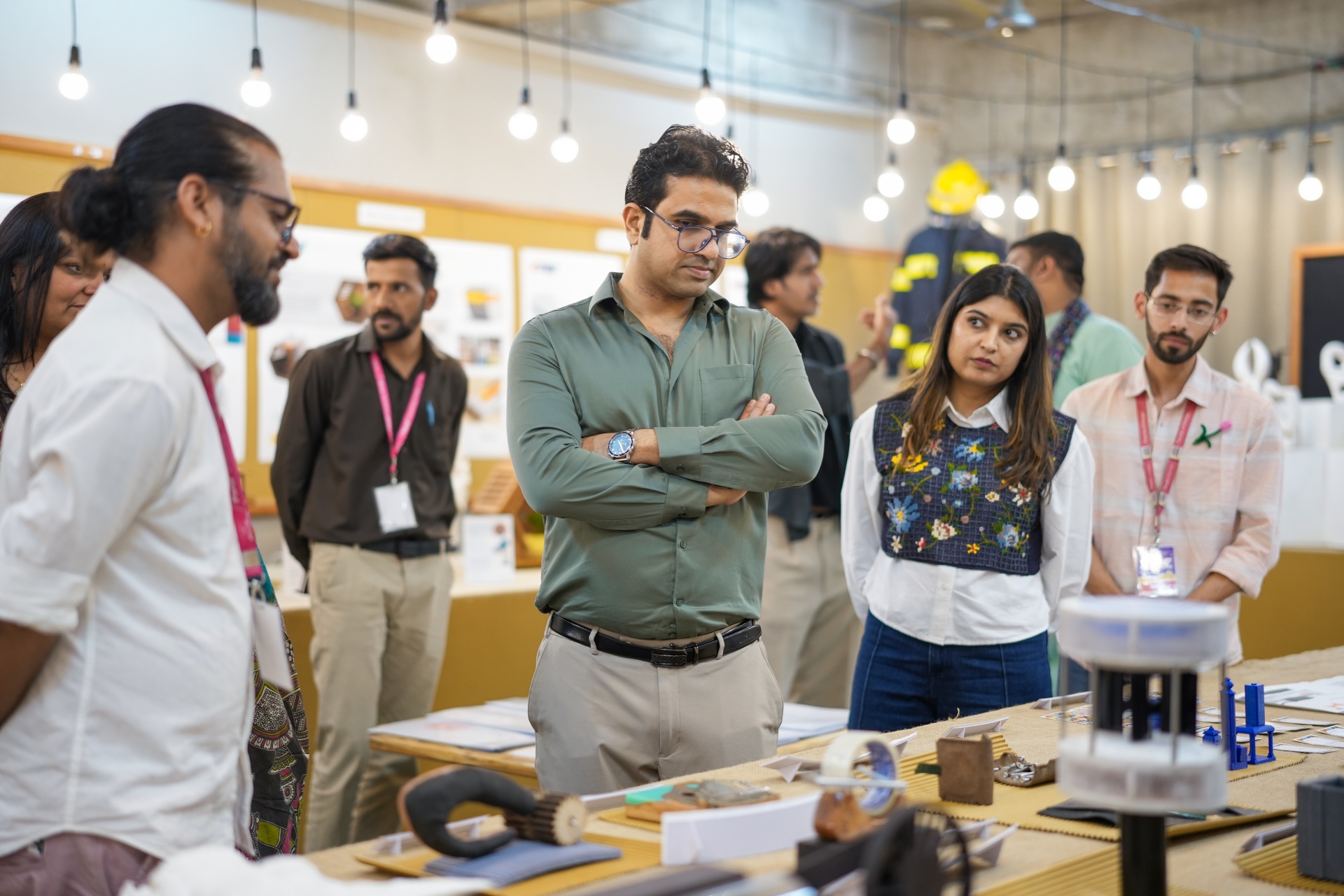
Visitors to the VFDF 4.0 student exhibition at Parul Institute of Design encountered the same tradition repeated across every department. Each student presenting their own work began by first introducing the thesis projects created by senior batches. Only after walking visitors through what the older students had built did they begin explaining their own semester projects.
It was a quiet hierarchy of respect that no faculty member appeared to enforce directly. Yet it shaped the tone of the entire exhibition. Spread across three buildings, the showcase brought together work from six departments at PID: Interior and Furniture Design, Product Design, Fashion Design and Technology, Communication Design, Animation and VFX, and Film and TV Production. Alongside the departmental exhibitions, more than fifteen student-led stalls operated as functioning design businesses throughout all four days of the festival.
What each department displayed revealed something larger about how the institute approaches design education, beginning with the installation that surprised almost every visitor who encountered it.
Interior and Furniture Design: The Sofa That Was a Swing
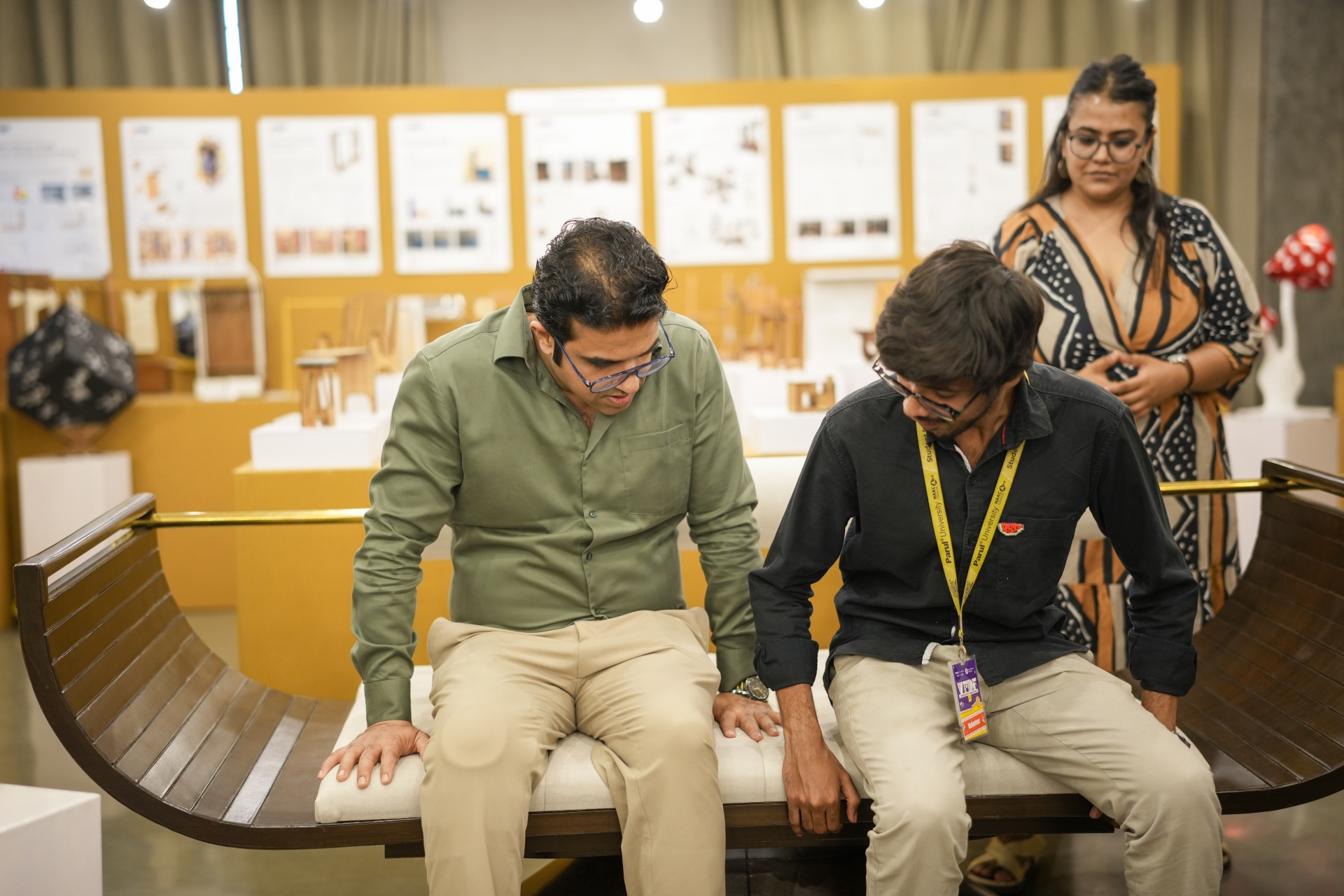
The Semester 5 interlocking-chair project included what initially appeared to be a standard full-size sofa. Visitors approached it expecting an ordinary seating experience. The moment they sat down, the furniture revealed itself as a swing.
The sofa had been engineered as a moving furniture system that gently rocked with the sitter’s weight. The surprise itself was part of the design logic. It was conceptualised by final-year students Samiksha Bijotkar and Kunal Vanzara and crafted in collaboration with artisans Yogesh Sahani, Bhavar Lal, and Pokhar Ram. A booklet accompanying the installation documented the designer-artisan process and concluded with a line that summarised the department’s approach to design education: design is not just what we create, but what you experience.
If you’re passionate about how physical spaces, furniture systems, and environments are conceptualised and built, enrol into PID’s B.Des. in Furniture and Interior Design program!
The department’s thesis and senior projects on display included:
- Anvesha Saini’s hostel interior-design thesis, focusing on circulation paths, room typologies, and shared community spaces
- Preet Soni’s Design Studio V project, a conceptual workspace exploring the dynamics of collaborative creative studios
- Janvi Jagada’s Paediatric Clinic (Infant and Child Care Unit), balancing clinical functionality with emotionally comfortable spaces for children and families
- Mrudula Satardekar’s Children’s Reformation Centre, integrating therapy spaces, recreational zones, and educational environments into a single rehabilitation-oriented design system
Semester 6 Bachelor of Design students also displayed furniture systems built entirely from single-material construction methods, including interlocking chairs, closets, tables, and modular kitchen racks. Semester 3 students showcased highly detailed dream-house models complete with miniature vases, curated bookshelves, and individually designed interior spaces.
The Bachelor of Design in Interior and Furniture Design programme approaches spatial planning, furniture engineering, material systems, and construction logic as interconnected parts of a single design discipline rather than isolated specialisations.
Product Design: Maker's Lab, the Kalimba, and the Droplet Project
The Product Design exhibition opened with something rarely seen inside an Indian design-school showcase: a Kalimba.
The African thumb piano, designed by student Sumit Bera using resin and wood, functioned simultaneously as a musical instrument and a product-design study in material behaviour. Playing it required no formal musical training. Designing and fabricating it, however, required an understanding of acoustic resonance, tine geometry, material density, and the relationship between instrument dimensions and sound vibration. The Kalimba sat beside subtractive POP carving exercises where students were asked to create abstract sculptural forms from a single plaster-of-Paris block using only removal processes, never addition.
The Maker’s Lab section, developed under the Innovation of Design initiative, highlighted the department’s applied-research orientation. The display focused less on decorative objects and more on systems thinking through everyday problem-solving.
Projects displayed inside Maker’s Lab included:
- Ovee Kelesar’s Trivet, a three-part kitchen heat pad designed from a single material system that expands outward to support larger utensils
- Palak Ajmere’s Lappy Desk, a dual-material laptop stand intended to improve posture while reducing direct heat and radiation exposure during prolonged usage
- The Droplet Project, a passive-irrigation planter system that repurposes used utensil water to support plant growth while reducing stagnant-water accumulation and mosquito breeding
- Snack Lock, a simple reusable locking mechanism designed to seal partially consumed snack packets and minimise food waste
- R’s Time, a combined watch-and-pen-holder fabricated entirely from a single aluminium sheet without additional material attachment
- A redesigned Door Stopper system relocated from floor level to a safer upper position to reduce accidental foot injuries for children and elderly users
Semester 4 Product Design student Siddharth Yavaley also demonstrated structural form studies using physical models explaining balance, geometry, and load distribution. His interest in Bachelor of Design in Product Design began much earlier in childhood after encountering a dog that had lost one of its legs. He attempted to build a prosthetic using whatever materials were available to him at the time. The device itself was imperfect, but the instinct behind it eventually became the reason he pursued product design education at PID.
Fashion Design and Technology: Pattachitra, Zero Waste, and Manaben
The Fashion Design exhibition moved along two parallel directions. One focused on bringing traditional Indian textile practices into contemporary garment design. The other explored zero-waste construction systems where garments were built with minimal cutting and material loss. Students worked closely with visiting artisan faculty member Manaben, whose sessions focused on traditional stitching methods and eco-printing techniques rooted in craft practices from rural India.
The Bachelor of Design in Fashion Design and Technology programme approaches Indian craft traditions not as museum references, but as living systems that can still shape modern fashion, textile innovation, and sustainable design practice.
Specific student projects on display included:
- Saloni’s Button Masala dress, constructed entirely through button-based assembly inspired by Anuj Sharma’s no-cut, no-stitch methodology. The garment was created through folding, draping, tucking, and fastening rather than conventional stitching.
- Iti Patel’s single-material denim outfit, demonstrating how one fabric system can generate an entire garment structure through efficient pattern cutting and assembly logic.
- Pattachitra-inspired textile products, translating the narrative-art traditions of Odisha and West Bengal into contemporary wearable and functional textile applications.
- Handmade thread paintings, including fully embroidered framed artworks produced for a literature festival within an intensive two-day production timeline.
- Sugarcane-based garment experiments, exploring biodegradable and unconventional materials within sustainable-fashion workflows.
Senior student collections by Punipreet Kaur, Kashish, and Aradhya were also displayed as part of the exhibition. Several of these collections had previously participated in and won awards at fashion showcases and modelling competitions.
Semester 4 student Ruchi Nathanjan, who guided visitors through the department, explained that her own interest in fashion design began at home while observing her mother, a tailor, work on garments. Her current design focus centres on preserving traditional textile and stitching techniques while adapting them into contemporary professional fashion contexts.
Communication Design: Typography, Motion Graphics, and Packaging That Earns a Second Life
The Communication Design exhibition was organised semester-by-semester, allowing visitors to see how the programme gradually moves students from foundational visual thinking into applied design systems and professional execution.
- Semester 2 students displayed brochure-design projects exploring quantitative and denotative communication principles alongside expressive typography exercises where emotion, tone, and meaning were conveyed entirely through typeface selection, spacing, hierarchy, and text arrangement.
- Semester 4 focused on Digital Hierarchy and Motion Graphics. Students recreated existing advertisements for brands such as Amazon, Discord, and Valorant while developing entirely original visual treatments, animation styles, and typography systems rather than simply copying the original campaigns.
- Semester 6 students presented Packaging Design projects, including one standout incense-stick packaging system engineered to transform into a functional holder after use. The packaging itself was designed as part of the product experience rather than disposable waste.
- Students also worked on Exhibition Space Design projects where they first visited real-world exhibition environments to study visitor movement, lighting, display logic, and execution before designing their own exhibition systems in rendered virtual spaces.
A separate publication-design track featured Magazine Design projects complete with editorial layouts, image systems, typography grids, and original written content. Students in the Communication Design programme also demonstrated projects in virtual streaming, motion design, and CGI workflows, including light matching in virtual environments and the use of virtual-production techniques in film and television pipelines.
Animation and VFX: The Stop-Motion Film That Made CUIFF 2025
The Animation and VFX department anchored its exhibition around two student films that demonstrated very different approaches to animation storytelling.
Aakhri Dor: The Last Thread, directed by Shubham D. Jaiswal, was a stop-motion experimental short centred on the Banarasi sari as both object and metaphor. The film treated the sari as the living voice of a fading textile tradition, turning fabric itself into a narrative character. It went on to win at a film festival, earned official selection at the CUIFF Film Festival 2025, and became a Semi-Finalist at the Cut-OK Short Film Festival 2025. Props and miniature production elements used in the film were physically displayed at the exhibition, allowing visitors to see the handcrafted process behind the final screen output.
The Bachelor of Science in Animation and VFX programme trains students across the complete animation pipeline, covering concept development, storyboarding, modelling, texturing, animation, compositing, and final visual output.
The second featured project, Akhabar Ek Baar Baar Baar, approached animation from a more experimental direction. Created by first-year students, the film combined stop-motion, 2D animation, and motion graphics to follow the journey of a newspaper as it passed through multiple hands across a single day. The project was nominated at the 24FPS International Animation Awards 2025 in the Experimental Studio category.
Additional department work included:
- Sailing to Unknown, a 3D animated short nominated at the 24FPS International Animation Awards 2025 in the Best Animated 2D/3D category
- VFX compositing demonstrations using professional node-graph workflows, integrating spaceship modelling, Earth textures, 2D character animation, and layered compositing systems
- Digital painting exhibits featuring student-created concept art, character-development studies, and environment-design work
Film and TV Production: The Student Short That Made Cannes
The Film and TV Production department centred its exhibition around a student film that achieved something very few Indian design-school productions manage to achieve.
The Fire Kept Its Promise, written and directed by Rohan Rajput and produced by Parul Institute of Design, was officially selected for the Short Film Corner at the Festival de Cannes, specifically under the Rendez-Vous Industry section. The film’s premise places two deeply embedded social realities (caste hierarchy and menstruation stigma) into direct collision inside a village setting. An upper-caste girl dies by suicide, but her cremation rituals are delayed because she was menstruating at the time of death.
What distinguished the project was not only the subject matter, but the scale of the student-led production structure behind it. The crew roster resembled that of an independent professional film production rather than a classroom exercise.
The production team included:
- DOP: Akash Tela and Abhi Sharma
- Editor: K.K. Thakkar
- Sound Design and Record Mix: Mudra Patel and Swayam Shah
- Colourist: Abhi Sharma
- Costume Design: Shreni Patel
- Executive Producer: Rocky Rathwa
- Line Producers: Raj Rathwa and Divyesh Rathwa
- Production Design and Art Direction: Sukhee, assisted by Vaishnavi Sahu and Saniya Memon
- Background Score and Music: Shivansh Tewari
The project was mentored by Rakesh Patra, Pritish Nayak, Sourav Panda, Sudhakar Vajjha, and Chaitanya Joshi. The Bachelor of Science in Film and TV Production programme trains students across the entire filmmaking pipeline, including screenwriting, cinematography, sound, editing, production design, colour grading, and post-production workflows through hands-on production environments.
A separate tribute installation inside the exhibition honoured the 101st birth anniversary of filmmaker Guru Dutt. Designed by students Anvi Narvakar and Tanvi, the installation recreated an immersive space featuring music from Guru Dutt’s films, archival behind-the-scenes imagery, and a mirror-based interactive photo setup. For animation and film students, the installation functioned as a practical introduction to Guru Dutt’s mastery of framing, lighting, and visual composition, techniques still considered among the most sophisticated in Indian cinema history.
Design in the Age of AI: four practitioners on homogeneity and specificity
Student-Run Stalls: 15+ Operating Businesses, Not Display Installations
Parallel to the main exhibition, more than fifteen student-led stalls operated as live businesses throughout the four-day duration of VFDF 4.0. These were not static showcase counters or simulated entrepreneurship exercises. Each stall functioned as a real commercial setup with pricing structures, product customisation systems, inventory handling, branding strategies, customer interaction, and order management operating in real time.
Students handled the entire business process themselves, from attracting visitors and explaining products to negotiating prices, managing sales, processing custom orders, and organising deliveries. Several teams also tracked demand patterns and customer responses across the festival period, effectively turning the exhibition into a live market-testing environment.
A partial list of the operating student businesses included:
- Maker’s Hub: Kintsugi-inspired restoration art and customised 3D-printed products, operated by Yajat Modi and Ritika Pawar (Product Design) alongside Vineeta Yadav (Fashion Design)
- Dhaga and Drip: handmade crochet and resin jewellery created by Aashika Jain (Fashion Design) together with Mitika Jain, Manya Garg, and Drishti Dhingra (Interior Design)
- Slayerz: custom 3D prints and lithophanes, light-reactive image sculptures that reveal visual details when illuminated, operated by Ishan Malhotra
- REALMS: an alumna-led jewellery and lifestyle label founded by Swati Prasad from M.Des Fashion Merchandising
- Additional student ventures included Lily’s Bloom, Elara Jewellery, Timtima Tarbooz, Qala, Aesthetic Hub, Funkit Up, JigTrip, Pocketful of Pixie, Little Frame Corner, and Milemist Jewel
What the structure demonstrated was not simply that students had creative hobbies outside coursework. It demonstrated that PID’s academic model allows students to actively run small-scale businesses while studying, supported by institutional infrastructure, mentorship access, exhibition spaces, and a built-in audience ecosystem through festivals like VFDF.
Several of these ventures continued operating online even after the exhibition concluded, turning what began as student-led festival stalls into ongoing independent design businesses.
Frequently Asked Questions
What is Parul Institute of Design known for?
Parul Institute of Design (PID) is the design faculty at Parul University, Vadodara. It offers bachelor's programmes in Product Design, Interior and Furniture Design, Fashion Design and Technology, Communication Design, and UX and Interaction Design with AI, along with B.Sc programmes in Animation and VFX and in Film and TV Production. PID hosts the annual Vadodara Film and Design Festival (VFDF), and its student short films have been selected for the Festival de Cannes Short Film Corner and CUIFF Film Festival.
Is Parul Institute of Design among the best design colleges in India?
Parul Institute of Design sits among Indian design institutes whose student work competes at international festival level. In 2025-26, PID student short film The Fire Kept Its Promise was selected for the Festival de Cannes Short Film Corner, and Aakhri Dor: The Last Thread was officially selected for CUIFF Film Festival 2025. PID operates under Parul University, which holds NAAC A++ accreditation (CGPA 3.55) and Category 1 Graded Autonomy. The institute runs programmes across six design disciplines along with B.Sc Animation and VFX and B.Sc Film and TV Production, admitting students through PU-DAT.
Has a PID student film been selected for an international film festival?
Yes. The Fire Kept Its Promise, written and directed by Rohan Rajput and produced by Parul Institute of Design, was selected for the Short Film Corner at the Festival de Cannes (Rendez-Vous Industry section). The stop-motion short Aakhri Dor: The Last Thread, directed by Shubham D. Jaiswal, was officially selected for CUIFF Film Festival 2025 and was a Semi-Finalist at Cut-OK Short Film Festival 2025.
What is the Maker's Lab at PID?
The Maker's Lab is the applied-research hands-on learning unit within the Innovation of Design initiative at Parul Institute of Design. Students identify everyday problems and design tangible product solutions. Project examples from VFDF 4.0 include the Droplet Project (passive plant irrigation from utensil water), the Lappy Desk (posture and radiation-safe laptop stand), the single-material Trivet, and the Snack Lock.
Can PID students run their own businesses while studying?
Yes. During VFDF 4.0, over fifteen student-run stalls operated as live product businesses across four days, selling everything from Kintsugi art and 3D prints to handmade jewellery and lithophanes. Several of these stalls continue to operate online after the festival ended. PID's curriculum supports student entrepreneurship as part of regular academic activity, not as a separate extracurricular track.
How do I apply to PID?
Applications to Parul Institute of Design run through the Parul University admissions portal. Design programme admissions use the PU-DAT (Parul University Design Aptitude Test), which evaluates creativity, reasoning, observation, and problem-solving rather than prior technical knowledge. Students from any 10+2 stream (science, commerce, or arts) at a recognised board are eligible. Portfolio submission happens on the day of the DAT exam.


