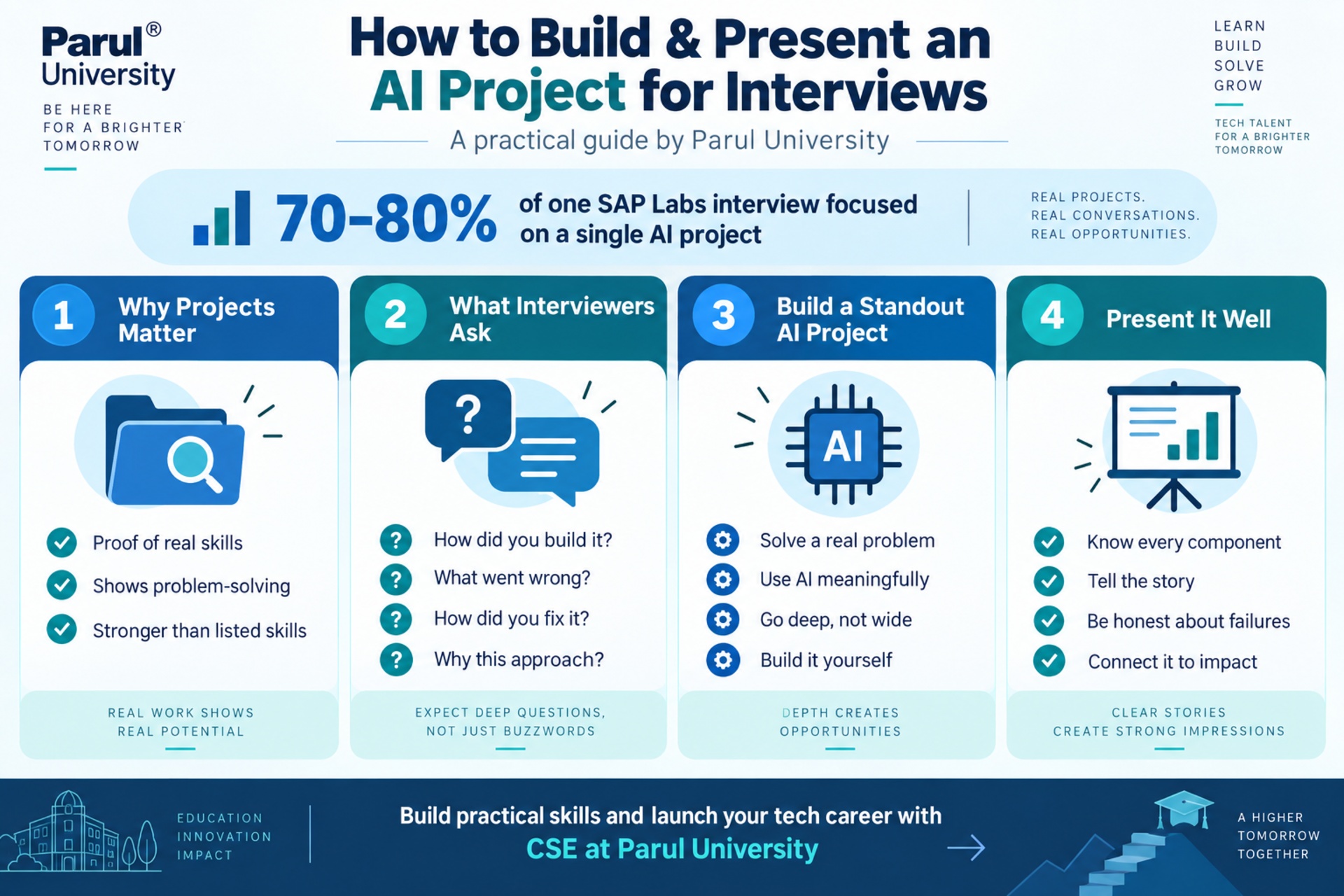
When a Parul University student was placed at SAP Labs, he made a striking observation: the vast majority of his technical interviews, by his estimate, were centred on one AI project. A second, non-AI project barely came up. His thorough experience captures a real shift in how tech companies are hiring and are looking for skill-based employees!
AI Projects - Importance & Demand!
For a fresher, a resume is full of things a recruiter cannot fully trust: listed skills, coursework, and marks. A real project is different; it is proof. It truly shows you can build something, make quick decisions, hit problems, and can derive a solution. As AI is becoming central to many companies, employers are looking for skill-based employees so they can match the pace. That is why interviewers now dig deep into project work, and why an AI-integrated project, in a field moving this fast, sends such a strong signal. In many technical interviews today, your project is the interview.
What Interviewers Actually Ask
Interestingly, when an interviewer focuses on the project, they’re testing whether it was perfect or not. They want to understand the mindset and how the fixing approach is. Here’s the list of questions that you can expect:
- What was the building process? Take me through your mindset, approach, and decisions you made!
- What was wrong? Where did you get stuck, and what surprised you?
- How did you fix it? How did you debug, adapt, and solve the problems you hit?
- Why this approach? What alternatives did you consider, and why did you choose this one?
- What would you do differently? How would you improve or scale it now?
They notice all these details and choose honesty over polishing words. An interviewer learns more about you while you’re handling a bug or managing any demo!
Building a Standout AI Project!
Not all projects impress equally. The strongest ones share a few qualities:
- Solve a real problem. The best projects address a genuine need. One student’s standout was a “smart file system” that finds files by their content, in plain language, rather than by name a real, relatable problem solved with AI.
- Integrate AI meaningfully, not as a bolt-on. The AI should be central to how the project works.
- Go deep, not wide. One project you understand completely beats five shallow ones you can barely explain.
- Build it yourself, with real understanding, rather than copying, since you will have to defend every part of it, as our guide to AI project ideas
Start Early, and Build Continuously
The single most repeated piece of advice from placed students is to start building early in your degree, not in final-year panic. Beginning early gives you time to make mistakes, learn, and develop a project deep enough to discuss with confidence. It also lets you fold in current, in-demand skills, and few are more valuable right now than practical experience with AI and modern tools. A project built and refined over months will always outshine one thrown together in a week. Inspired already? You too can work at the intersection of technology and AI by discovering courses such as Parul University’s B.Tech in Computer Science and Engineering (CSE), Bachelor of Computer Applications (BCA), and B.Tech in Artificial Intelligence – ML & Robotics.
How to Present Your Project in an Interview!
Building the project is half the job; presenting it is the other half. To do it well:
- Know it inside out. Be ready to explain every component and decision.
- Tell the story, not just the result. Walk through the problem, your approach, the obstacles, and how you overcame them.
- Be honest about what went wrong. Interviewers respect candour and problem-solving far more than a claim of perfection.
- Connect it to impact. Explain what your project achieves and why it matters.
If executed well, your project becomes a conversation you lead, exactly the position you want to be in during a technical interview, and a skill that complements strong coding-interview and system-design preparation.
FAQs
Why are projects so important in technical interviews?
Because a real project is proof you can actually build, not just a claim on a resume. It shows how you approach problems, handle obstacles, and think. As AI has become central to technology, interviewers increasingly focus on project work; sometimes it makes up the majority of a technical interview to see genuine, hands-on capability.
What makes a good AI project for placements?
A strong AI project solves a real problem, integrates AI meaningfully (not as an afterthought), and is built with genuine understanding rather than copied. Depth matters more than breadth: one project you understand completely and can defend in detail is far more valuable than several shallow ones.
How to discuss a project in an interview?
Do your research well before applying for any job; understand their problem, and examine your approach and the obstacles you will face. Be honest about your process and talk about failures too; that’s when interviewers will be inclined towards knowing more about the projects, and they prefer problem-solvers, not just coders!