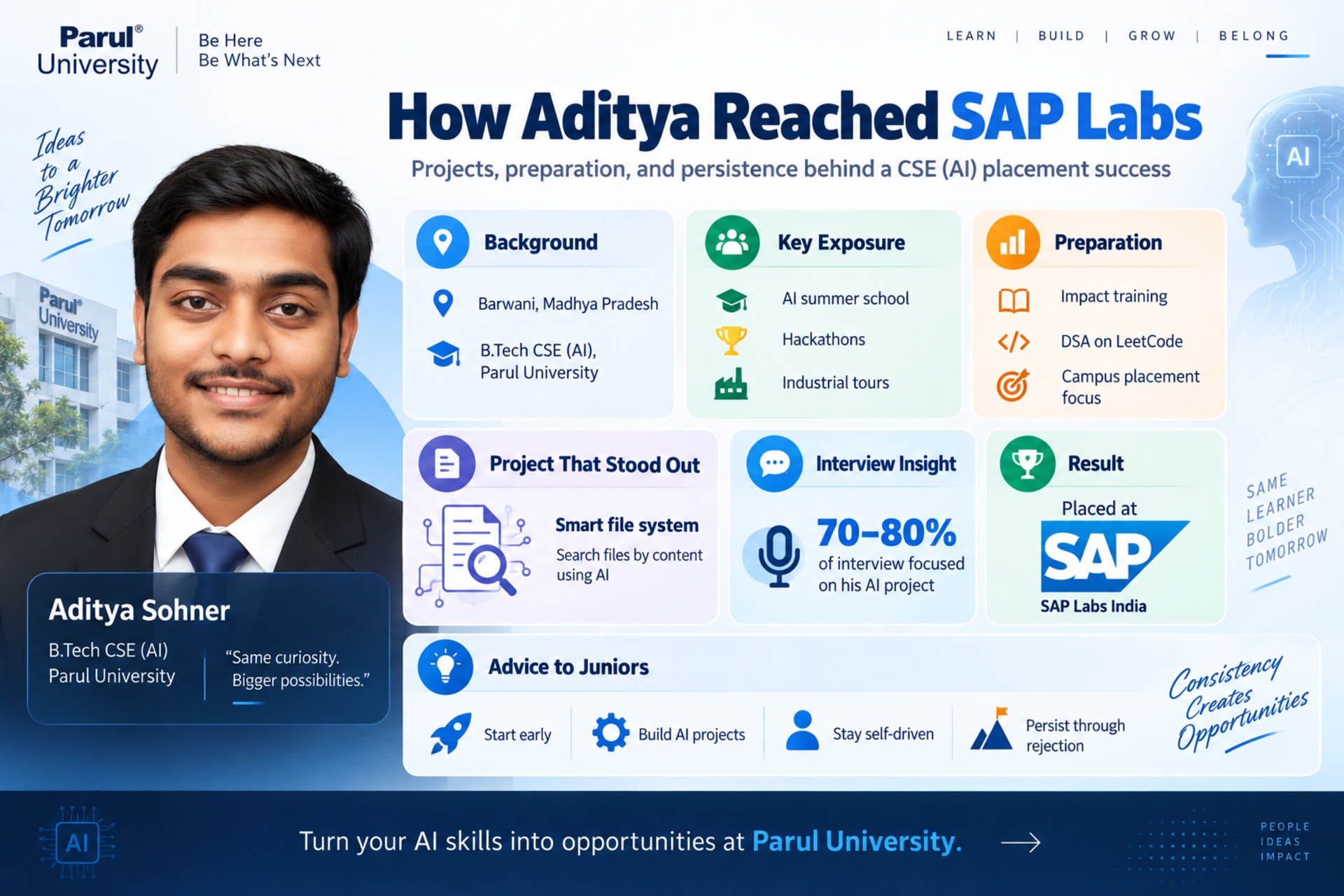
When we think of any placement story, we think of a straight line. But Aditya Sohner’s story wasn’t as smooth as it sounds. As a final-year B.Tech CSE AI student of Parul University, he has successfully cracked a placement at SAP Labs India – the product development and R&D front of a global tech company. After a full circle of efforts, setbacks, and continuous hard work, his journey is an inspiration for all the techie students out there!
From Barwani to Parul University
Hailing from Barwani, Madhya Pradesh, his interest in computer science traces back to his father, who works in an IT company. From a very young age, he saw his father’s curiosity and dedication in unfolding solutions, and that’s what made him curious. With the advancement of AI, he chose Parul University as the best option, as it was in the central direction from his house and for making industry connections!
A “Roller Coaster” Four Years
Aditya describes his four years, which began with induction in August 2023, as a “roller coaster” of fun, stress, and real challenges. Rather than stick to coursework alone, he said yes to opportunities as they came: an AI-focused summer school, hackathons on and off campus, and industrial tours. That informal willingness to take part, he found, gave him a breadth of experience that later became valuable material in interviews.
Beyond The Classrooms!
A highlight he returned to often was a 2023 summer school on AI and sustainability, which drew students from several countries. Selected to represent his college, Aditya joined a five-person team that included students from Russia and Poland; together they built a sustainability project, presented it to the panel, and won second prize, a win he spoke about with real pride. He also entered external hackathons, including “Deviathon” in Mathura, where his team placed 12th. Not a podium finish, but, as he put it, valuable for learning to work fast and stay useful under pressure, exactly the kind of growth hackathons offer.
Getting Placement-Ready
Aditya traces the real start of his preparation to May 2025, when the university ran a 40-day training program that he refers to as “Impact.” That, he says, is when he genuinely began to understand how companies hire and what recruiters look for. From there, he leaned into DSA practice on LeetCode and began tracking specific companies closely. When off-campus applications did not gain traction, he focused his energy on campus recruitment, and that is the route that led to SAP Labs. (The structured program he credits is covered in our guide to Impact Training.)
The Projects That Mattered
Asked what actually moved the needle on his resume, Aditya pointed to his AI projects and spoke with real enthusiasm about one in particular: a “smart file system” that lets users search for files by their actual content rather than the file name or extension. Describe what you are looking for in plain language, and the system finds it by understanding the content. Far more work went into it, he said, than a resume line could show. That project, it turned out, would become the centre of his placement.
The SAP Labs Process, Step by Step
Aditya walked through the SAP Labs process candidly. The online assessment threw him off: unlike the generic aptitude and coding tests he had seen elsewhere, it was built almost entirely around AI concepts, harder to prepare for and harder to gauge. After clearing it, he got his interview slot with just one day’s notice, yet went in believing he could clear it. The process had two rounds: technical and then HR. He cleared the technical round first, which gave him a real confidence boost, then cleared HR the same day, and two days later received the confirmation email from the college. Notably, this was his very first in-person interview; every earlier rejection had come at assessment or screening stages, which made this win feel especially meaningful.
What the Interviewers Actually Cared About
Aditya’s sharpest insight came here, and it is one every AI student should hear. He estimates that 70 to 80 percent of his SAP Labs interview centred on his AI project, how he built it, what went wrong, and how he fixed it, while a second, non-AI project on his resume barely came up.
Around 70 to 80 percent of the interview was about my AI project, how I built it, what went wrong, and how I fixed it.
– Aditya Sohner
To him, that is a clear signal of how much weight AI-related Project Work now carries in technical interviews, a lesson we explore fully in a companion guide.
The Power of Self-Driven Learning
One of the most valuable things about Aditya’s journey is how much he took ownership of his own AI learning. Rather than waiting to be taught, he actively chased exposure, the summer school, the hackathons, and his own projects, and taught himself a great deal about AI along the way. He is candid that self-driven learning made a real difference, and it is a strength worth emulating: in a field moving as fast as AI, the students who explore independently, building on the platforms their university provides, tend to move fastest. Parul University’s summer school, hackathons, and Impact Training gave him the launchpads; his own curiosity did the rest.
Rejection and Persistence
Aditya does not pretend the rejections did not sting. But he kept returning to one point: keep working, regardless of how any single attempt goes. Looking back, the eventual selection made the earlier setbacks feel worth it, and that persistence, he believes, is what carried him through. It is perhaps the most universal lesson in any placement story. Turn your interest in technology into practical skills, real-world projects, and career opportunities with Parul University’s B.Tech in Computer Science and Engineering (CSE), Bachelor of Computer Applications (BCA), and B.Tech in Artificial Intelligence – ML & Robotics.
His Advice to Juniors
Aditya’s advice is direct and practical:
- Start engaging with AI from day one of college, and start building projects early.
- Let your projects carry your resume, since technical interviews centre heavily on what you have actually built.
- Fold AI into your projects; it makes a real difference given how fast the field is moving.
- Be proactive and self-driven; chase opportunities rather than waiting for them.
- Expect rejection, and persist through it; it is part of the process, not the end of it.
FAQs
Where was Aditya Sohner placed after his CSE (AI) degree?
Aditya Sohner, a final-year B.Tech Computer Science Engineering (AI specialisation) student at Parul University, was placed at SAP Labs India, the product-development and R&D arm of the global software company SAP, through campus recruitment.
How did he prepare for his placement?
He credits a 40-day structured training program (which he calls “Impact”) as the real starting point, followed by DSA practice on LeetCode, close tracking of target companies, and, above all, strong AI projects. He also built experience through an AI summer school and hackathons and taught himself a great deal about AI independently.
What was most important in his SAP Labs interview?
His AI project. Aditya estimates that 70 to 80 percent of his interview focused on his “smart file system” project, how he built it, what challenges he faced, and how he solved them, while a non-AI project barely came up. It reflects how heavily technical interviews now weigh AI project work.