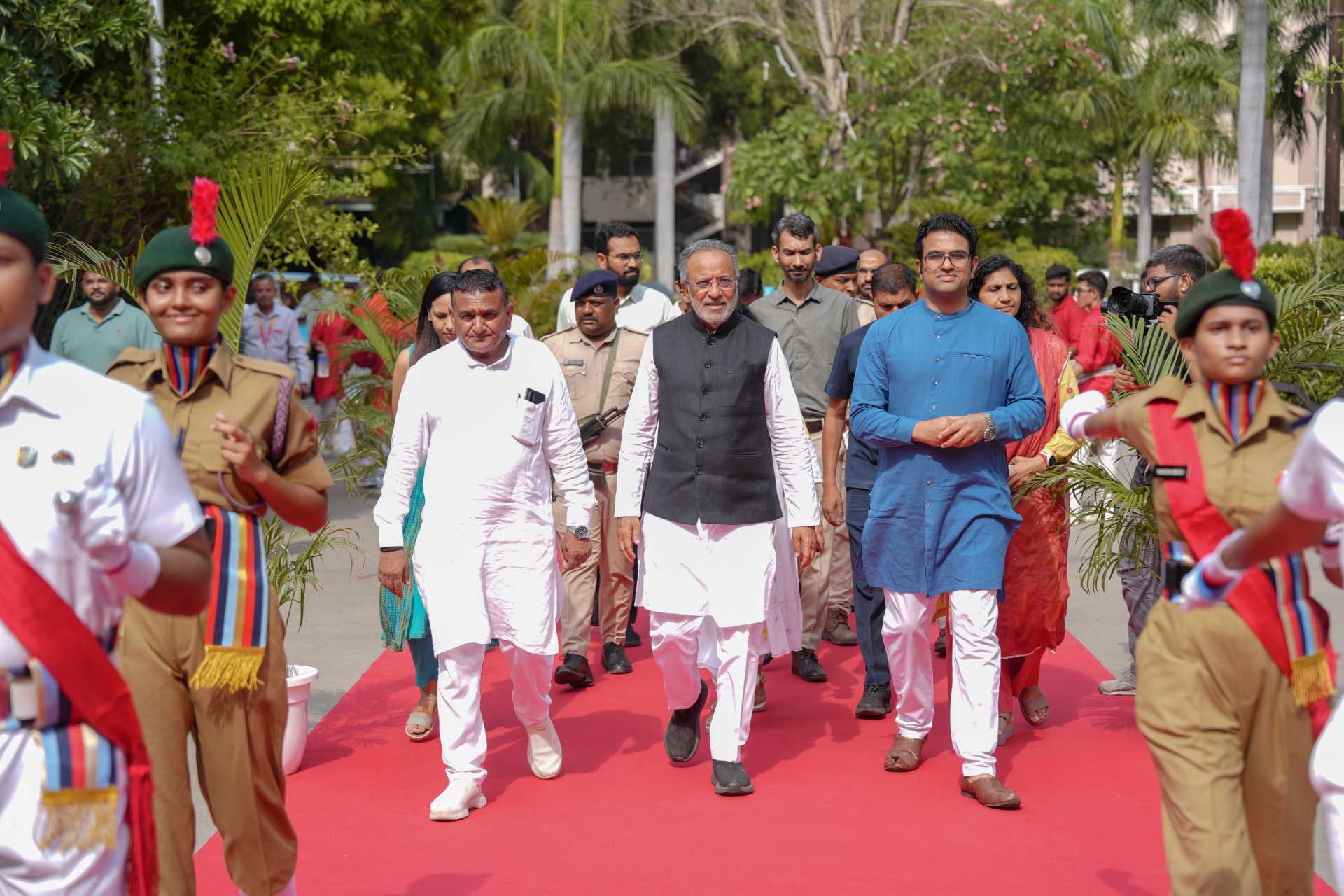
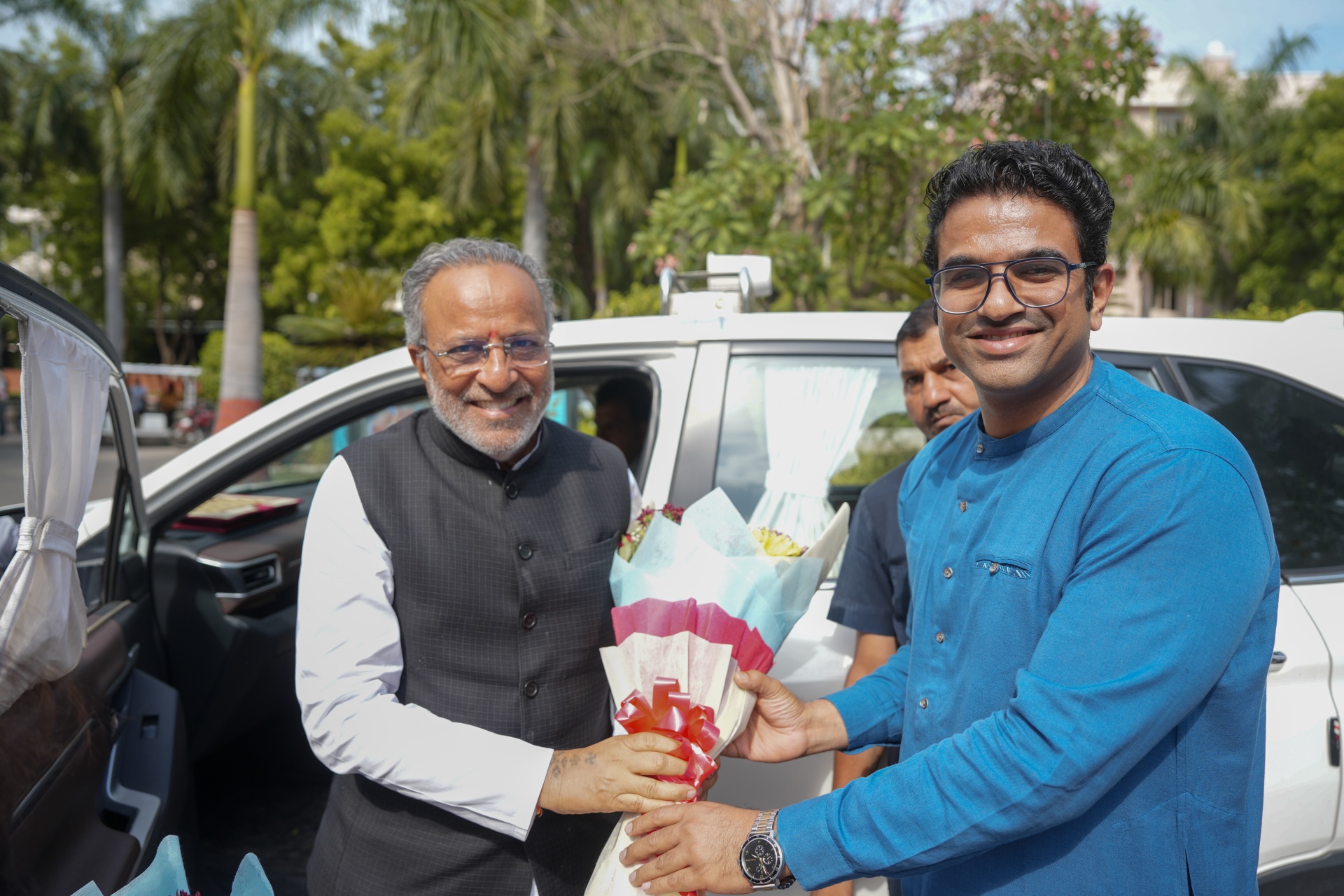
On the sunny day of 19th June 2026, Parul University proudly welcomes Gujarat’s Cabinet Minister – Shri Arjun Modhwadia Ji – for the inaugural ceremony of the MSW 200 Municipal Solid Waste Disposal System. It was a day-long program that even included an exclusive tour of Lakshya 2047 – Innovation Hub, an address to students on climate policies and unveiling of Rani Lakshmibai’s Statue.
The detailed substance of the student innovation showcased during the visit is treated in the companion article on the Environment Hackathon 2026 winners and the institutional sustainability framework the visit validated is detailed in the Sustainable Campus 2047 article
Why this visit mattered beyond ceremony
This is how the day looked – he has spent the morning inside five laboratories interacting with student innovators; the inauguration was followed by a sustained keynote rather than concluding the day, and four students questioned the Minister in an auditorium session attended by the University community.
This composition engaged the Minister with three substantive levels: infrastructure investment validated through the MSW200 inauguration, student capability witnessed through the Lakshya 2047 lab tour and hackathon presentations, and institutional positioning articulated through the Minister’s keynote holding up the campus as a model.
Shri Arjun Modhwadia Ji’s own background made the engagement substantive. Trained as a mechanical engineer before entering public life, Hon’ble Shri Arjun Modhwadia Ji engaged with student innovators in their own technical language and pressed pointed questions about datasets, methodology, and deployment rather than receiving briefings passively.
The MSW200 Plant: function, philosophy, and the circular waste vision
The Municipal Solid Waste Disposal System inaugurated during the visit operates under a deliberate message: Transforming Waste into Energy, Transforming Campuses into Change. He said –
In conventional waste handling, material is used, discarded, and handed over to collection services. The MSW200 operationalises a different framing in which waste is the beginning of a new cycle rather than the end of an old one.
He proudly inaugurated the facility in two acts. The first activated the plant’s gasifier unit, the core mechanism converting solid waste into usable energy. The second was the symbolic deposition of a bucket of waste material to initiate the first processing cycle.
Functional capabilities brought online include scientific segregation of waste at source, conversion of segregated waste into usable energy, reduction of dependency on landfill disposal, and contribution to the campus biogas plant, which converts food and organic waste from daily meals into energy.
In operational terms, no waste leaves the Parul University campus unaccounted for. Solid waste becomes material used for road construction. Wastewater is treated within the campus sewage treatment plant and reused for garden irrigation. The broader sustainability infrastructure framing the MSW200’s role includes solar power, rainwater harvesting, biodiversity conservation across 200+ acres, and the Centre for Sustainability connecting this apparatus to research and curriculum work.
The Lakshya 2047 tour: connecting infrastructure to student innovation
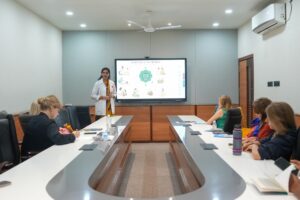
Before the inauguration, the Minister was taken through the Lakshya 2047 Innovation Hub, an applied learning centre hosting five laboratories that support prototyping across digital and hardware domains. Each lab represents a different category of capability, and presenting them in sequence builds a composite picture rather than offering a single example.
- Apple Lab : The first lab on the tour, supporting students working within Apple’s development ecosystem and the Swift programming language. The Minister met Praneel Pandey, a second-year B.Tech Computer Science Engineering student at Parul Institute of Technology who placed in the Top 350 of Apple’s global Swift Student Challenge 2026, a competition that draws thousands of student developers worldwide.
- AR/VR Lab : The most substantive demonstration of the day. The three winning teams of the Environment Hackathon 2026 presented to the Minister: AgroSense (first runner-up) on AI crop disease detection trained on 54,000 Indian crop images, EcoSathi (Best Design) on GPS-based sustainable urban mapping, and Optiflow AI (second runner-up) on predictive healthcare logistics. The Minister also experienced a virtual reality operation theatre demonstration.
- Drone Lab : Structured introduction to drone architecture, propeller-driven lift mechanics, and deployments of unmanned aerial systems across agriculture, emergency response, ecological monitoring, and supply chain operations.
- Sensor Lab : Exposure to sensor-based technologies and data-acquisition systems supporting modern automation, monitoring, and smart-technology applications.
- IDEA Lab : Subtractive manufacturing demonstration through the SIL 1325 CNC Router. The Minister received a wooden portrait carved by the facility, translating a digital image into a milled physical likeness within minutes.
The structural point was that infrastructure investment in MSW200 sits within a broader investment in the student capabilities that will build the next generation of sustainability technology. Both are required.
The keynote: technology, custodianship, and Green Soldiers
The Cabinet Minister’s keynote address was structured around three substantive arguments rather than the ceremonial talking points typical of inauguration speeches. Each is connected to specific commitments the Government of Gujarat and the Government of India have made and the role universities are being asked to play.
The first argument concerned commitment to technological currency. The issue facing universities is not whether a specific technology appears on the syllabus today, but whether the institution has sustained commitment to assess what remains relevant. He held up Parul University as a model maintaining continuous upgrades to faculty, syllabus, curriculum, and laboratory infrastructure.
The second argument concerned humanity’s relationship with the natural world. The Minister framed human intelligence as an advantage meant to make humankind custodian of creation rather than license unchecked dominance, contrasting conventional household indifference toward waste with the self-contained Parul University model where waste is processed within the campus and converted into productive use.
The third argument concerned what universities and students should now do. The Minister set out specific commitments: India’s 500 GW renewable energy target by 2030 (260 GW already built, 100 GW allocated to Gujarat), the 2070 zero-carbon footprint global target, India’s 2050 renewable majority goal, and biofuel blending approval to 30% from 20%. He referenced the International Solar Alliance, which India co-founded with France in 2015 and is now headquartered in Delhi with 16+ member nations. He urged students to become Green Soldiers, framing recycling and sustainable development as genuine avenues of employment.
Direct dialogue: four student questions and what they revealed
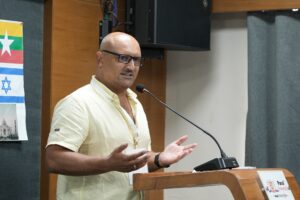
The question-and-answer session following the keynote was open rather than scripted. Four students addressed the Minister on questions ranging from philosophy to engineering, revealing how Parul University students engage substantively with state policy at the level of detail the Minister was willing to engage back.
- Gandhian philosophy and sustainable development (Yashman Surya). The research scholar drew the connection between Gandhi’s teaching that the earth provides enough for need but not greed and contemporary environmental balance. The Minister framed Gandhi’s central teaching as one of restraint and called the principle uniquely relevant to climate response.
- The path to zero waste (Jaynil Govil). The questioner pressed that the deeper solution is producing less waste rather than only managing it better. The Minister cited Indore’s enforcement-driven civic discipline (mandatory household segregation paired with fines) as a working model and acknowledged candidly that the MSW200 plant requires more investment than it currently returns, with break-even projected over roughly a decade.
- Time management lessons from the Prime Minister (Devansh Patel). The Ahmedabad student asked what students could learn from Shri Narendra Modi‘s reported work discipline. He connected disciplined time management to minimal personal needs as the foundation of sustained effectiveness.
- Engineering solutions for environmental challenges (Yash Chaudhary). The questioner asked how engineering helps resolve environmental challenges and how students might apply technical skills. The Minister traced the decline in solar power tariffs (Rs. 2.85 per unit today versus Rs. 16-17 two decades ago) as evidence that technological progress drives environmental viability, projecting India’s circular economy at $2 trillion by 2047 against the current $4 trillion economy.
What this visit positions Parul University toward
Ministerial visits matter most for what they signal about institutional trajectory. His repeated framing of Parul University as a model worthy of study is the substantive takeaway, tied to specific decisions: continuous faculty and curriculum upgrade discipline, self-contained waste processing, and the technological depth visible across the five Lakshya 2047 labs.
The broader implication is that Parul University’s sustainability infrastructure is now positioned within Gujarat’s articulated vision for the State’s contribution to India’s climate goals. The 100 GW renewable allocation to Gujarat, the mangrove plantation across one lakh hectares of coastline, and the wild cat conservation programmes sit alongside the University’s MSW200, solar infrastructure, and student innovation as elements of a single State-level sustainability landscape. The visit did not create this alignment; it made it visible.
FAQs
Who is Hon'ble Shri Arjun Modhwadia, and what was the purpose of his visit to Parul University?
Hon'ble Shri Arjun Modhwadia is the Government of Gujarat's Cabinet Minister for Forests and Environment, Climate Change and Science and Technology. He is from Porbandar (the birthplace of Mahatma Gandhi) and was trained as a mechanical engineer before entering public life. His 19 June 2026 visit to Parul University centred on the formal inauguration of the MSW200 Municipal Solid Waste Disposal System, alongside an extended tour of the Lakshya 2047 Innovation Hub, a keynote address on climate policy and student responsibility, an interactive question-and-answer session with students, the unveiling of a Rani Lakshmibai statue, and a closing feedback session with University leadership.
What is the MSW200 Plant at Parul University and what does it do?
The MSW200 Municipal Solid Waste Disposal System is a waste-to-energy facility inaugurated at Parul University on 19 June 2026. It operates under the message Transforming Waste into Energy, Transforming Campuses into Change. The plant's core mechanism is a gasifier unit that converts solid waste into usable energy. Its functional capabilities include scientific segregation of waste at source, conversion of segregated waste into energy, reduction of dependency on landfill disposal, and integration with the campus's existing biogas plant, which processes food and organic waste from daily meals. The plant is part of Parul University's circular waste system in which solid waste is converted into materials used for road construction, and wastewater is treated within the campus's own sewage treatment plant and reused for garden irrigation.
Which student projects did the Cabinet Minister engage with at Parul University?
The Cabinet Minister engaged directly with the three winning teams of the Parul University Environment Hackathon 2026. AgroSense, developed by Team CropMatrix (Gaurav Sharma and Eshant Bhardwaj of the Faculty of Engineering and Technology), placed first runner-up and presents an AI crop disease and soil health platform trained on 54,000 images of Indian crop varieties. EcoSathi, developed by Team TheRebuilders (Yagnik Patel and Deepak Jha of the Faculty of Engineering and Technology), won Best Design and offers GPS-based mapping of community services and sustainability resources. Optiflow AI, developed by Team Planetary Healers (Dhruv Prajapati and Kuldeepsinh Parmar of the Faculty of Medicine), placed second runner-up and provides predictive forecasting for blood and medicine demand to reduce healthcare waste. The Minister also met Praneel Pandey, a second-year B.Tech Computer Science Engineering student at Parul Institute of Technology who placed in the Top 350 of Apple's global Swift Student Challenge 2026.
What did the Cabinet Minister say about Gujarat's and India's climate commitments at Parul University ?
The Cabinet Minister set out specific policy commitments during his keynote address. India targets 500 GW of renewable energy capacity by 2030, with 260 GW already constructed and 100 GW allocated to Gujarat, reflecting the State's leadership in renewable energy. The global target is zero carbon footprint by 2070, with India targeting a renewable majority energy by 2050. Biofuel blending has been approved up to 30%, increased from a previous 20% limit. India co-founded the International Solar Alliance with France in 2015, now headquartered in Delhi with more than sixteen member nations. Gujarat has planted mangroves across one lakh hectares of its coastline to rebuild coastal ecosystems, and the State is working to restore tiger and cheetah populations in the Kutch region to return all four large cat species native to India to Gujarat. The Minister projected India's circular economy at $2 trillion by 2047 against the current $4 trillion economy.