A base across several languages
- • How a background in Python, C, and C++ made Swift straightforward for Dhruv Sharma.
- • What the certification covered, from Swift basics to SwiftUI and Xcode.
- • How open lab hours carried out his preparation.
- • His score, his WWDC 2026 hackathon, and his advice on basics
880 / 1000
His examination score
2 to 3 weeks
to learn Swift basics
Room AWS 103
exam venue, ten students
Dhruv Sharma is a third-semester CSE AIML student from PIET, Parul University. Programming was introduced to him at an early age, with Python in his 10th standard, followed by SQL, and then C, C++, HTML, CSS, and Java. At the time he went to the Swift workshop, he had a wide base, and this influenced the remainder of the course. He already knew Python, C, and C++, and the logic was quite easy, and then the syntax wasn’t too difficult. He says that Swift is based on multiple languages and the syntax was similar to JavaScript, HTML, and Python.
What the exam needed
His preparation covered three connected areas:
- The basics of Swift, including data types, conditionals, structures, enumerations, optionals, and object-oriented programming
- The basics of SwiftUI, the framework for buttons, text fields, navigation, and the app’s visual side
- Navigating Xcode, the environment where Swift code is written, run, and debugged
The lab and the hours he kept
The one thing that needed planning was access to a Mac, which is required to run Xcode. He does not own one, so the lab is where the work happened. Its hours ran from 9:30 to 4:30, and since his classes ended at 2:10, he stayed on afterwards. Later, the lab also opened from 5 to 7 in the evening, which gave him more time. The language itself did not take long. Two weeks were enough for the basic concepts, he says, while frameworks such as SwiftUI take longer to master.
The exam itself
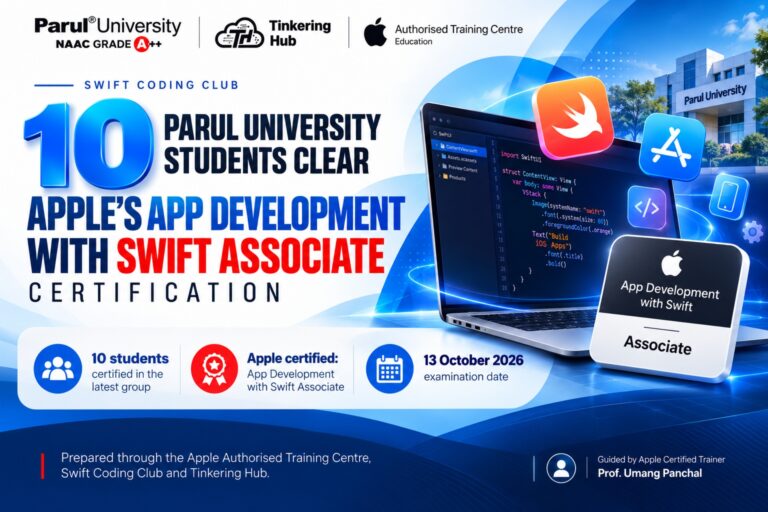
Dhruv took the exam in room AWS 103. Ten students sat, each on a device on the Certiport platform. The questions were centrally focused on basics. They came in forms: matching columns, drag-and-drop, and multiple-choice questions where more than one option could be correct. With no marking, Dhruv made a calculated choice to skip the two or three questions, which gave him a sigh of relief. His final score was 880 out of 1000.
Why SwiftUI won him over!
Dhruv studied SwiftUI; SwiftUI was the part he enjoyed most because it gave him freedom. In design, SwiftUI offers possibilities. Learning Swift also changed how Dhruv approaches a task: He reads the design first, deciding how a button should look and then moves to what it should do.
What the certificate is worth!
For Dhruv, the value is in how the certificate reads to an employer. A certificate carrying the Apple certification helps in shortlisting. It truly conveys that he is capable enough and has mastered the basics of Swift and iOS development. Dhruv has also used Swift in practice, including a month-long hackathon organised by IndeHub linked to WWDC 2026. His final message to students was, “Make your basics strong and everything else feels easy.” If you’re super passionate about AI and the progression of next-gen technologies, enrol in Parul University’s B.Tech CSE in AI/ML course and get placed by top tech companies in India and the world!
| SOURCE AND CONTEXT. This article is based on an interview with Dhruv Sharma. His examination score is reported as 880 out of 1000. His LinkedIn profile is linked with tracking parameters removed. |
Explore the ecosystem and pathways
Students who want to build for Apple platforms can begin at the campus Apple lab and explore the future-skills centre.
People and organisations
- Dhruv Sharma, CSE AIML student, Apple Swift Associate certified
- Prof. Umang Panchal, Apple Certified Trainer
- Parul University, Vadodara, Gujarat