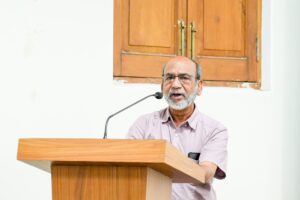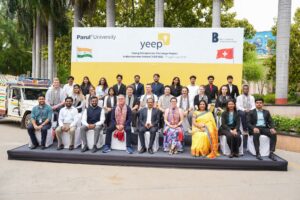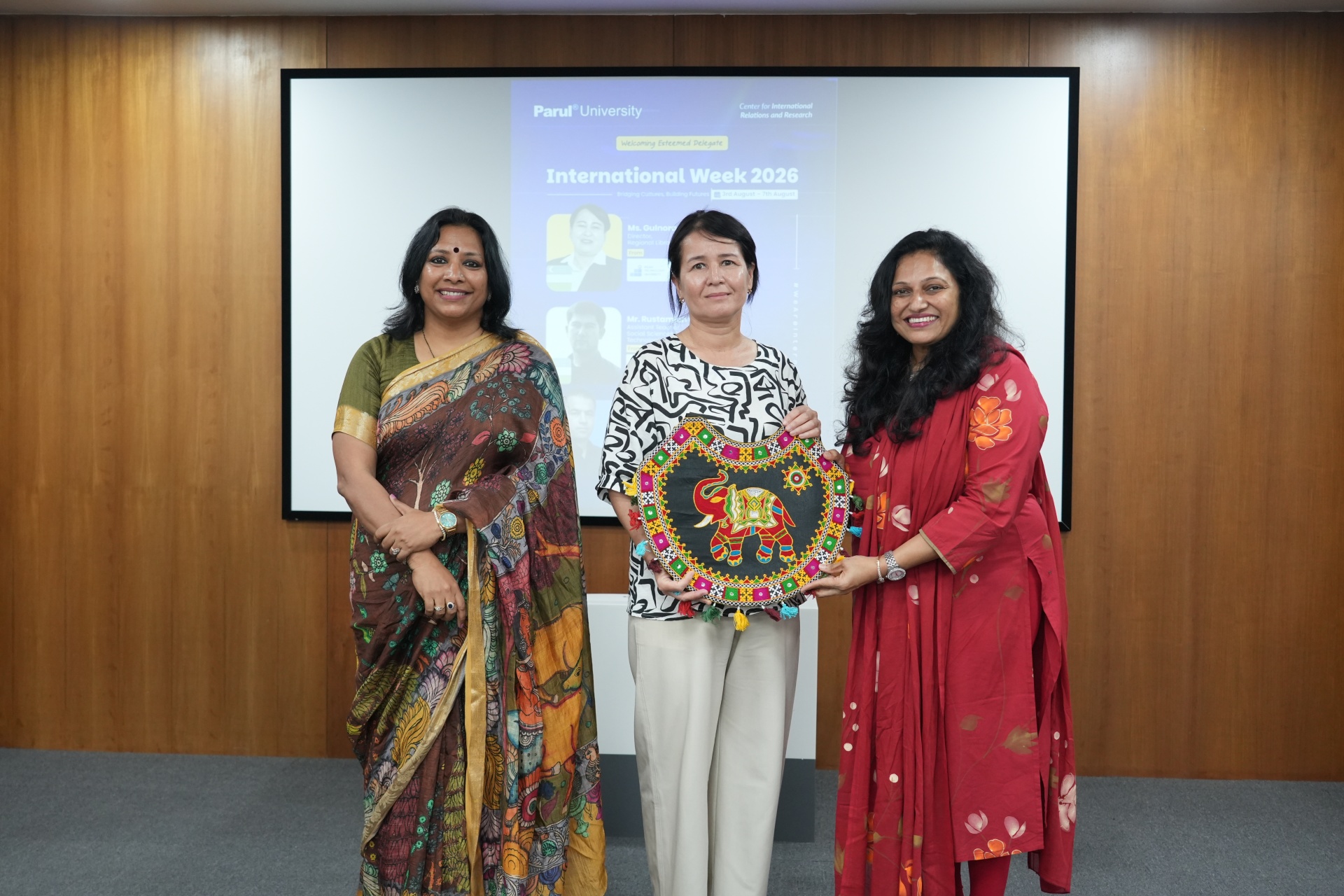
Parul University celebrated International Week 2026 recently. The session invited an English & German lecturer, Ms. Nilufar Sharipova. She teaches at the University of Economics and Pedagogy. She didn’t deliver the lecture, it was more of a discussion. A discovery for students about the country Uzbekistan. She shared the history of the country and its modernity. She addressed that the country shares a good bond with India.
A Bond Between India and Uzbekistan
The affection is mutual and old. Sharipova spoke of her own lifelong love of Indian culture, sparked, like that of many Uzbeks, by Indian films and performing arts in childhood; in Uzbekistan, children sing Indian songs, dance Indian dances, and some institutions teach Indian languages. The historical ties run deeper still: Babur, the founder of India’s Mughal Empire, came from the Uzbek city of Andijan. As a modern symbol of this affection, a replica of the Taj Mahal stands in Samarkand. Academic ties are growing too, with exchange programmes and dozens of Indian scholars having already visited Uzbekistan.
The Four Jewels of the Silk Road
At the heart of the session was a tour of four ancient cities strung along the Great Silk Road, each a world of its own.
Tashkent: The Tenacious Metropolis
Every country has a history that lives and waits for a day, so that it can come out. It waits to come out because it remained unexpressed for many years. Tashkent too, has a history. It is the capital of Uzbekistan. Also, it is Central Asia’s largest city. It has greenery, wide streets, parks and water. Home of almost three million people. It is studied that the city faced a down fall devastated state due to an earthquake in 1966. It rebuilt itself brick by brick. Got inspiration from old Islamic architecture and modern high-rises. The famous bazaar is Chorsu Bazaar is a vast blue dome. Its Soviet-era metro, especially the Kosmonavtlar station honouring astronauts, is famous worldwide for its marble floors and grand chandeliers.
Samarkand: The Ancient Heart
Old times have stories to share. Times as old as 2000 years. Carrying a deep history. Samarkand shares the culture, art, and many more things that shaped Uzbekistan. Samarkand attracted visitors, one of them being Alexander the Great and Marco Polo. The emperor Timur planned to build the city. One of the most cities in the world. The Registan Square, with gold-leaf and turquoise domes, and the Gur-e-Amir mausoleum, show how close he came. The history shares with us that Samarkand was home to Ulugh Beg too. He was grandson and famous astronomer who enumerated thousands of stars before the telescope existed. He was a genius whose advanced observatory was lost for centuries after his assassination.
Bukhara: The Living Museum
Bukhara holds an interesting story. People still live in the old mud-brick houses. It is among the narrow alleys. It has a 47 meter Kalyan Minaret, made of baked brick in 1127. Genghis Khan liked it so much that he ordered it as spared. The city is still a home for hat-makers, gold-embroidery specialists, and weavers. The city lives with the past of trading and in the great domed bazaars.
Khiva: The Desert Fortress
Ever felt that a place gives you a real sense of old times? Khiva is one such place. When you visit the place and the city, you can see walled inner city. The Itchan Kala that gives you a feel of ancient times. Its Kalta Minor Minaret, wide, short, and covered in blue and turquoise tiles, was left unfinished when the king who commissioned it died.
The Juma Mosque astonishes with its flat wooden ceiling supported by 218 individually carved wooden columns.
The Taste and Sound of Uzbekistan
Every corner you visit has its own food. The taste that their people like. Their national dish is Plov. Plov is made of cooked rice served with lamb. Carrots and onions. It is a celebrated dish, hence prepared for hundreds of people at once. The culture of Uzbek lives in art, culture and food. If you witness the clothes, carvings on monuments, and taste of food it speaks a lot more about it. Their food Shashlik is a charcoal-grilled marinated meat. It seems very close to Indian Kebab. Samsa, yes you read it right, Samsa is like an Indian Samosa visually. It is filled with golden meat and is less spicy. Bread, or Naan baked on the walls of a clay oven. It is stamped to make it look decorative. It is served with green tea. Poured back into the pot three times as a mark of respect.
The arts run just as deep, from intricate Ikat silk weaving and Rishtan ceramics to the stringed dutar and the doira drum that accompany folk dances in flowing silk dresses.
A Land of Sun, Science, and History
A few facts capture Uzbekistan’s character. It covers around 448,900 square kilometres, home to about 30 million people, and is one of only two “double-landlocked” countries on earth, bordered entirely by other landlocked nations (Kazakhstan, Kyrgyzstan, Tajikistan, Afghanistan, and Turkmenistan). It enjoys more than 300 sunny days a year and celebrates its Independence Day on 1 September. Its intellectual legacy is world-changing: beyond Babur, the region produced Al-Khwarizmi, the mathematician whose work gave us the word, and much of the foundation, of algebra.
A Two-Day Tour, If You Ever Go
For students inspired to visit, Sharipova sketched a practical itinerary. Day one explores the city: the Chorsu Bazaar, the Hazrati Imam complex (home to an ancient Quran written on deer skin), Independence Square and Amir Timur Square, the Museum of Applied Arts, and views from the Tashkent TV Tower, ending with the famous “Wedding Plov” at the Besh Qozon restaurant, and always, she advised, take the metro rather than surface taxis. Day two turns to nature: the Ugam-Chatkal National Park and the glacier-blue Charvak Reservoir, horse riding or cable cars in the Chimgan mountains, and a finale at Tashkent City Park with its skyscrapers and musical fountains.
Why Cultural Exchange Matters
The session was more than a travelogue; it was cultural diplomacy. It showed students that beneath geographic distance lie deep cultural affinities, and that understanding another country enriches your own perspective. That is precisely the value of experiences like Parul University’s International Week, which bring the world, and its stories, directly to students. As the session closed, many left with broadened horizons and a new wish: to one day walk the old Silk Road themselves.
FAQs
Are there more than one Silk Road?
Yes, there are four routes. The Silk Road cities of Uzbekistan. There are Tashkent, Samarkand, Bukhara and Khiva. Each has a different history, showing a different era of Central Asian history.
What is the relation of India and Uzbekistan?
The two countries are connected. They are connected with cultural and historical ties. It is connected through culture. Babur, the Mughal Empire founder in India. He was born in the Uzbek city of Andijan. It is observed that people of Uzbekistan like Indian films, music, dance forms and food. It is seen that replica of Taj Mahal is there in Samarkand. The countries are now maintaining their relations through global exchange programmes too.
What is Uzbekistan known for?
Uzbekistan is different from other countries through its culture. It has Silk Road history. The country showcases great Islamic architecture. It is famous for its dish Plov. And it is one of the two countries with double-landlocked on earth. It has three hundred summer days. The great mathematician AL-khwarizmi is from the same country.