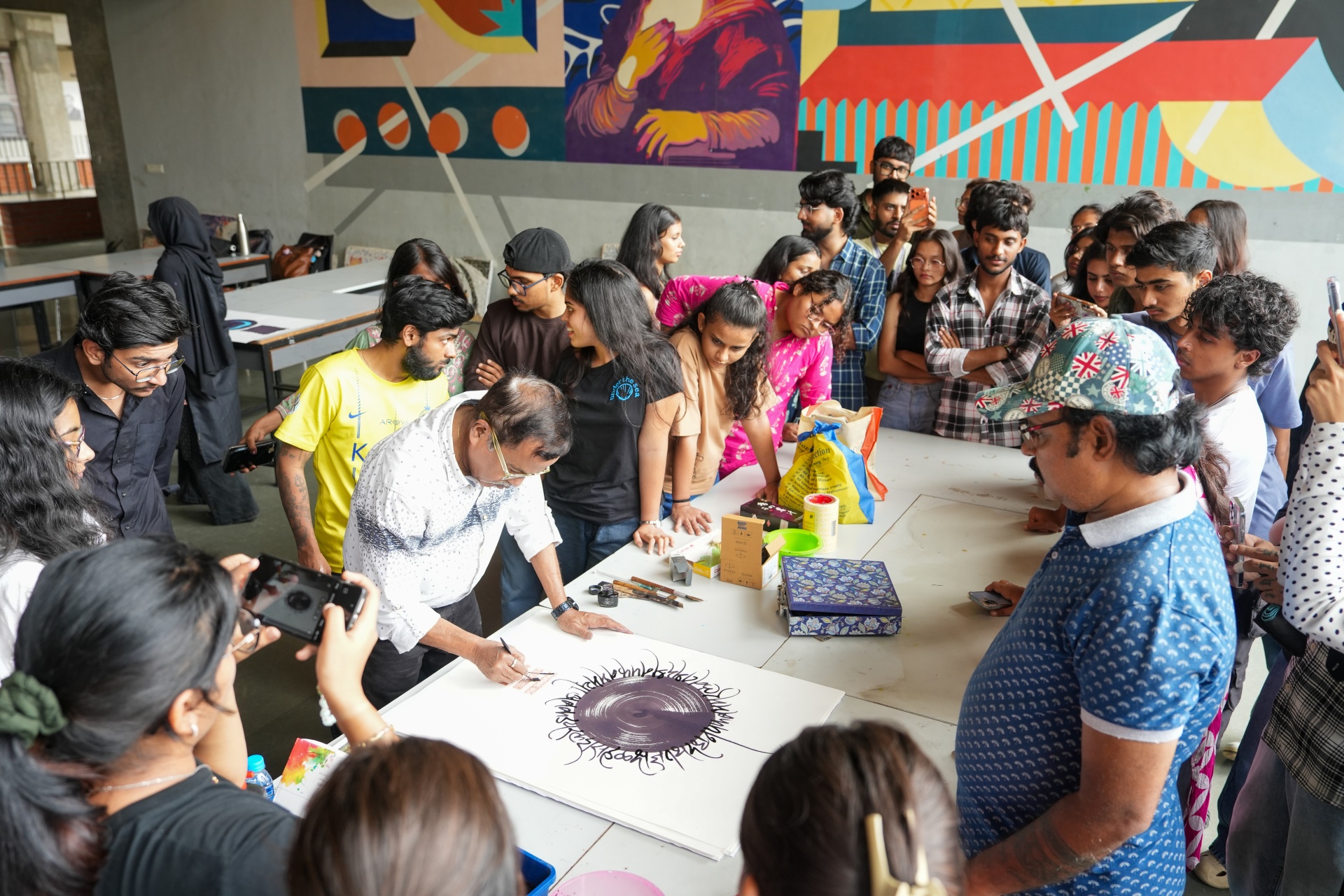
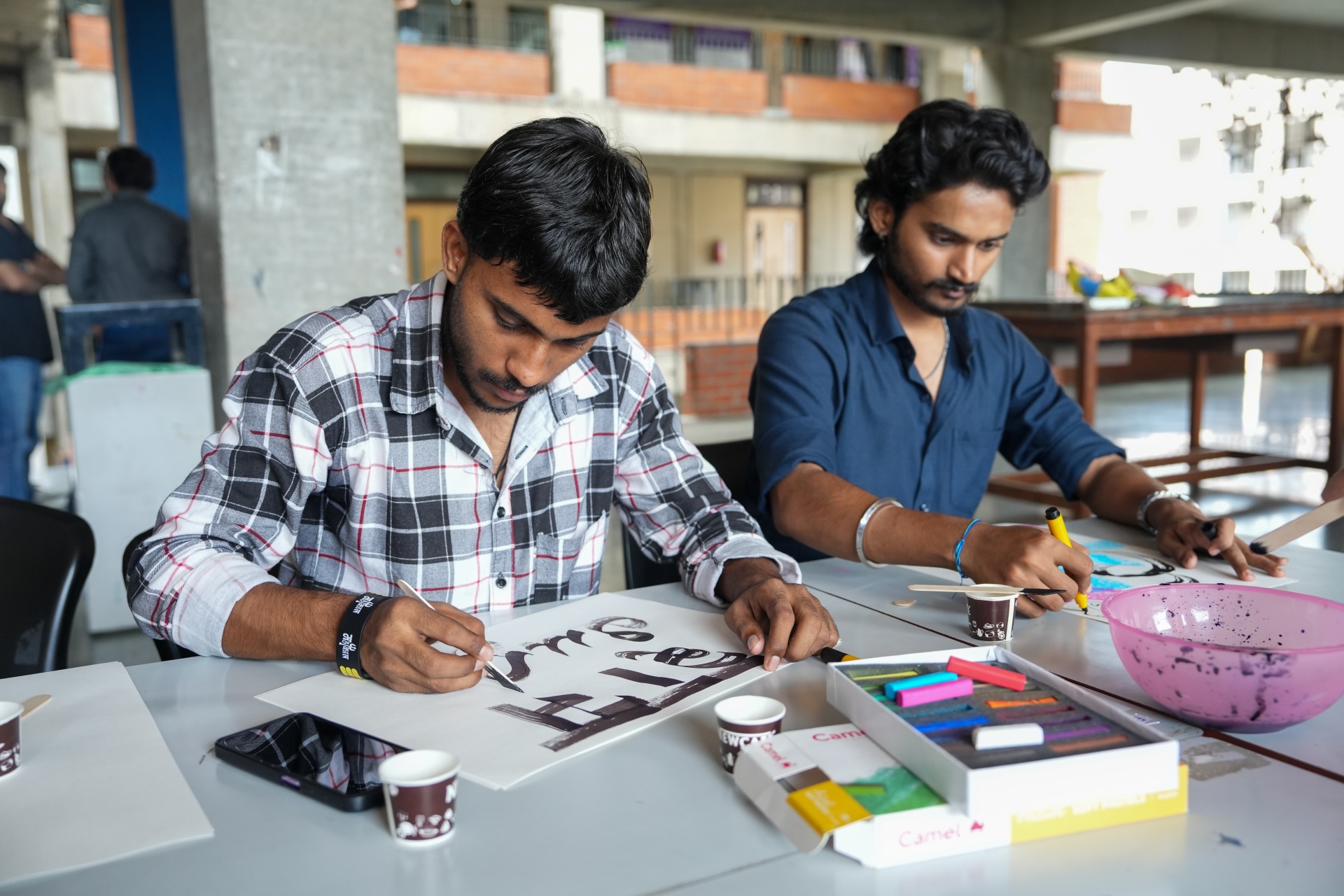
How does a written story become a painted image, and what happens in the space between the two? That question, “Text and Image,” was the heart of the National Symposium at Lipikalpa 2026, where some of India’s most eminent art historians guided students through the country’s great painting traditions. Here is the journey they charted.
The Mughal Court: Where Text Became Splendour
Dr. Asok Das, former Director of the City Palace Museum, Jaipur, and a consultant to the Victoria & Albert Museum and the Metropolitan Museum of Art, opened with the refined visual culture of the Mughal court. Through the celebrated Gulshan Album, he showed how the Mughals developed a sophisticated art of manuscript-making in which text, calligraphy, illumination, and image came together as a single, integrated_
Narrative Traditions: The Tongue and the Text
Padma Bhushan Gulammohammed Sheikh, the renowned artist, poet, and critic, widened the lens to India’s narrative traditions themselves. In “The Story of the Tongue and the Text,” he explored the relationship between narrative, language, and visual representation, and pressed students to think critically about a deceptively simple act: the choices an artist makes when deciding how to represent a text. It was a reminder that every illustration is also an interpretation.
The Jain Tradition: Teachings Made Visible
Two scholars illuminated the extraordinary Jain manuscript tradition. Padma Shri Ratan Parimoo, former Director of the L.D. Museum, Ahmedabad, presented his research on an illustrated manuscript of the Uttaradhyayana Sutra from Patan, showing how the religious and philosophical teachings associated with Mahavira were transformed into visual narratives through manuscript painting. Dr. Shweta Prajapati, Director of the Oriental Institute at M.S. University of Baroda, then introduced a rare and specialised form: the illustrated Vijnapti Patra, or invitation letters, sent by Jain merchant communities to invite monks to their cities during Chaumasa, revealing how religious practice, community life, and visual art were intimately connected.
The Mewar School: Interpreting the Word
The Mewar school of miniature painting drew two perspectives. Dr. Shailendra Kushwaha, former Dean of the Faculty of Fine Arts at M.S. University of Baroda, traced the origin and development of the Mewar tradition, using it as a case study for the methodological challenges of studying Indian painting through established art-historical frameworks. Dr. Rita Sodha, Head of the Department of Art History at M.S. University of Baroda, focused on how artists use creative freedom to interpret and elaborate written narratives, drawing on works such as the Bihari Satsai, Rasmanjari, and Sur Sagar, where the painter becomes a co-author of the text.
Pahari Painting and the Karnataka Tradition
Dr. Sarang Sharma explored a fascinating theme in “Imagining the Demonic: Puranic Text, Folk Imagination and the Grotesque in Pahari Painting,” examining how artists visualised the demonic and grotesque by weaving together Puranic narrative and folk imagination. And carrying the story south, Dr. Raghavendra Rao H. Kulkarni, Principal of Karnataka Chitrakala Parishath, Bengaluru, presented “Text & Image: A Journey of Miniature Art in Karnataka,” broadening the picture beyond the northern schools to the distinctive traditions of the Deccan and the south.
A Gathering of National Scholarship
The symposium’s depth was reinforced by the presence of scholars from India’s foremost cultural institutions. Dr. Shweta Prajapati also examined the interplay and gaps between “Text and Image,” while Dr. Kanu Priya, Head of the Department of Art History at Banaras Hindu University, added her scholarship to the gathering. From the Indira Gandhi National Centre for the Arts (IGNCA), the symposium’s collaborating institution, Prof. Sudhir Lall and Dr. Sachchidananda Joshi, the IGNCA’s Member Secretary, lent their weight to the proceedings, a reflection of the event’s national significance.
Why These Traditions Matter
Taken together, these sessions revealed a profound truth about Indian art: text and image were never separate. In manuscript after manuscript, tradition after tradition, the written word and the painted image were designed to work as one, each deepening the other. Understanding this heritage is not just art history; it is a window into how India told its stories, transmitted its knowledge, and expressed its imagination for centuries. For students of fine arts, engaging with it, guided by scholars of this calibre, is an education in the very roots of Indian visual culture. Study and explore the depths of Indian art at Parul University with programmes such as visual arts, history, and design.
FAQs
Where should one go for schools of Indian miniature paintings
India is filled with culture, history, and traditions. The major traditions and art forms include Mughal painting, Jain manuscript painitng, then there is Mewar School of Rajasthan and last but not least, Pahari Painting from the Himalayan foothills. In regional traditions there is miniature art of Karnataka. These schools are different in their own way, offering different forms of art and creativity.
What does “text and image” mean in Indian art?
“Text and image” refers to the way Indian manuscript and miniature-painting traditions combined the written word, calligraphy, and painted illustration into a single, integrated art. Rather than merely illustrating a story, artists interpreted and elaborated the text visually, so that word and image worked together, each enriching the other.
What is the Gulshan Album?
India holds a deep history. Digging deep about all gives a view of the culture, art and stories. The Gulshan Album is one of them. It is an example of Mughal manuscript art. It depicts the intricate visual culture of the Mughal court. It contains text, calligraphy, illumination, and shows how the image comes together as one integrated form. It is a reflection of Mughal artists. The art inspired from Persian miniature conventions. It formed a distinctive Mughal visual language.