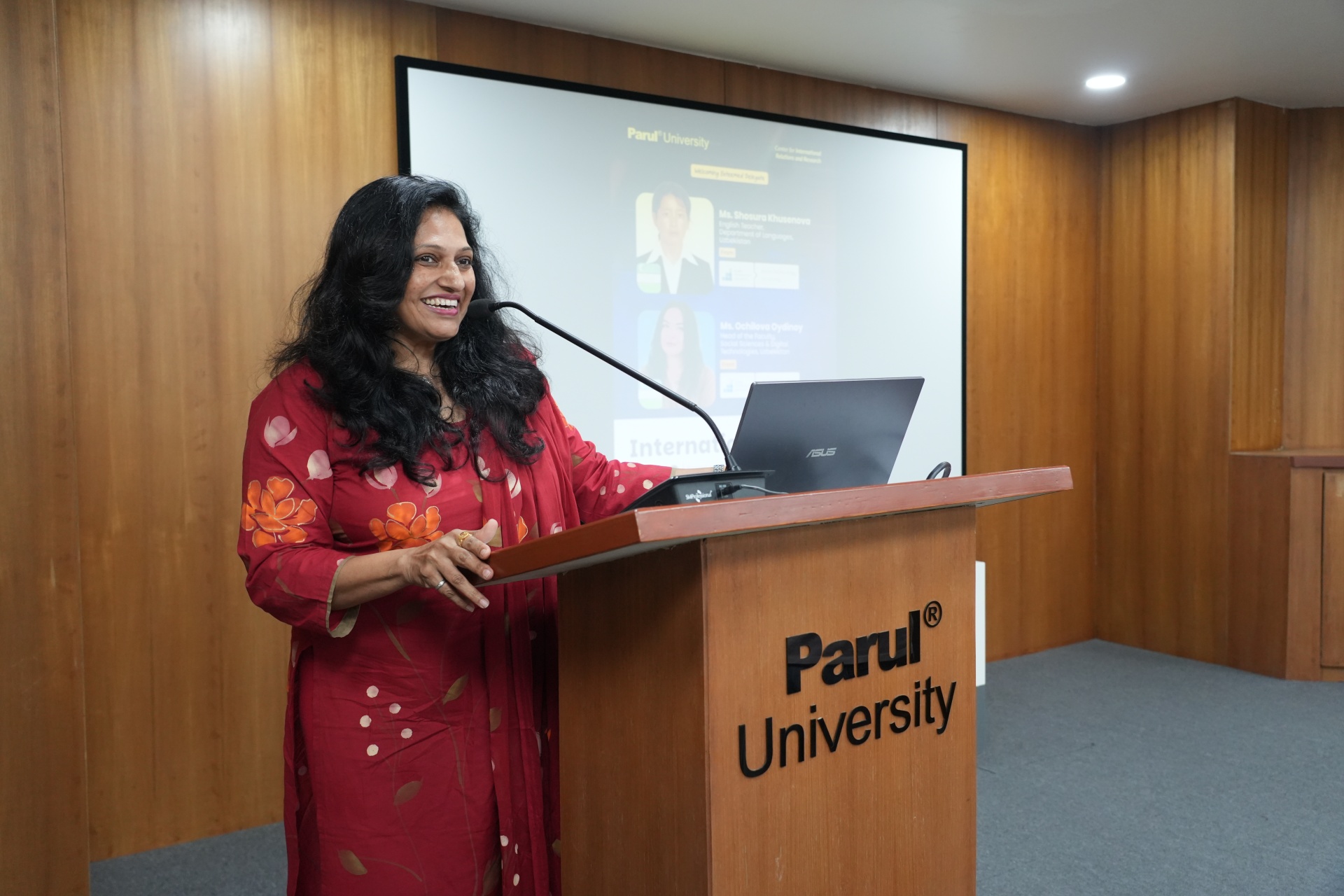
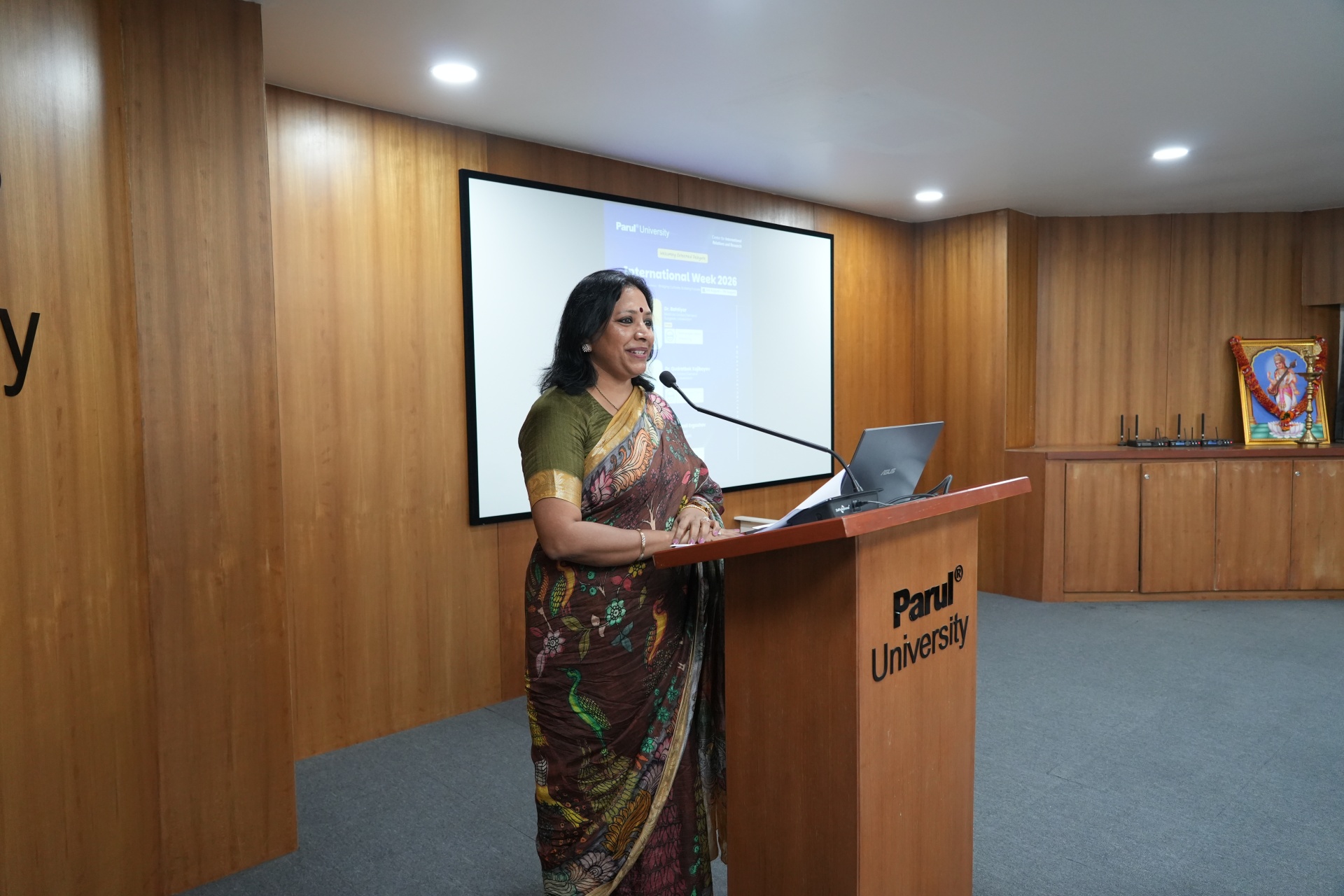
Most universities talk about being global. Parul University spent two weeks proving it. They recently invited international guests. Centre of International Relations and Research (CIRR) of the university organised International Week 2026. Seventeen delegates from Uzbekistan were invited. They visited Vadodara to teach, meet the young talent, take sessions and exchange knowledge. Knowledge exchange took place across various fields.
It was the first International Week the university had ever dedicated specifically to colleagues from Uzbekistan, and it revealed a clear, deliberate idea of what “global” education should actually mean.
A Relationship Years in the Making
Grand partnerships rarely begin grandly. As CIRR Director Dr. Preeti Nair explained, this delegation traced back roughly three years to a single, easily forgettable event: one Uzbek professor’s visit to the Faculty of Liberal Arts. That modest interaction planted a seed that grew into a full delegation spanning medicine, linguistics, logistics, and beyond. When the programme was opened up, more than 70 delegates from Uzbekistan expressed interest, and a structured evaluation process narrowed that pool down to a carefully selected group of professors across several distinct disciplines. The lesson, as Dr. Nair framed it, is that institutional relationships begin not with grand gestures but with a single conversation that someone chooses to follow up on.
Three Pillars: What Internationalization Means at Parul University
The intellectual centre of the inauguration was Dr. Nair’s definition of internationalization, not as an abstract value but as a working philosophy built on three objectives.
1. Academic Engagement: Internationalization at Home
Rather than treating global exposure as something that happens only when students travel abroad, Dr. Nair pointed to a deliberate strategy of bringing international academics onto Parul’s own campus. With a student cohort of roughly 75,000, she argued, the university carries both the scale and the responsibility to bring global academic exposure to students who may never have the means or circumstance to travel themselves internationally. This is “internationalization at home”, reframing global exposure not as a privilege for the few who can afford to leave the country, but as something the university actively brings to its own gates.
2. Cultural Exchange
Dr. Nair spoke warmly of the similarities between India and Uzbekistan, in the warmth of their people, their traditions of hospitality, and the value both place on friendship, while stressing that respecting genuine cultural differences matters just as much as celebrating shared ground. She invoked the Indian tradition of “Atithi Devo Bhava”, the idea that a guest is to be treated as the divine, as the guiding philosophy for hosting the Uzbek visitors.
3. Friendship
The third pillar, friendship, was positioned not as sentiment but as the structural foundation of everything else. Academic cooperation, Dr. Nair argued, ultimately develops through people, not institutions or buildings, and it is shared understanding and purpose that allow a partnership to outlast its opening-day handshakes and become a genuine, lasting relationship.
A World in Flux: The Provost’s Vision
Provost Prof. Dr. K. N. Madhusudanan’s keynote set the ceremony in a wider frame, describing Uzbekistan as an important neighbouring country bound to India by cultural and linguistic connections stretching back centuries, and arguing that international academic connections have taken on renewed urgency in a rapidly shifting global environment. He leaned on Parul’s interdisciplinary character as an asset, encouraging the delegation to use their two weeks not just to deliver prepared lectures but to seek out interdisciplinary connections, the kind of unplanned intellectual cross-pollination that rarely happens by accident. International Week, he made clear, was built as a platform for sustained collaboration, with students as the ultimate beneficiaries.
One Delegation, Many Disciplines
The delegation’s breadth was striking. Dr. Parul Patel, Vice President of Parul University, welcomed a group that included experts in medicine, surgery, Ayurveda, management, academic and library sciences, and English language education, united, she noted, by a common purpose: creating knowledge, solving real-world challenges, and contributing to society, regardless of discipline. The visiting professors, drawn from universities across Uzbekistan, were scheduled to lead sessions spanning:
- English language pedagogy and applied linguistics, including public speaking and storytelling.
- Logistics and management, taught as disciplines in their own right.
- Liver transplantation and surgery, including laparoscopic and robotic techniques.
- Ayurveda and integrative healthcare, and traditional Eastern medicine.
- Uzbek culture, history and the Silk Road, connecting students to Central Asia.
Beyond Lectures: Building Real Partnerships
Some of the most substantive exchanges happened before the formal ceremony even began. In an informal conversation, the Uzbek medical delegates and Parul’s medical representatives discussed liver transplantation and transplantology, and the visitors’ interest in further cross-border experience exchange. The talk turned practical too: any foreign doctor wishing to participate in clinical work or surgery in India requires prior permission from the National Medical Council, a process taking around three months. Parul’s representatives shared the university’s plans, an existing transplant unit with ambitions to expand into liver transplantation, and a broader expansion including a planned oncology department in a dedicated 250-bed building. The conversation said as much about the seriousness of this collaboration as any formal speech.
Measuring Success in Friendships
The university was explicit about how it intends to judge the fortnight: not simply by the number of sessions delivered or topics covered, impressive as that range was, but by the friendships built, the ideas exchanged, and the partnerships strengthened.
International Week 2026 was framed, from the outset, not as a self-contained event but as the first of many, the articulation of a vision in which education crosses borders and cultures become bridges.
For Parul University’s students, that vision has a very practical payoff: a rare, condensed encounter with global academic thinking, delivered by the specialists who actually practise it, without leaving campus.
Also Read: The Silk Route and Discovering Uzbekistan
Frequently Asked Questions
What is International Week at Parul University?
International Week is a programme run by Parul University’s Center for International Relations and Research (CIRR) that brings visiting academics from around the world to teach and collaborate on campus. For International Week 2026, the university hosted a delegation of professors from Uzbekistan across disciplines including medicine, logistics, linguistics, and Ayurveda.
What is “internationalization at home”?
Internationalization at home means bringing global academic exposure to students on their own campus, rather than relying only on students travelling abroad. As Parul University’s CIRR Director explained, with around 75,000 students, the university brings international academics to its gates so that global exposure is not limited to those who can afford to travel internationally.
Why did Parul University host a delegation from Uzbekistan?
India and Uzbekistan share deep cultural and historical ties, and the collaboration grew from a single visit by an Uzbek professor to Parul’s Faculty of Liberal Arts about three years earlier. International Week 2026 brought a full delegation to teach across many disciplines and to build lasting academic partnerships between the two countries.


