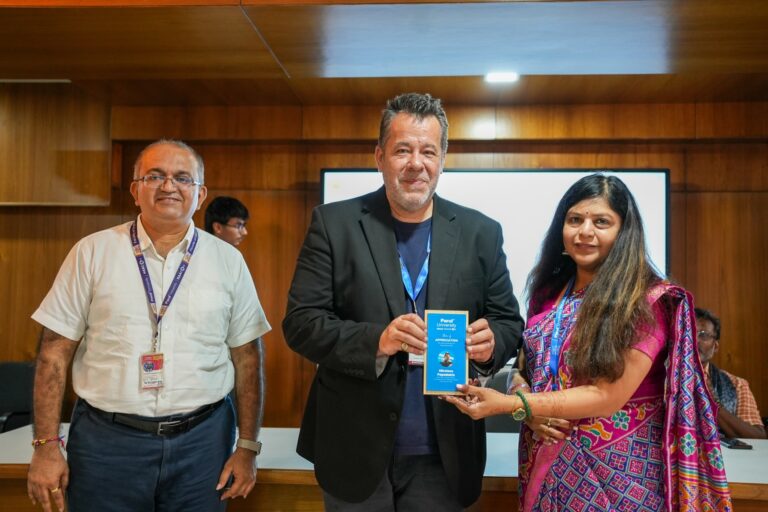
Dr. Malkhaz Nikolashvili at IVPP 2026, Parul University!
A manager who understands the machine
Dr. Malkhaz Nikolashvili is the head of the Bachelor Program of Digital Technologies and AI at Georgian-American University, Georgia. He worked as a project manager at the National Bank of Georgia, advised organisations such as USAID and UNDP, and even received a Shell Centenary Chevening Scholarship awarded by the University of Cambridge. He was a Faculty of Management Studies, Parul University, Visiting Professor under the Centre for International Relations and Research (CIRR) with classes of MBA students on the processes of running modern enterprises and the impact of the global economy on startups.
He was the pioneer of the Uber business model. Students had been comparing Uber to the traditional e-commerce model in retail, and the debate had been about Uber not having any cars and the drivers being independent contractors, not employees, and issues of wages, insurance, and security of employment. Surge pricing became a lesson in how free markets self-correct: higher prices attract more drivers, which brings prices back down. He contrasted this with the centrally planned economy of the former Soviet Union, where fixed prices removed competition, to make the point concrete
The eight elements of a business model
The core of the teaching was a working definition: a business model is simply a plan for how a company makes a profit, where earnings must exceed spending. Dr. Nikolashvili broke it into eight parts. The concept of value proposition is explained with two examples of supermarkets, one of which is winning on price and another on selection. The revenue model is the way that the company makes money, and he gave a small business a heads-up on advertising (Facebook, YouTube), subscriptions (Netflix), freemium, transaction fees (Uber, eBay), direct sales, and affiliate commissions.
The other factors that were considered were market opportunity (the choice of a city, a country, or niche to target, such as professional photographers), competitive environment, competitive advantage, market strategy, organisational development, and management team. He likened a company to cells dividing tasks in the body, cautioned small businesses not to go on a price war with larger purchasers like Amazon and reiterated that investors invest in execution and experience, not ideas.
Funding a startup and the PIERC connection
On how startups raise money, Dr. Nikolashvili was blunt that only about one in ten survives, which is why investors spread risk across a portfolio. He walked students through the stages of funding: seed capital, which is high-risk and often comes from government or university programs; venture capital once a startup has proven itself; and a commercial bank loan only when the company is stable and has assets to guarantee it.
At this point, the MBA students told him about PIERC, the Parul Innovation Entrepreneurship Research Centre, explaining how it helps them secure government and university funding and connects them with venture capitalists. Dr. Nikolashvili responded warmly and encouraged students to use that ecosystem to build businesses while still studying, a direct endorsement from an outside expert of the startup support Parul University runs through PIERC.
Cannibalisation, the value chain, and global economies
Using Lego, which sells online at the same price as in shops, he explained cannibalisation: if a manufacturer undercuts its own retail partners online, those partners stop stocking the product, so a business must never steal customers from its own channels. He taught the industry value chain through a loaf of bread, from farmer to miller to baker, with cost and value added at each step and value-added tax charged on the new value, and showed how the internet lets a business source cheaper inputs worldwide.
Comparing developed economies such as Japan and Europe with developing ones such as India and Georgia, he explained why goods are cheap but labour expensive in rich, saturated markets and the reverse in fast-growing ones, which is why India’s growth makes it fertile ground for new digital businesses. The session was highly interactive: students explained India’s income-tax system, the PAN card, and tax deducted at source, which he noted resembles the United States, and he covered business-to-business models, including e-procurement portals and private dealer networks such as a car brand’s parts system.
Strategy, and a connected-cars case
Dr. Nikolashvili set out five strategies a business can win on: product differentiation (branding tested, reliable products, as Anker does with chargers), cost competition (dangerous for startups), scope of selection, market focus (picking one niche, as Amazon did with books) and customer intimacy. He closed one session by recommending students use AI learning tools such as Google NotebookLM to study more effectively.
Teams then studied a case of connected cars for a final exercise. Students termed the current generation of cars as ‘smartphones on wheels’ and identified business opportunities such as paying parking fees, collecting tolls, paying for fuel via a touchscreen, and in-car entertainment, among others, and real concerns such as the complexity of registration, privacy issues from using location tracking, and distracting in-car advertising. The session put theory into practice and equipped students with a concrete model of building, financing, and managing a digital business.