A biomathematician focused on research output
An Associate Professor, Dr. Isaac Kwasi Adu, of Applied Mathematics at Kumasi Technical University in Ghana. He has a specialisation in biomathematics. Maths used for understanding and modelling infectious diseases. It is within which he applies optimal control methods, and his research also covers fractional calculus and optimal control theory.
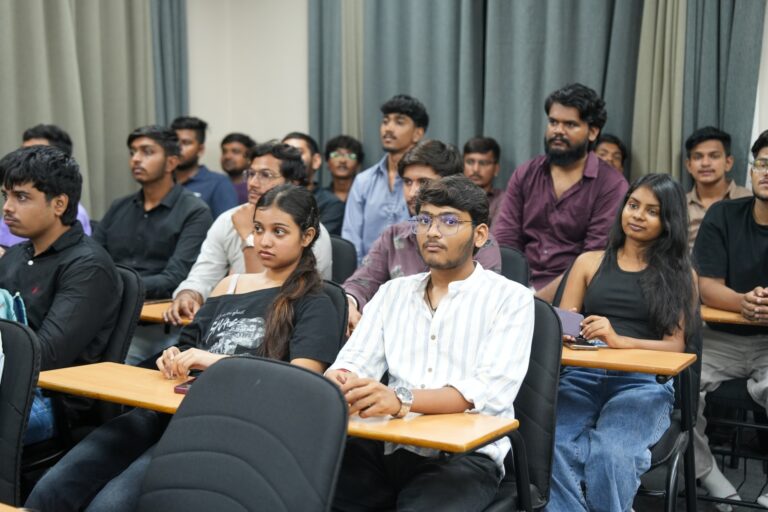
He brings 15 years of university teaching, a PhD earned in Wuhan, China, and experience as a head of department and vice-rector, along with his university’s Vice-Chancellor Star Award for Best Researcher. He chose to spend his four weeks at Parul University’s Faculty of Applied Sciences, under the Centre for International Relations and Research (CIRR) Visiting Professor Program, on both teaching and research output.
How mathematics follows a disease
Put simply, Dr. Adu explained, this field uses equations to follow a disease through a population. Researchers sort people into groups, for example those who can still catch the disease, those who are infected and those who have recovered, and ordinary differential equations track how people move between groups over time. A model lets a researcher test what would happen under different conditions before anything happens in the real world, and it becomes far more useful once real data is added. His recurring point to students was that clinical data from real diseases can be used to solve problems in society.
Optimal control and fractional calculus
Dr. Adu showed how two further tools extend the picture. Optimal control theory is about steering a system toward a target in the best possible way; with an infectious disease the target might be fewer infections, and the steering comes from measures applied over time, so the theory helps work out which strategy reaches the goal most efficiently. Fractional calculus takes derivatives and integrals beyond whole-number orders, which lets the past leave a trace on what happens next, adding memory to a model. Together the three form a chain: differential equations describe the disease, fractional calculus adds memory, and optimal control asks what should be done, and students applied all three in their own work.
From learning to published research
Rather than treat the sessions as lectures alone, Dr. Adu had students work in groups to turn the modelling into research papers meant for publication, with faculty members who share his interests joining the effort with topics of their own. This reflected his own path: his research began under a master’s supervisor who trained him well, he had published 12 papers before winning a Chinese government scholarship in 2016, completed his PhD in Wuhan in 2019, and moved to a public institution in 2021. He framed the IVPP as leaving behind a research group, fresh topics and new methods once a visitor has gone, and said some Parul University lecturers wanted to research in his area and cooperated fully.
Also Read: Understanding the Marketing Transitions