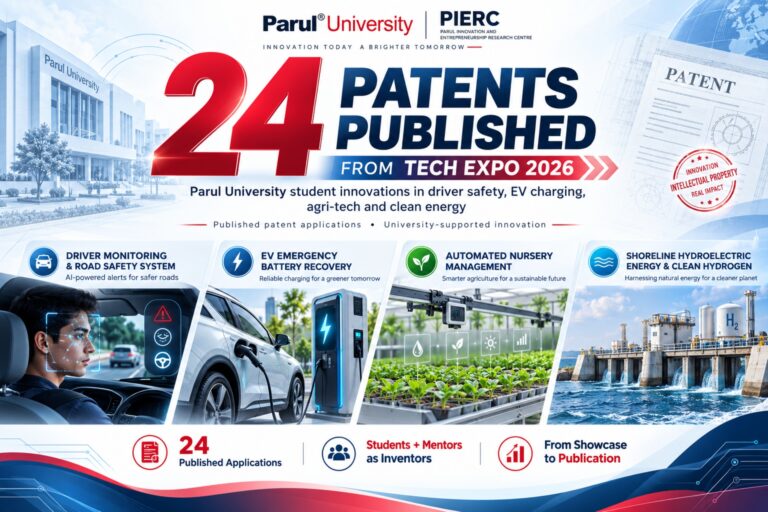
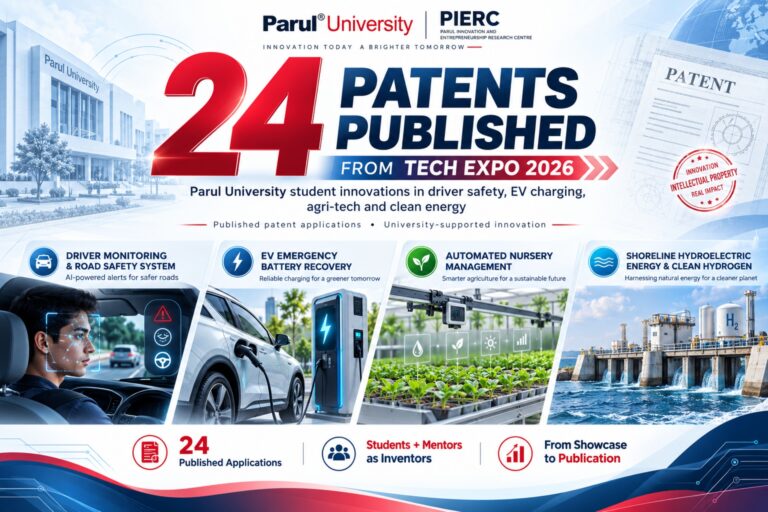
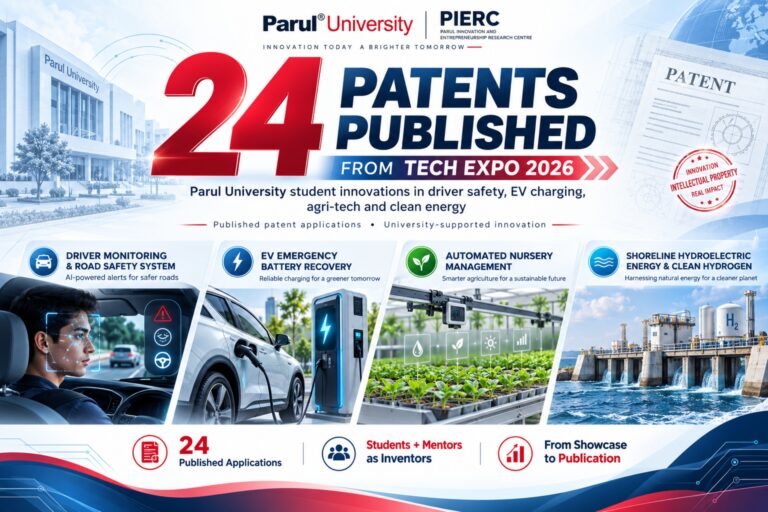
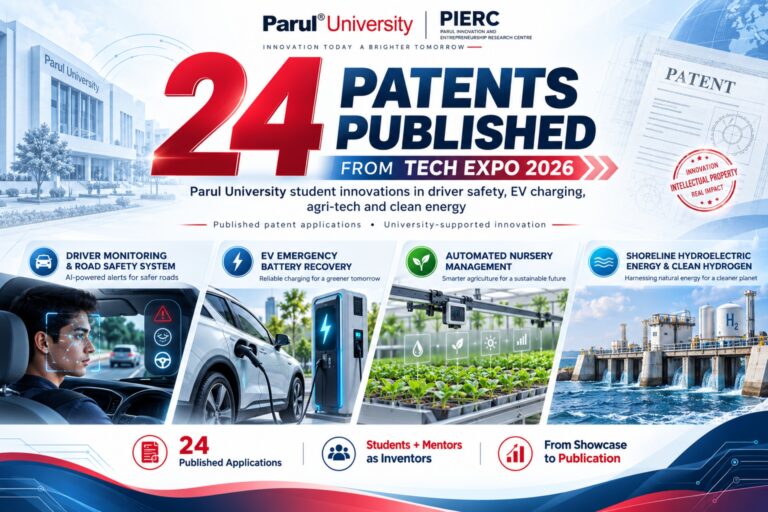
Samarth Chaurasia's Driver Monitoring and Accident Prevention Patent at Parul University!
- ● How Samarth Chaurasia and Aeklavya Patni developed a minor IoT project into a published patent application.
- ● How the system combines alcohol detection and camera-based drowsiness monitoring to address driver safety.
- ● How the students divided technical development, research, and documentation with faculty mentorship.
- ● What the published patent application covers, including sensors, facial recognition, alerts, and vehicle-start prevention.
202621060933 A
Published patent application
Approx 9 CGPA
Samarth's diploma result
Rs 7,000 to 8,000
Prototype cost
Samarth Chaurasia, originally from Uttar Pradesh, completed his Diploma in Computer Engineering at Parul University with around a 9 CGPA. An interest in the Internet of Things led him to a road-safety idea, and what began as a minor project grew into a major one, was selected for TechExpo, where it received a consolation award, and then progressed to a published patent application.
The application, titled Driver Monitoring and Accident Prevention System, is numbered 202621060933 A, filed on 13 May 2026 and published on 10 July 2026. Parul University is the applicant, and Samarth and his teammate Aeklavya Patni are named as inventors.
The problem and the system
The idea came from the risks of drunk and drowsy driving, after Aeklavya’s relative had an accident linked to it. The two set out to see whether a compact, affordable system could help.
The system combines two functions:
- Alcohol detection, intended to identify alcohol-related impairment before the vehicle starts
- Driver monitoring, using a camera to watch visible facial features, particularly the eyes, for signs of drowsiness
The design envisaged an alert when the driver appeared unfit, with further responses to detected drowsiness. Those remain development goals, and the team is clear that extensive safety testing would be needed before any real-world use.
Who built what
Samarth led the technical development. Aeklavya focused on identifying the problem, suggesting solutions and handling documentation.
The most challenging component was the eye-monitoring system, built with Python and machine-learning techniques to analyse facial movement and detect closed eyes or drowsiness. Samarth found it the most interesting part, since it needed more work than the simpler alcohol-detection component, whose early prototype could sometimes be bypassed or miss detection and had to be made more reliable.
The mentors and the patent process
Several faculty members guided the work. Vijay Vasaiya helped shape the initial idea, Ankit Jasoliya helped improve it and prepare for TechExpo, and the HOD, Poonam Faldu, advised on areas to strengthen. Om Kamal Vashi explained the patent process and the importance of documenting the invention.
What the application covers
The published application describes a driver-monitoring system with alcohol detection through a sensor-equipped air intake channel, a camera using facial-expression recognition to identify fatigue and drowsiness, and a microcontroller to generate alerts and prevent the vehicle from starting under specified conditions. It also describes proposed components such as seat-related sensors and a mechanism to spray water on the driver’s face when drowsiness is detected.
What is still to come
The biggest remaining challenge is integrating the prototype with a vehicle so it can communicate with the vehicle’s systems. The team demonstrated prototype components, but the complete system has not been implemented in a real vehicle, and the prototype cost around Rs 7,000 to 8,000.
Samarth is now pursuing B.Tech in Electronics Engineering at another college, aiming at a career in VLSI and semiconductor technology, while continuing to explore the driver-monitoring project. His advice to students is not to underestimate an idea because it starts small.
SOURCE AND CONTEXT. This article is based on an interview with Samarth Chaurasia and the published patent application. The application is published, not granted. The system is a prototype and, by the team’s own account, would require extensive safety testing before real-world use. LinkedIn profiles are linked with tracking parameters removed.
Explore the innovation ecosystem
Students with a safety or IoT idea can explore the campus innovation ecosystem and the future-skills centre.
PIERC, innovation and incubation: pierc.org
Lakshya 2047, Centre for Future Skills: paruluniversity.ac.in/academics/lakshya-2047
People and organisations
- Samarth Chaurasia Inventor, Diploma in Computer Engineering
- Aeklavya Patni Co-inventor
- Vijay Vasaiya Faculty, early guidance
- Ankit Jasoliya Faculty, TechExpo preparation
- Poonam Faldu Head of Department
- Parul University Named applicant on the patent application