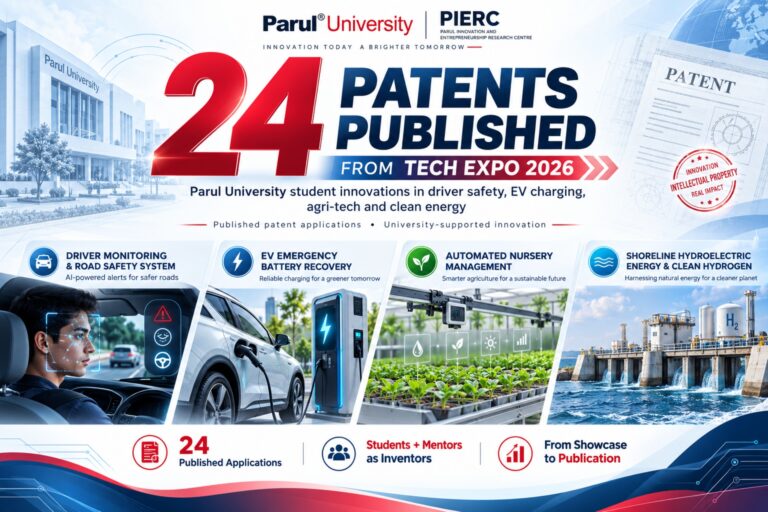
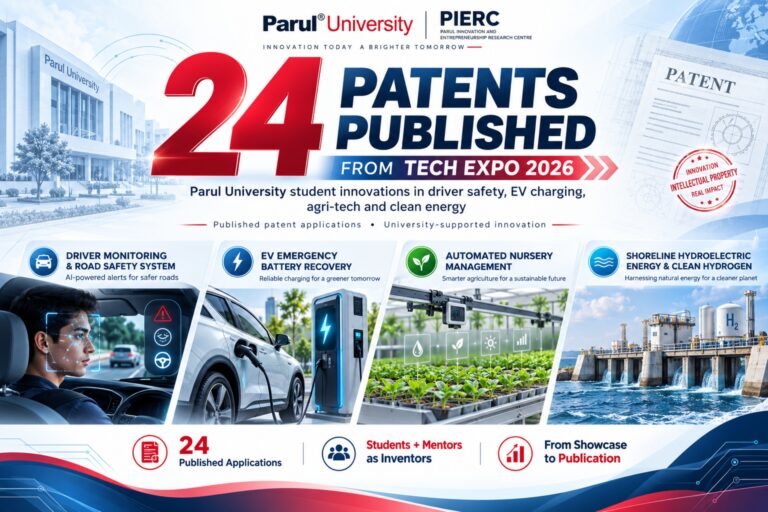
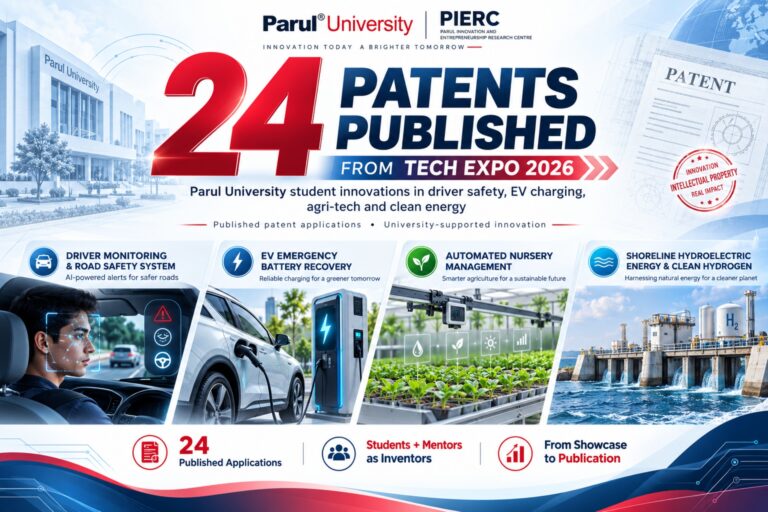
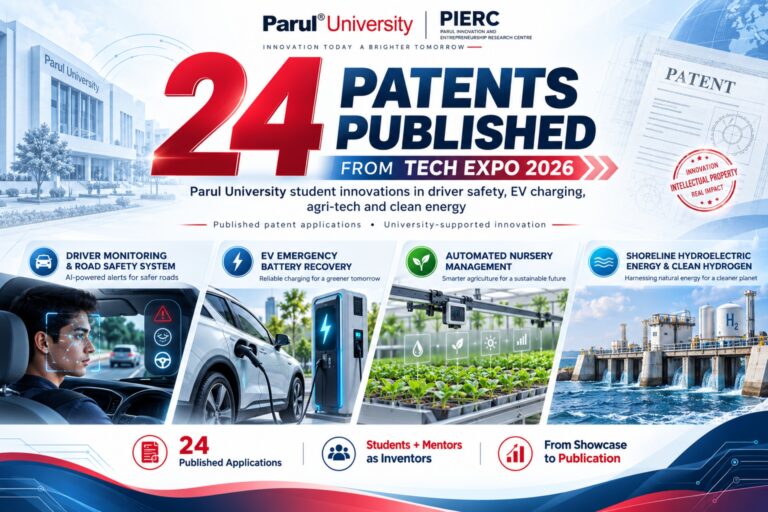
The Automated Nursery Management System: An Agri-Tech Patent from Parul University Students!
- • How a farming problem led three IT students to an agri-tech innovation.
- • What the Automated Nursery Management System is designed to do.
- • How coding, data management and farming insight combined in one team.
- • Why data collection was the biggest challenge, and what comes next.
202621063389 A
Published patent application
About 400 projects
TechExpo field it was selected from
3 students
Plus faculty inventor Shaleen Shukla
From a farm problem to a patent application
For Shivkumar Patel, Khushi Patel and Bijoy Patel, three Information Technology students at Parul University, an agricultural idea grew into the Automated Nursery Management System, a project for plant-health monitoring that reached a published patent application.
Indian patent application 202621063389 A was filed on 19 May 2026 and published on 17 July 2026, with Parul University as applicant and the three students named alongside faculty inventor Shaleen Shukla. As the records note, the publication records a patent application and does not by itself establish that a patent has been granted.
What the system does
The application describes a system combining several functions:
- Automated movement across a nursery
- Moisture and nutrient sensing
- Plant tissue analysis and plant-health monitoring
- Disease and pest detection
- Targeted dispensing of water or treatment mixtures
The aim is to make plant-health monitoring and disease identification more accessible and systematic, since plants can show similar symptoms for different reasons and the right treatment is hard to judge.
Three students, three strengths
The project worked because the three brought different strengths.
Shivkumar Patel: coding and data
He led the coding and database development, moving into AI, machine learning, computer vision and neural networks through implementation. He had earlier built a women’s safety app, and this project stretched him into a new domain with more complex data.
Khushi Patel: data collection and research
She led data collection and management, approaching institutions and researching sources, and brought an understanding of academic research built up through Google Scholar and faculty publications.
Bijoy Patel: the farming perspective
He brought a real farming background. Noticing his wheat crop turning brownish and tracing it to excess moisture taught him why accessible, reliable crop information matters, and he kept the team focused on affordability, local soil differences and plain language for farmers.
The hardest part: data
Data collection might seem easy. But it is not. A lot of planning, how to collect, what tools to use, which location etc, requires to be decided. Hence, it happens to be a challenge. And with agricultural data, the collected data might vary. It depends on the crops, regions, and growing conditions. Also the information from space may not hold true for another. The team has to find, arrange, and prepare suitable data. It is done while building the system. It learned that an AI application is only as good as the data behind it.
TechExpo and mentoring
The project was chosen at TechExpo out of roughly 400 proposals, which encouraged the team to consider actual implementation. Mentor Shaleen Shukla (faculty member and inventor in the team as well) assisted them with the presentation of their work in the showcase. The team agrees that successful collaboration does not presuppose equal skills, only openness to discuss and unite coding, data, and agricultural knowledge.
Affordability and future plans
The team wants to make sure that the technology is feasible and affordable with understandable language for farmers, and even subscribers, though the price is not determined yet. Their plans involve considering more plants and analyzing the soil, which will require additional data collection and testing in different conditions.
To junior students, the advice from the team is to work on the ideas and do not wait till everything is understood before doing it.
SOURCE AND CONTEXT. This article is based on an interview with the project team and the published patent application. The application is published, not granted. LinkedIn profiles are linked with tracking parameters removed.
Explore the innovation ecosystem
Students with an idea rooted in a real problem can explore the campus innovation ecosystem.
PIERC, innovation and incubation: pierc.org
Lakshya 2047, Centre for Future Skills: paruluniversity.ac.in/academics/lakshya-2047
All programmes: paruluniversity.ac.in/all-programs
People and organisations
- Shivkumar Patel Inventor; coding and database development
- Khushi Patel Inventor; data collection and management
- Bijoy Patel Inventor; agricultural perspective
- Shaleen Shukla Faculty mentor and named inventor
- Parul University Named applicant on the patent application