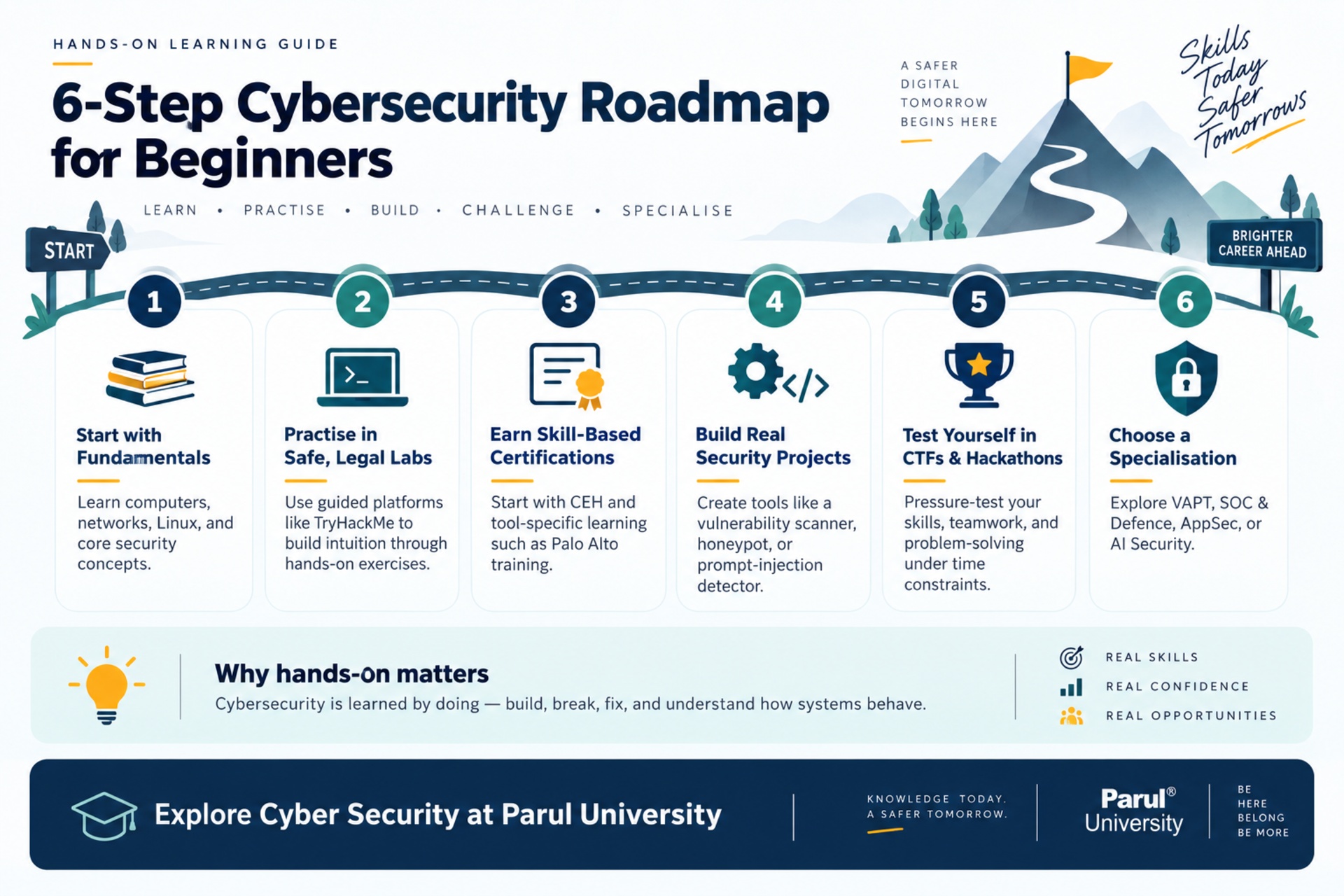
To gain in depth knowledge of any field, one should also take practical exposure. And real experience is gained by working on live projects, or practicing at labs available like Parul University has. When you ask anyone who is in cybersecurity, they will say it is learned by doing. Theory is definitely necessary to gain the knowledge of concepts. Without concepts one can’t understand the practical part too. But after learning the concepts one should work on to having skills through working with systems, encountering errors, exploring vulnerabilities, and seeing how defence actually behave.
That is exactly how Mohith Neravati, a Parul University cybersecurity student, went from a simple curiosity to 1st Runner-Up at a national PwC hackathon . Here is the hands-on roadmap his journey maps out.
Step 1: Fundamentals
It is very important to focus on basics. One should not take learning fundamentals as last thing in their list. If you plan to start then start with gaining knowledge on how computers, networks, and operating systems (especially Linux) work. Apart from that check the box of learning core security concepts, how vulnerabilities arise, how attacks work, and how defences respond.
A good academic curriculum provides this base, and it is what makes your practical work meaningful rather than mechanical. When you are building tools, these basics, problem-solving ability and structured training help you.
Step 2: Practise in Safe, Legal Labs
This is where cybersecurity learning comes alive. Use tools that teach you and help you grow. Give a safe space to take risks. One can try using tools like TryHackMe. As it offers guided, legal, hands-on labs. It has a simulated space where you can practice without any fear, and make mistakes so that you learn from it. You can practice both attacking and defence systems. This gives you a structured learning path. Through this you get to face real errors, explore how vulnerabilities behave, and build genuine intuition. These things are not taught in lectures. The key to practice is legal, that is practice on platforms designed for it, and not on systems you don’t own or have permission to test.
Step 3: Earn Certifications That Prove Skill
Certifications structure your learning and signal your ability to employers. A widely respected starting point is the Certified Ethical Hacker (CEH) from EC-Council, which builds understanding of ethical hacking through scenario-based problems. Vendor programmes, such as those from Palo Alto Networks, add practical, tool-specific knowledge. Certifications are most valuable when they sit on top of real hands-on practice, proving not just that you studied, but that you can do.
Step 4: Build Your Own Security Projects
Nothing demonstrates ability like building something real. Creating your own security tools, a vulnerability scanner, a honeypot, an analysis engine, forces you to understand concepts deeply enough to implement them, and gives you concrete proof of skill for interviews and competitions. Mohith built exactly these: a deception environment, a web vulnerability scanner with remediation advice, and a prompt-injection detection engine. Crucially, build them independently, with real understanding, rather than copying, using AI as a helper, not a substitute for knowing how and why a system works.
Step 5: Test Yourself in CTFs and Hackathons
Once you have skills, pressure-test them. Capture the Flag (CTF) competitions and cybersecurity hackathons put your knowledge to work against real challenges and a clock, and they build exactly the teamwork, time management, and calm-under-pressure that the job demands. They are also where you meet the community and prove yourself. If the idea feels intimidating, remember that Mohith’s first hackathon ended in a national podium finish, so do not wait to feel ready.
Step 6: Specialise
As you grow, focus. Cybersecurity is broad, spanning areas like Vulnerability Assessment and Penetration Testing (VAPT), security operations and defence, application security, and now AI security. Choosing a specialisation, as Mohith did with VAPT, lets you develop genuine depth and become the person a team relies on for that skill, while the strong foundation beneath it keeps you adaptable. To understand the career paths this can lead to, from red teams to blue teams, see our guide to cybersecurity careers.
FAQS
How should I learn cybersecurity, as a fresher?
As a fresher, it is necessary that you focus on basics. Make the fundamentals strong. You can do it by understanding the foundations in computers, networks, operating systems and security concepts. Next you can use the tools where you take risks, make mistakes and learn from it such as TryHackMe. Earn certificates like CEH. Make your own security projects, and test your knowledge in CTFs and hackathons. Through all these you will understand that cybersecurity is a field that is learned by doing and not by theory alone.
What tool to use for learning cybersecurity?
You can use TryHackMe tool. Yes, it is a great tool that allows you to take risks. A guided platform, legal with hands-on labs and a simulated space for beginners. You can safely practice attacking and defending systems. And work through structured learning paths. They build the practical intuition that theory cannot, which is why many successful learners rely on them.
What certifications are good for cybersecurity beginners?
A widely respected starting certification is the Certified Ethical Hacker (CEH) from EC-Council, which teaches ethical-hacking concepts through scenario-based problems. Vendor programmes, such as those from Palo Alto Networks, add tool-specific skills. Certifications work best alongside real hands-on practice and projects.