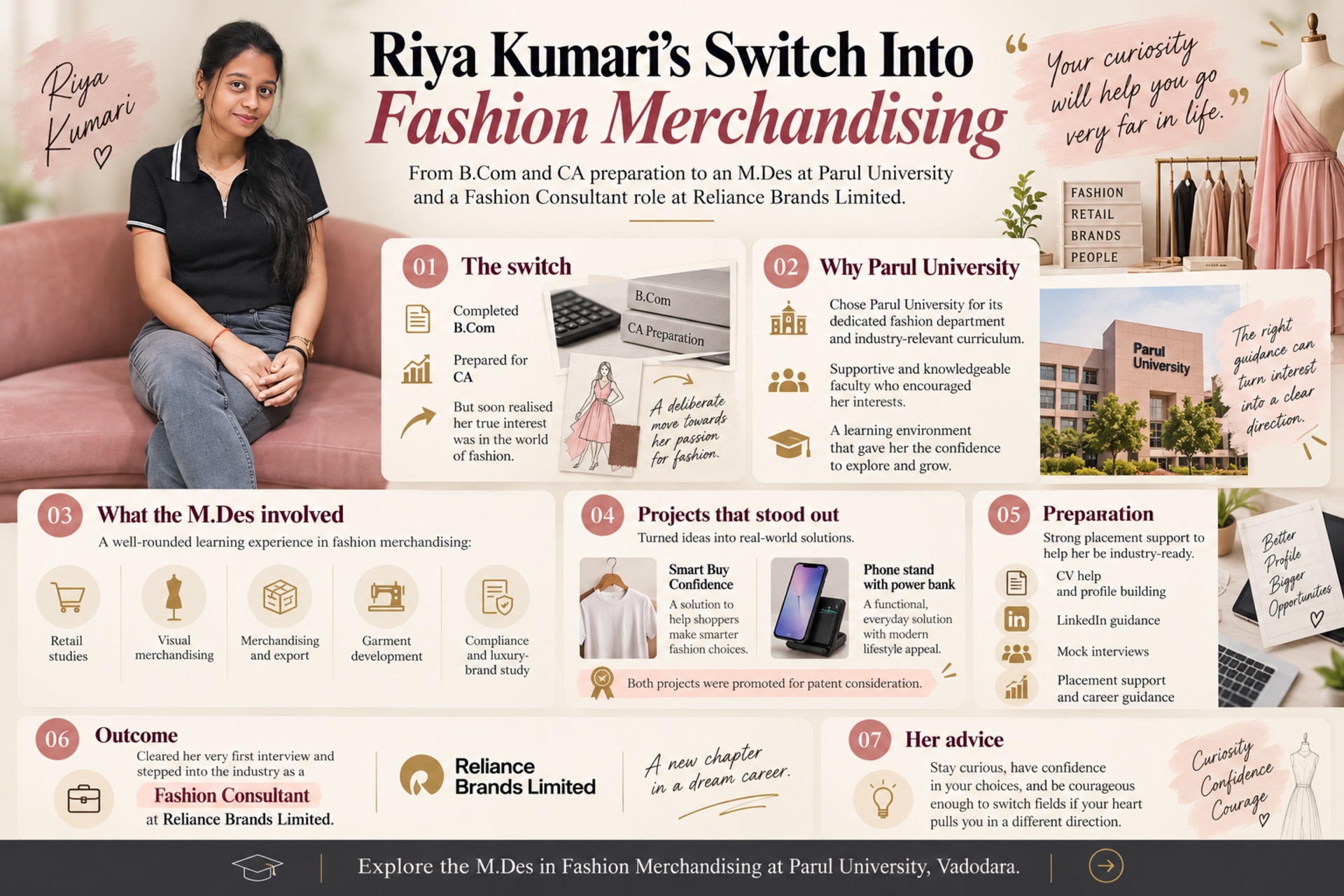
Riya Kumari‘s placement is unusual in two ways. It followed a full change of field, from commerce and a Chartered Accountancy track into fashion, and it was the first interview she had ever sat. No prior internship, no earlier job, one interview, one offer, at Reliance Brands Limited. The role of Fashion Consultant she now holds is the end of a decision most students are afraid to make: leaving a path that was not working to pursue one she actually wanted. That decision, rather than the offer itself, is the real subject of her story.
She pursued B.Com initially and then went for preparation on Chartered Accountancy. After understanding the course and staying in it for a long time, she realised that it doesn’t suit her. Instead of taking it as a setback she planned to switch the field. She researched about the Fashion field, a field that interests her from childhood. The switch was deliberate. Started the fashion field journey with one year diploma in Fashion Designing to build a foundation. Then took M.Des in Fashion Merchandising at Parul University. The point to focus on is that with this degree she didn’t leave her commerce background, instead she used it for the business side of the fashion and learn more about it with the master’s degree she took.
“I was interested in fashion but I also had an inclination towards business, so my commerce background stayed useful for understanding the business side of fashion.”
Why she chose Parul University
Riya says she came to Parul University specifically aware of its Fashion Department, having heard positive things about it, particularly the faculty. Her experience after joining matched that expectation. She describes the faculty as supportive, cooperative and helpful throughout the Master’s, and credits their involvement across both the academic and placement process with making the journey easier and building her confidence to move forward. For a student who had just changed fields and had no prior work exposure, that support mattered more than it might for someone already settled in their track.
What the M.Des actually involved: projects over theory
The strongest part of Riya’s account is how practical the programme was. She worked on projects spanning the breadth of the fashion and retail ecosystem rather than isolated design exercises:
- Retail, visual merchandising and quality assurance studies, including store visits and VM analysis.
- Merchandising and export projects covering the stages of merchandising and retail operations.
- A merchandising kit covering costing, merchandising calendars and export documentation, which is the business and operational side of fashion.
- Garment development: in the first semester, students created their own collection and developed a garment from it, translating an idea into an actual product.
- Compliance and luxury-brand study, broadening exposure to different retail environments.
This range is what she drew on in her interview. When she was asked questions, she answered with reference to the projects she had actually done, which is the clearest argument for doing real project work rather than treating it as a formality. A CV point you can explain from experience is worth more than one you cannot.
Projects promoted for patent consideration
Two of Riya’s projects were recognised and promoted for patent consideration by the jury. It is worth being precise about what that means: these were projects recommended for patent consideration, not filed applications and not granted patents. Within that accurate framing, they are a genuine signal of original thinking.
- Smart Buy Confidence: a project built around helping customers make more informed and confident purchasing decisions. Riya says it received recognition from Reliance and was promoted for patent consideration by the jury.
- A design-thinking product: a phone stand integrated with a power bank, conceived from the everyday frustration of charging wires and the inability of static phone stands to adjust angles. This too was promoted for patent consideration.
Both came out of a design-thinking approach that pushed students to start from a real customer problem rather than a brief. That is the habit that distinguishes a merchandiser who understands customers from one who only processes products.
She prepared: faculty and the placement team
The preparation was strict and regular. Riya was disciplined and specific with her preparation. She mentioned her professors, faculty who have helped her. Rajat Bhattacharya helped her with her LinkedIn profile and making CV, along with interview preparation, mock interviews, and giving the questions that might be asked, clarifying doubts. She was helped by Anand Bharadwaj and Dhara Vinod Sharma. She mentioned that practising the interviews in a certain way will help the students understand what matters and what steps will not help in the moment. She also credits the Training and Placement team. Speaking about Ankit Pandya and Andrew Nassar who helped her by creating the connection with Reliance Brands Limited. They coordinated students with location, package and brand-related queries.
One clarification from Riya is worth preserving exactly, because it reflects her actual experience rather than a generic claim: her batch did not undergo a separate dedicated training programme for this placement. The preparation came through the faculty and the placement team’s coordination. Stating that honestly is more credible than adding a training label that was not there.
The interview, and the role
The selection was a single interview round, which Riya describes as a one-to-one, communication-based interaction. The interviewers were less interested in theoretical knowledge than in how a candidate communicated: how she responded to questions, managed the flow of conversation, expressed herself, handled an unexpected turn, and carried herself with confidence. That focus makes sense given the role. A Fashion Consultant at Reliance Brands works on the retail floor, managing in-store supply-chain inventory, consulting customers who visit the store, and handling sales, so communication and confidence are not soft extras, they are the job.
For Riya, clearing it carried extra weight because it was her first interview ever, across her entire path from CA to commerce to the diploma to the M.Des, with no internship or job in between. She called her parents over video immediately. They were proud and passed the news to relatives. She described the feeling simply:
“It was extremely thrilling. It was my first ever interview and I cleared it.”
Her advice: driving force, curiosity, and the courage to change
Riya’s advice to students is drawn directly from her own path. She tells students to find their driving force, to understand what genuinely interests and motivates them. Hers, she says plainly, are fashion, business and independence, in that progression. She has a specific message for young women: become self-sufficient and do things yourself rather than depending on others, with a longer-term ambition to gain professional expertise and eventually build her own business, while being honest that she is at the start and has much to learn first. She also urges students to stay curious beyond their syllabus.
“Your curiosity will help you go very far in life.”
Her message was simple: keep the curiosity alive. She shared from her own journey of transitions that it is acceptable to change your career path. Initially, some students make the choice or think that a particular type of career might suit them. After a point they might even feel that it is not something that they are looking forward, hence it is okay to change the field and have the courage to do so. Riya Kumari left the CA path and went to fashion to pursue what actually suits her.
Also Read: Fashion Merchandising Explained. Different Careers, Roles and Business Mind Helps
Frequently asked questions
Can you switch to fashion from a commerce or CA background?
Yes, you can switch the field. Someone from a commerce or CA background can pursue fashion field. Riya Kumari being one of such person who did. She started with a diploma in Fashion Designing and then M.Des in Fashion Merchandising at Parul University. With this, she could crack the Reliance Brands Limited interview. Giving her an advantage in understanding the commercial part of fashion.
What is the role of a Fashion Consultant at Reliance Brands Limited?
Tasks of a fashion consultant at Reliance Brands Limited is to work on the retail floor. Riya Kumari shares that her role is to manage the in-store supplies, check supply-chain inventory, consult customers who visit the store and handle sales.
Were Riya Kumari's projects patented?
No. Two of her M.Des projects, Smart Buy Confidence and a design-thinking phone stand integrated with a power bank, were recognised and promoted for patent consideration by the jury. That means they were recommended for patent consideration, not that patents were filed or granted. The recognition reflects original, problem-driven thinking during the programme.