Many capable people hesitate before an MBA for one reason unrelated to the degree: they took a break. Maybe it was two years preparing for competitive examinations, time spent on family responsibilities, a job that did not work out, or a health reason. The fear is always the same: that the gap has quietly closed the door on placements. It has not. You can get placed after a career or study gap, and many people do. But the honest answer matters more than the reassuring one, because a gap does change what you have to do, and pretending otherwise helps no one.
What a gap actually changes.
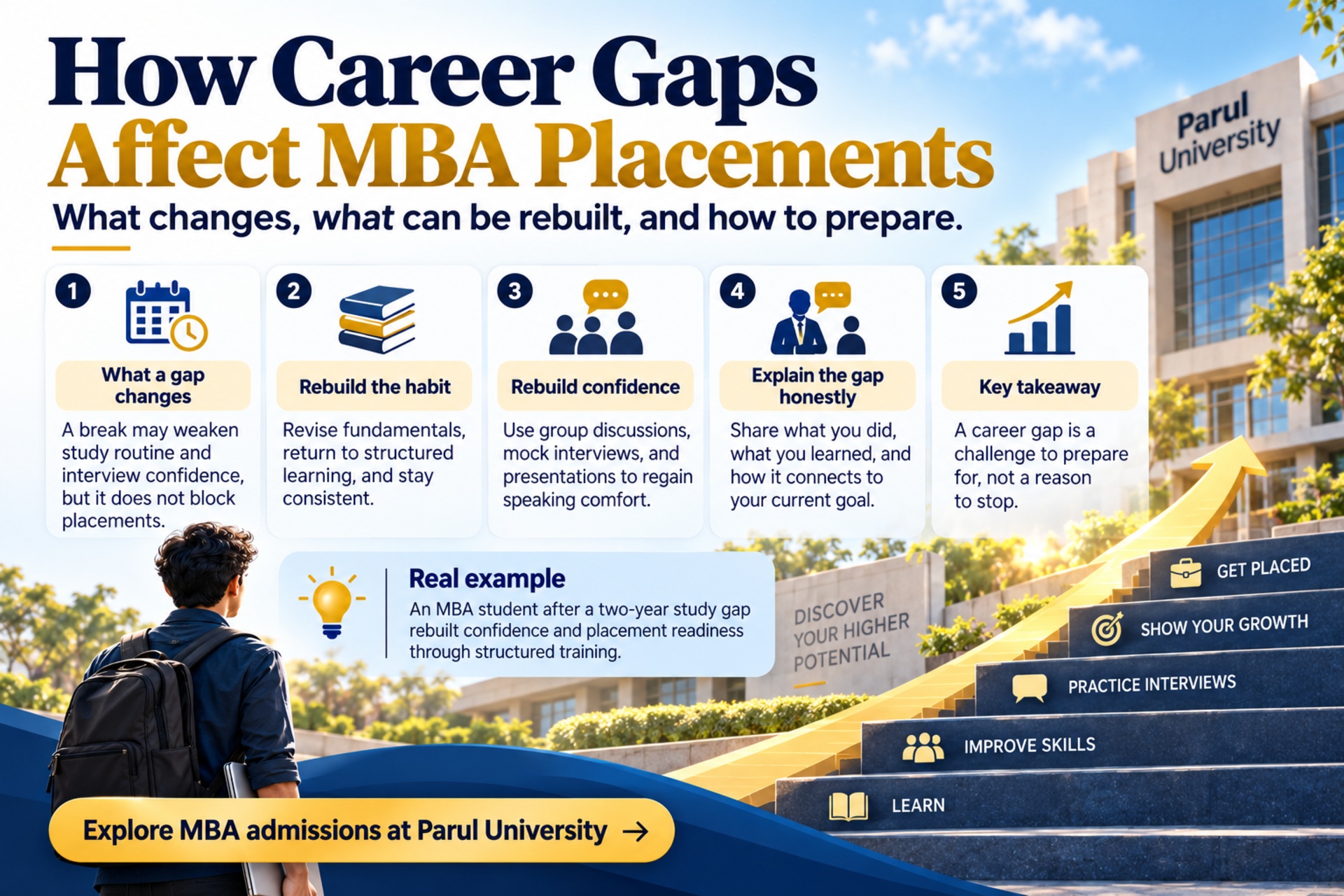
The real effect of a gap is rarely what students fear. It is not that recruiters reject you on sight. It is that time away from structured study erodes two specific things: your academic routine and your comfort in high-pressure spoken situations like interviews and group discussions. If you spent a couple of years out of formal education, returning to lectures, assignments, and examinations is itself an adjustment, and you may need to revise fundamentals your classmates still carry fresh. Just as importantly, long periods outside academic or professional settings tend to dull the ease of speaking in front of others. These are the things a gap damages, and the good news is that both are rebuildable.
Rebuilding the academic habit
After a break, the most mundane job is to make the comeback together. This is part of it: being able to take it in stride that you might have to practice more than the people around you, particularly in a field that you haven’t been working in for years. This is not a cheat code; it’s the first challenge of the course mindset. Aadishaisav Bhakt, one of the MBA students at One Parul University, took a break of about two years to prepare for competitive exams before making his way to MBA Banking & Finance. This is what he has to say about it: “I had to start studying from the beginning, as I took a break for about 2 years to prepare for competitive exams before enrolling in the MBA in Banking & Finance. Clearing that hurdle was one of the things the MBA had given him, and he viewed that as a good thing, not a bad thing.
Rebuilding confidence and communication
Many people find that discussions, presentations, and interviews in groups are more intimidating than before after a break. This is normal, but it can be corrected (but not by reassuring; it has to be repeated). The structured employability or soft-skills training in which you are required to speak on topics you are given, to provide opinions in groups, and to sit through mock interviews is the best method to rebuild it, as it is what you will go through during a placement. This type of training is cited to the student above as being responsible for moving them out of their comfort zone and making the actual selection stages more familiar to them: impromptu speaking, group discussions and mock interviews. If there is this, then make it the main preparation instead of an additional activity.
How to explain a gap in an interview?
Recruiters are looking for a genuine profile and interest. They’re interested in an organized presentation of your decisions. Covering up a gap or apologising for the gap is the worst thing to do. The right approach is to explain what you did in the break, what you learned, and how it relates to where you are now. Using time for preparation for competitive examinations. For example, it is a defensible, disciplined use of time and can show persistence rather than drift. The idea is to have ownership of the choice and continuity. The interviewer who recognises your trajectory and the fact that you can articulate it without defensiveness is a lot more comfortable than the interviewer who thinks you are skirting the topic.
Why failure during the process is not the gap's fault
Gaps often lead people to see an early rejection to their placement as the validation of the worst fears about the break, that it has rendered them unemployable. Usually it has not. People with even the best academic records face rejections, which are best responded to in the same way as for anyone else: an unsuccessful interview must be treated as information and preparation for the next one, not as a verdict. The student example shows an early rejection by one company preceding a successful placement with another, and the advice that helped was that the failure is the first step to success. The same internalisation of the fact that a single rejection is not the gap’s verdict is half the battle for someone in a similar boat.
Selecting a program to assist the rebuild
The one thing which a program can provide when it is intended to return for further education after an absence is the preparation for placement in a structured way together with the learning of the content. Focus on employability or impact training, mock interviews, group-discussion training, and presentation training, and an active placement cell, not just the course syllabus, when evaluating MBA programs. Employability-skills sessions, mock interviews and presentation training, for example, are conducted along with the subject teaching in the MBA at Parul University, which is the mix that works for gap students. It is the same everywhere: a gap is something to overcome and learn how to deal with, rather than a wall.
FAQs
Is there an opportunity to be placed after a career break or study hiatus?
Indeed, a break from academics and interviews is not necessarily a barrier to placements due to a career or study gap. The important thing is to reconstruct their study discipline, to regain self-confidence in their speaking skills, and to explain the absence in an open and truthful manner.
So, what is the best way to explain a gap year during an interview for a placement?
Describe what you did in the gap, what you learned from it, and how it is helping to further your current objectives, but don't be apologetic. Not taking competitive exams or sitting for them for a long time could demonstrate discipline and persistence. An interviewer wants a candidate to acknowledge his choices, rather than cover up or rationalise the situation, and explain them clearly.
Is there any impact on MBA placements with a gap year specifically?
A gap can make the first part of the MBA more difficult, as you may have to learn how to study differently and even revise what you studied in the first place, and it can make you feel more intimidated during your interviews, but it doesn't prevent placements. Subject teaching alongside employability training, mock interviews, and presentation practice helps gap students to return to both the academic and the confidence side, the latter being what is tested in the selection process.