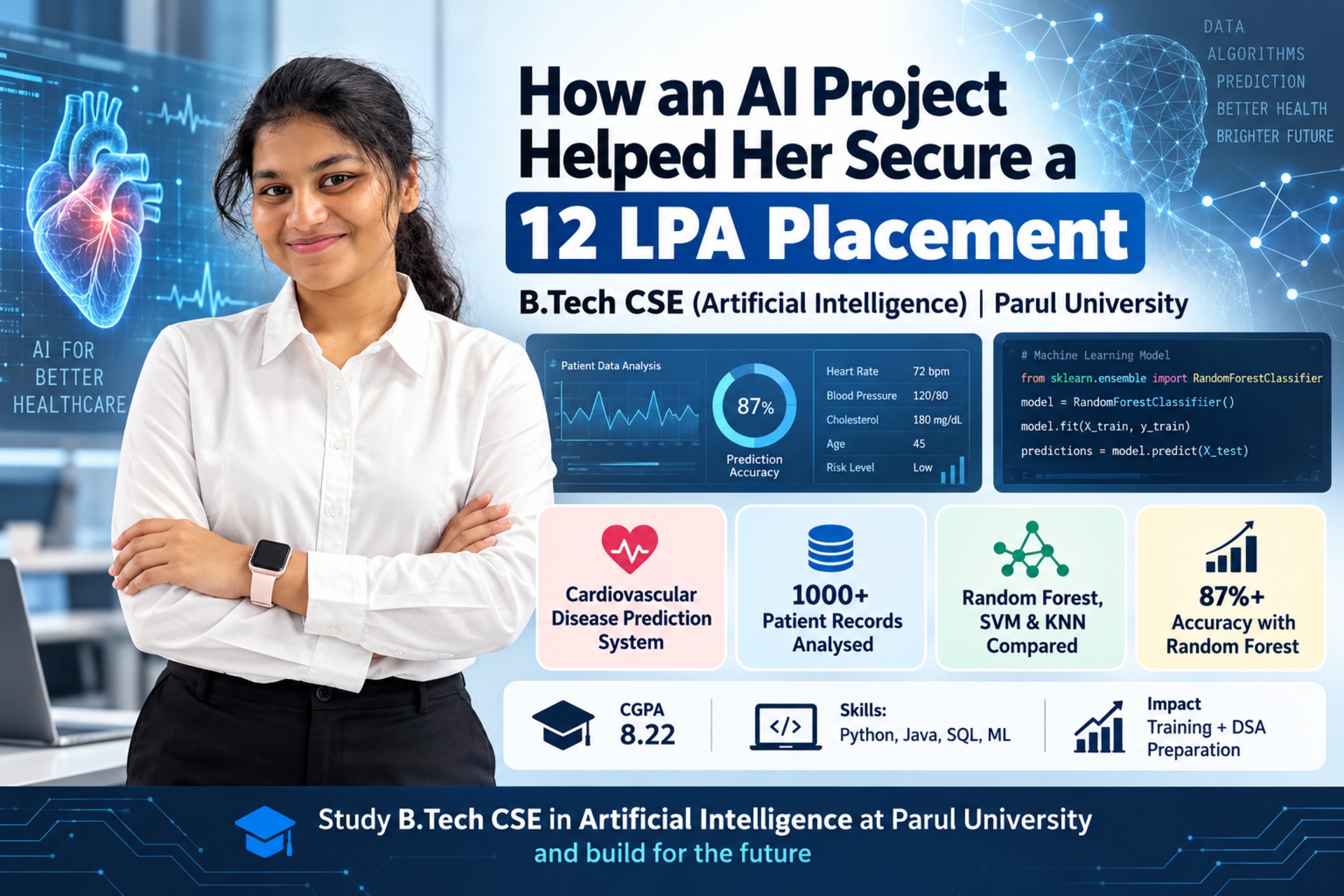
Kancharla Sankeerthana made one of the decisions that every engineering student is discouraged from taking: she took the wiffle ball and went narrow. There were no hackathons, no distribution of her activities throughout her degree, just her academics, her fundamentals, and one project on machine learning that she knew inside and out. The latter, a system to predict cardiovascular disease, was the one thing that got her a 12 LPA offer from SAP Labs India during the placement interview. A final-year B.Tech student specialising in Artificial Intelligence in Tech Computer Science at Parul University, Sankeerthana has a CGPA of 8.22 and is a counter to the notion of placement readiness being about doing everything. Sankeerthana is from Andhra Pradesh and chose to study away from home deliberately, to become more independent and widen her exposure to new people and opportunities. Her choice of specialisation was just as considered. She describes her interest in artificial intelligence in terms of what it lets her do rather than as a subject to clear.
“I chose artificial intelligence because I’m interested in technology and problem solving, and AI allows me to build intelligent solutions for real-world problems.”
That orientation, toward building things that solve real problems rather than collecting credentials, is the thread that runs through her whole account. Over her degree, she built working knowledge of Python, Java, SQL, and machine learning, and she is clear that these were not CV line items but connected skills that produced applied work, the kind interviewers later questioned her on in depth.
Choosing depth over breadth
When asked directly about hackathons and study fests, Sankeerthana did not hedge.
“No, I have never participated in hackathons.”
This is worth sitting with, because it runs against the usual advice. Rather than spread her energy across competitive events, she concentrated it on academics, her project work, and building the kind of depth that would matter most in interviews. By her own assessment, and by the outcome, the trade-off worked in her favour. The lesson is not that hackathons are useless; it is that a student who knows one real thing completely can be in a stronger position than one who has touched many things lightly. Depth is a defensible strategy, not a gap.
The project that carried the interview
The centrepiece of her placement story is her final-year project, a cardiovascular disease prediction system, and understanding it explains why she stood out. She built it in Python, using Pandas and NumPy for data handling and Scikit-learn for the machine learning models, working with a dataset of more than a thousand patient records, a scale large enough to demand careful preprocessing and validation.
“I worked with more than a thousand patient records and compared algorithms like Random Forest, SVM, and KNN. Random Forest performed the best, achieving more than 87 percent accuracy.”
Two things about her method matter. First, she did not commit to one algorithm up front. She compared Random Forest, Support Vector Machines, and K-Nearest Neighbours, which let her make an evidence-based choice rather than an assumed one. Random Forest won, at over 87 percent accuracy. Second, she validated properly: a confusion matrix and cross-validation to confirm the result was reliable and not a product of overfitting or a lucky sample. The system’s purpose was preventive, predicting whether someone is likely to develop heart disease from existing patient data, flagging risk before onset rather than diagnosing after. That real-world relevance is exactly what made it a natural conversation starter with interviewers.
Interview process of SAP Labs India!
Sankeerthana found that her SAP Labs India interview revolved around her project rather than generic theory, which meant her go-deep strategy paid off directly.
“They asked more questions only on this project and situation-based questions. How did you manage a thousand patient records, and what are the challenges you faced during your project and your team?”
She says that the way the interview went was determined by the question: what would you do, and the technical one: how. It’s a silent discussion that runs throughout her narrative: If you don’t already know your project, you won’t get very far with an interviewer. She had seen the bumpy road, the data-processing woes, and the squabbling among her staff and was able to talk them down, not freeze them out.
How she prepared: fundamentals, project, and impact training
She was preparing on two fronts: data structures and algorithms and her project. She learned early that DSA is the main source of over half the recruitment-hungry companies visiting her campus and made it a habit to revisit her basics and rehearse her project from all angles: technical, situational, and reflective because she knew it was going to be called into question. She attributes the Impact Training at the university in particular, and without which her account would not be complete. Here, faculty taught her about DSA, operating systems, and other topics, but one thing comes to mind: how to tackle new problems and how to discuss them with confidence.
“At that time, they helped us to solve new problems and to speak confidently. It helped me so much in my placement journey.”
One of the mentors who helped her the most was Nikhil Sir, who not only gave her technical help but also gave her the confidence to tackle problems she had never encountered before. That’s the mental attitude of being able to respond to pressure and the technical preparation she brought to the SAP Labs interview. Ready to build your future in AI and technology? Explore a B.Tech in Computer Science & Engineering, a B.Sc. IT in Artificial Intelligence Systems, and a Master of Science (M.sc IT) in Artificial Intelligence at Parul University.
Selection, and a family dilemma resolved!
Her SAP Labs India offer came at 12 LPA. By her own account, it was the highest in her batch this year, a claim worth noting as hers rather than a university record. What mattered more at home was that the offer resolved a genuine disagreement between her parents: her mother had hoped she would pursue an M.Tech., and her father preferred she take a job. The outcome felt to her family like it honoured both hopes at once, which made the moment especially meaningful for them. She was among the first in her circle to receive an offer of this scale.
Takeaway for AI enthusiasts!
She tells juniors there are two things that companies look at when they’re hiring on her campus: data structures and algorithms and communication skills. She also encourages students to complete the training, which is led by the university, in full; for instance, certifications like GCP training are added value for placement. The one takeaway she delivers is straightforward: Do it all, take advantage of the basic curriculum, as well as the softer skills: communication and composure. In the future, she wants it to be more about the direction she’s headed, rather than the final goal: to be technically strong, work on more difficult problems, and continue to develop with the organisation she is joining.
FAQs
What package did Kancharla Sankeerthana get at SAP Labs India?
Kancharla Sankeerthana, a B.Tech CSE (Artificial Intelligence) student at Parul University, received a 12 LPA offer from SAP Labs India. By her own account it was the highest offer in her batch this academic year. Her placement centered on a machine learning final-year project rather than on competitive events like hackathons.
What was her machine learning project?
She built a cardiovascular disease prediction system in Python, using Pandas and NumPy for data handling and Scikit-learn for modelling, on a dataset of more than a thousand patient records. She compared Random Forest, SVM, and KNN, with Random Forest performing best at over 87 percent accuracy, and validated her results with a confusion matrix and cross-validation. The system predicts heart disease risk before onset.
How did she prepare for her placement at Parul University?
She focused on data structures and algorithms as a daily practice, since it is the primary filter for most campus recruiters, and rehearsed her project from technical, situational, and reflective angles. She credits the university's impact training and mentor Nikhil Sir for teaching her to approach unfamiliar problems and communicate with confidence under interview pressure.