India is in the Amrit Kaal, the operational phase from 2022 to 2047, according to the policy the government has made. India envisions becoming a developed nation, or “Viksit Bharat” by 2047. The reason for choosing 2047 is that India will be completing 100 years of independence.
The educational dimension is the one that determines whether the rest is achievable. The plan is simple: to teach the required skills and to integrate the skills, courses, and the learnings in the degrees, school education, certifications, and more.
Skills are the binding constraint on every other ambition in the Viksit Bharat framework.
Defining 'future skills': what the term actually covers
The Indian policy ecosystem, working through the National Skill Development Corporation (NSDC), the All India Council for Technical Education (AICTE), and the Department of Science and Technology (DST), has converged on a working definition of future skills that covers ten to twelve technical domains. The list is operational, drawn from national mission portfolios and industry-skill gap analyses.
- Artificial intelligence and machine learning: neural network design, computer vision, natural language processing, generative AI, MLOps.
- Cybersecurity: network security, application security, threat intelligence, security operations, governance and compliance.
- Cloud computing: infrastructure-as-code, DevOps, multi-cloud architecture, cloud security, FinOps.
- Semiconductor and VLSI design: integrated circuit design, EDA tooling, semiconductor device physics, fabrication-process literacy.
- Quantum technology: quantum computing, quantum communication, quantum sensing, quantum materials science.
- Drone and unmanned systems: drone piloting (RPTO certification), drone systems engineering, battery technology, autonomous flight control.
- Robotics and industrial automation: robot programming, PLC and SCADA, multi-robot cell design, vision systems integration.
- Sensor technology and IoT: electrochemical sensors, biosensors, embedded systems, edge computing.
- Augmented and virtual reality: spatial computing, immersive simulation, AR development on consumer and enterprise platforms.
- Advanced fabrication: industrial additive manufacturing, CNC machining, precision metalwork, MEMS fabrication.
- Mobile and software development: iOS and Android development, full-stack web, cross-platform application engineering.
- Engineering simulation: FEA, CFD, multiphysics modelling using ANSYS and equivalent tooling.
These domains are not parallel; they are interlocking. AI workloads run on cloud infrastructure that depends on semiconductor supply chains. Drones rely on sensor technology and embedded systems. Cybersecurity sits underneath all of it. The National Quantum Mission, the IndiaAI Mission, and the India Semiconductor Mission together signal the policy-level recognition of that interlocking structure.
The NSDC Centre for Future Skills model: what national-scale skill build-out looks like
The Government of India, through the National Skill Development Corporation (NSDC) under the Ministry of Skill Development and Entrepreneurship, has been building a network of Centre for Future Skills (CFS) facilities across leading higher-education institutions in India. The model is a direct institutional response to the future-skill question this article is concerned with.
The NSDC Centre for Future Skills model is currently active across 11 institutions in India and has already trained over 50,000 candidates. The CFS network operates through a structural partnership: NSDC provides the policy framework and skill-certification standards, Ethnotech Academy operates as NSDC’s project partner delivering on-ground implementation, and the partner institution provides the campus, the student cohort, and the integration of CFS programs into the existing university curriculum. The model integrates global certifications with hands-on practical learning into existing university curricula at a price point designed to be affordable for institutional adoption.
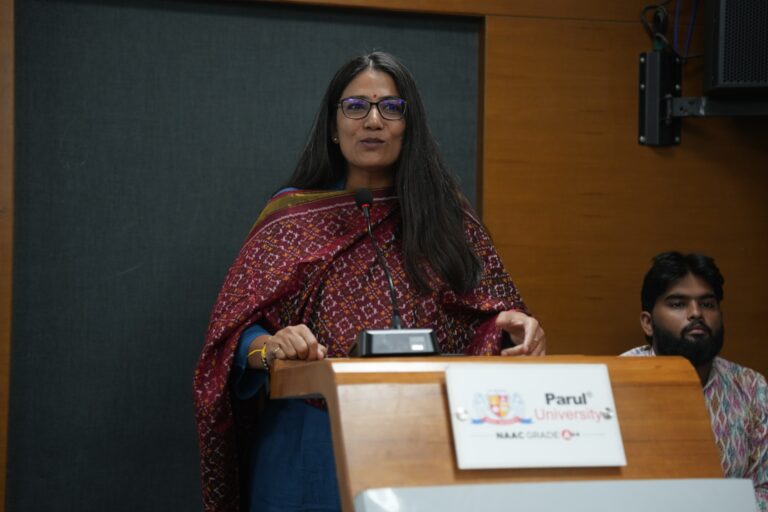
The launch of the first Centre for Future Skills in Gujarat is an important step as we move towards building a Viksit Bharat. With this, the model is now active across 11 institutions and have already trained over 50,000+ candidates. What stands out is the integration of global certifications with hands-on learning integrating with the existing curriculum. Our focus is to equip students with practical, industry-relevant global skills that help them upskill themselves and transition confidently into the workforce and contribute to India’s growth. – Mr. Nitin Kapoor, Vice President, National Skill Development Corporation (NSDC)
CFS has been very effective in bringing elite global certification programs to the doorstep of colleges at the most affordable cost. We are committed to bridging the gap between academics and industry by creating globally skilled, innovation-driven professionals. This initiative is a step toward building a future-ready workforce that will contribute to India’s technological growth and global competitiveness in alignment to the vision of our Hon’ble Prime Minister Sri Narendra Modi Ji. – Dr. Kiran Rajanna, CEO, Ethnotech Academy
The demographic window: why now
India is operating inside a closing demographic window. The country currently has the largest young population in the world, with median age around 28 years and a working-age population that will continue to expand into the early 2040s before beginning to age. The skill investment the country makes in this generation determines what economic position India occupies on the other side of that demographic shift. The window is not indefinite. By 2050, India will be ageing on a similar trajectory to other major economies.
As long as this advantage has been destined to be yours, this generation, it would be unfair to yourselves if you are not able to make the best of it.- Dr. Jitendra Singh, Union Minister of State (I/C), Science and Technology, on India’s demographic window
Currently, by official measurement, only around 4.5 percent of the Indian working-age population holds a formal skill certification through institutionalised training pathways. The gap between this number and what the future-skill framework above requires defines the scale of the build-out the country needs over the next two decades. The NSDC CFS model, scaling across 11 institutions and 50,000+ trained candidates already, is one of the structural responses now scaling to address that gap.
Where universities sit in the skill build-out
Universities are one of three primary delivery channels for future-skill capacity. The other two are industry-led training programmes (corporate academies, vendor certifications, and partnership programs between industry and government) and standalone skill-development institutions operating under NSDC frameworks. Each channel has structural advantages. Universities are uniquely positioned for the integration challenge: the combination of underlying theoretical foundations with applied skill development, delivered to a cohort during the formative undergraduate and postgraduate years when career trajectories are still flexible.
The challenge for universities, particularly in the private higher education sector, is capital and operational. Future-skill infrastructure is expensive. A working ABB industrial automation lab is not the same investment as a chalk-and-talk lecture hall. A semiconductor design lab with electronic design automation tooling, an AR/VR lab with current-generation spatial computing headsets, a drone training facility with RPTO certification, a sensor research lab with electrochemical analysis instruments, a cloud computing lab with vendor-grade hardware, an ANSYS simulation lab: each represents a capital commitment beyond the operational cost of conventional teaching infrastructure.
The NSDC CFS partnership model is one structural answer to that capital problem. By aggregating institutional demand across 11 universities and delivering through Ethnotech Academy as the operational partner, the model brings elite global certification programs to campus environments at a per-institution cost lower than each university individually procuring and operating equivalent facilities. The universities that take this commitment on are the ones that can credibly claim to be building future-skill capacity rather than describing it.
One institutional example: the Parul University Lakshya 2047 model
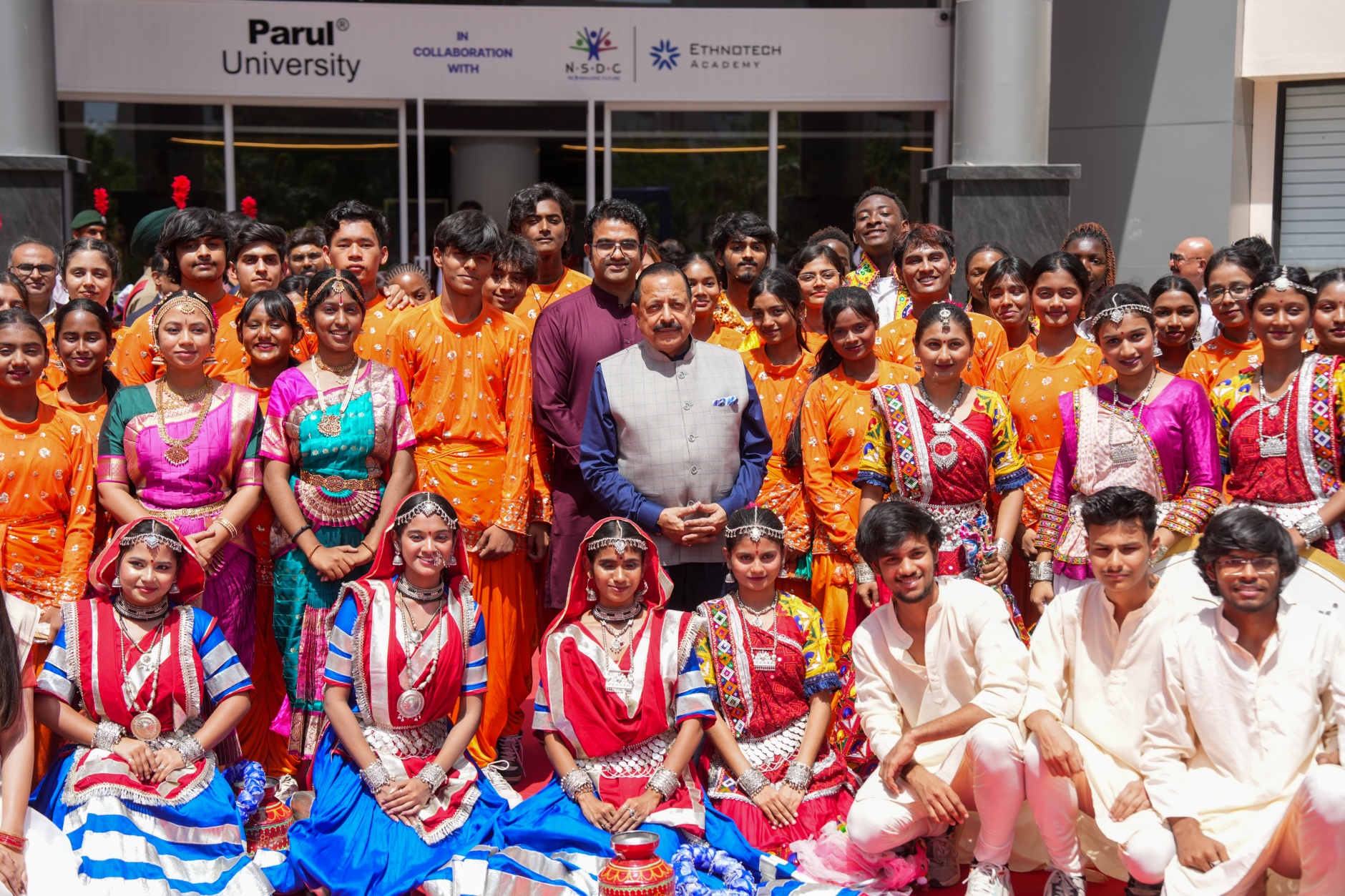
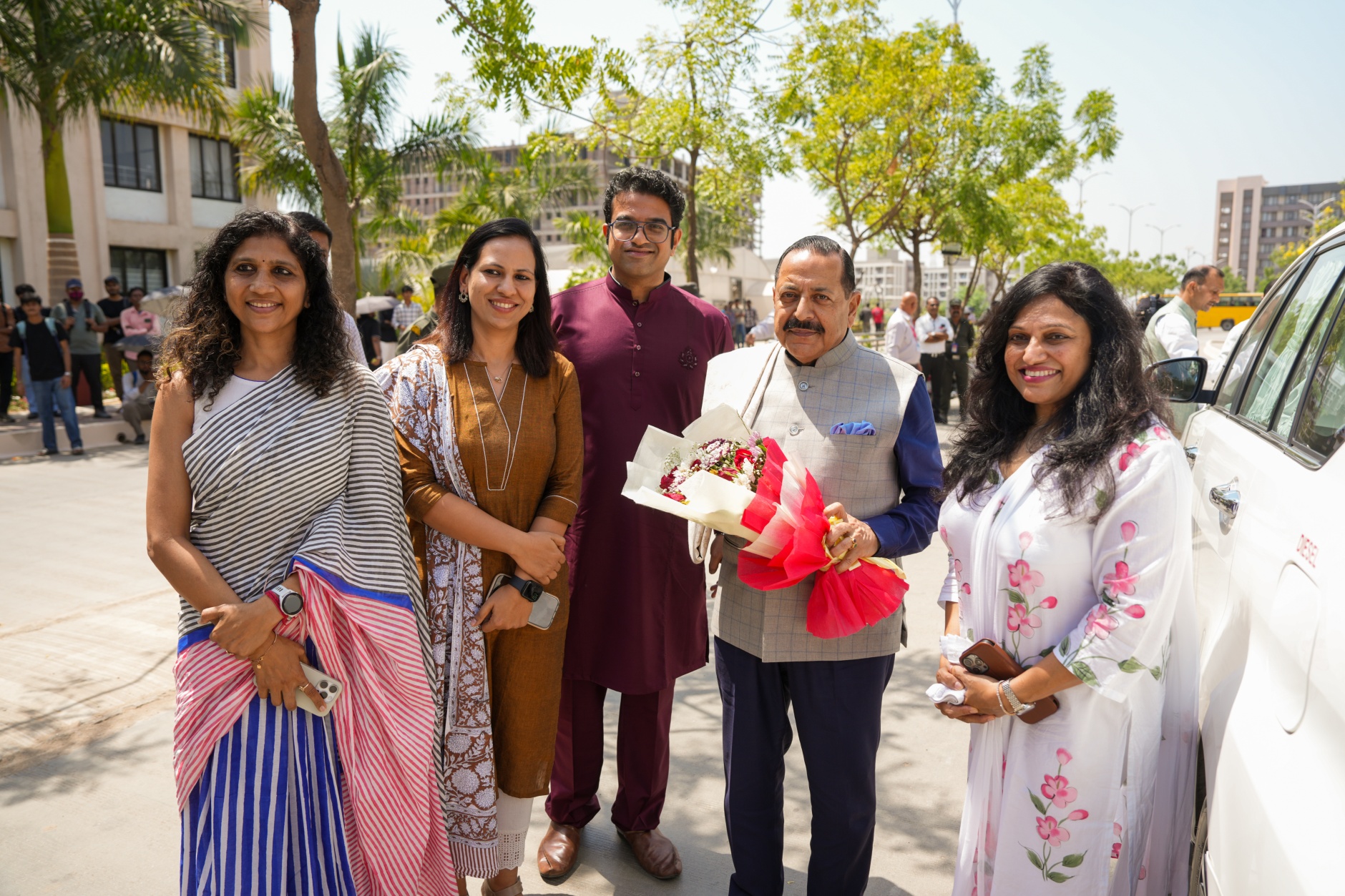
Parul University, Vadodara, inaugurated Lakshya 2047, a purpose-built Centre for Future Skills, on 8 May 2026. The full inauguration is covered in the Dr. Jitendra Singh inauguration hub. Lakshya 2047 is Gujarat’s first NSDC Centre for Future Skills, established in partnership with NSDC and Ethnotech Academy. The building is referenced here because its structure illustrates, in tangible form, what an institutional response to the future-skill question can look like when capital, operational, and curricular commitments are all aligned to the NSDC CFS framework.
- NSDC Lab Ecosystem (10 labs): NVIDIA Lab (AI and GPU computing), Cisco Lab (networking, cybersecurity), ABB Lab (industrial automation), AR/VR Lab (Apple Vision Pro and Meta Quest), ANSYS Lab (engineering simulation, FEA, CFD), Adobe Lab (creative design), Autodesk Lab (CAD), VLSI Lab (chip design), AWS Lab (cloud), Apple Lab (iOS development).
- AICTE AVPL/IDEA Lab Zone: drone training with RPTO curriculum, fabrication centres with industrial 3D printers and CNC equipment, material synthesis labs, teamwork spaces.
- Research laboratories: Mind Lab, Centre of Excellence in Sensor Technology, Special Integrated Facilities Idea Lab supported by AICTE.
- Design philosophy: globe representing Vasudhaiva Kutumbakam, framing advanced technology training within rooted Indian values.
Lakshya 2047 is one example of the NSDC CFS model at the institution level. It is also documented in the Lakshya 2047 lab guide.
The parallel medical-skills infrastructure at Pragya, the Advanced Skills and Simulation Centre extends the same logic to healthcare training.
What a student or parent evaluating future-skill credentials should ask
For a student choosing where to pursue undergraduate or postgraduate education in any of the future-skill domains, the evaluation criteria are tractable. The questions below apply to any institution being considered.
- Government partnerships: is the institution part of the NSDC Centre for Future Skills network, an AICTE-supported AVPL/IDEA Lab Zone partner, a DSIR-recognised R&D Centre, or other government-recognised future-skill infrastructure programme?
- Equipment specification: name the hardware. ABB robotic arm or generic robot kit? Apple Vision Pro or smartphone-attached cardboard headset? ANSYS suite or generic CAE software?
- Faculty depth: name the faculty. What is their domain experience? Are they publishing, building, or only teaching?
- Student work shipped externally: what student work has cleared external editorial filters? Apple App Store recognition, hackathon wins, patent applications, peer-reviewed publications, start-up funding rounds?
- Industry connections: which recruiters visit campus, and what offers do they make? What internship pathways are structured into the curriculum?
- Research output: are patents being filed? Are research grants flowing through DSIR, DST, AICTE, or international funding bodies?
- Government recognition: NAAC accreditation grade and CGPA, NIRF rankings, QS Asia rankings, Category 1 or Category 2 University status, Centre of Excellence designations.
For Parul University specifically, the answers map onto NAAC A++ at 3.55 CGPA, QS World University Rankings 1001-1100 band (Asia 2026), NIRF Top 50 Innovations Ranking, Category 1 University with Grant of Graded Autonomy, Centre of Excellence notification from the Government of Gujarat; DSIR recognition under the Ministry of Science and Technology; and the new NSDC Centre for Future Skills partnership. Recent placement and research data is documented in the Placement Day hub and the Foundation Day institutional history.
Where the answer comes from in 2047
By 2047, India’s economic position will be substantially determined by decisions made and skill investments completed in the 2020s and early 2030s. The institutions that take the future-skill build-out seriously today are the institutions whose graduates will be operating the country’s research labs, manufacturing facilities, healthcare systems, defense platforms, and software industry through the second half of the twenty-first century. The decision space is now. The capacity building is now. The NSDC CFS model expanding from 11 to potentially hundreds of institutions over the next decade is one operational vehicle for that capacity. The students entering undergraduate programs today will be the senior engineers, scientists, doctors, and policy professionals of 2047.
Read More: Lakshya 2047 Center for Future Skills