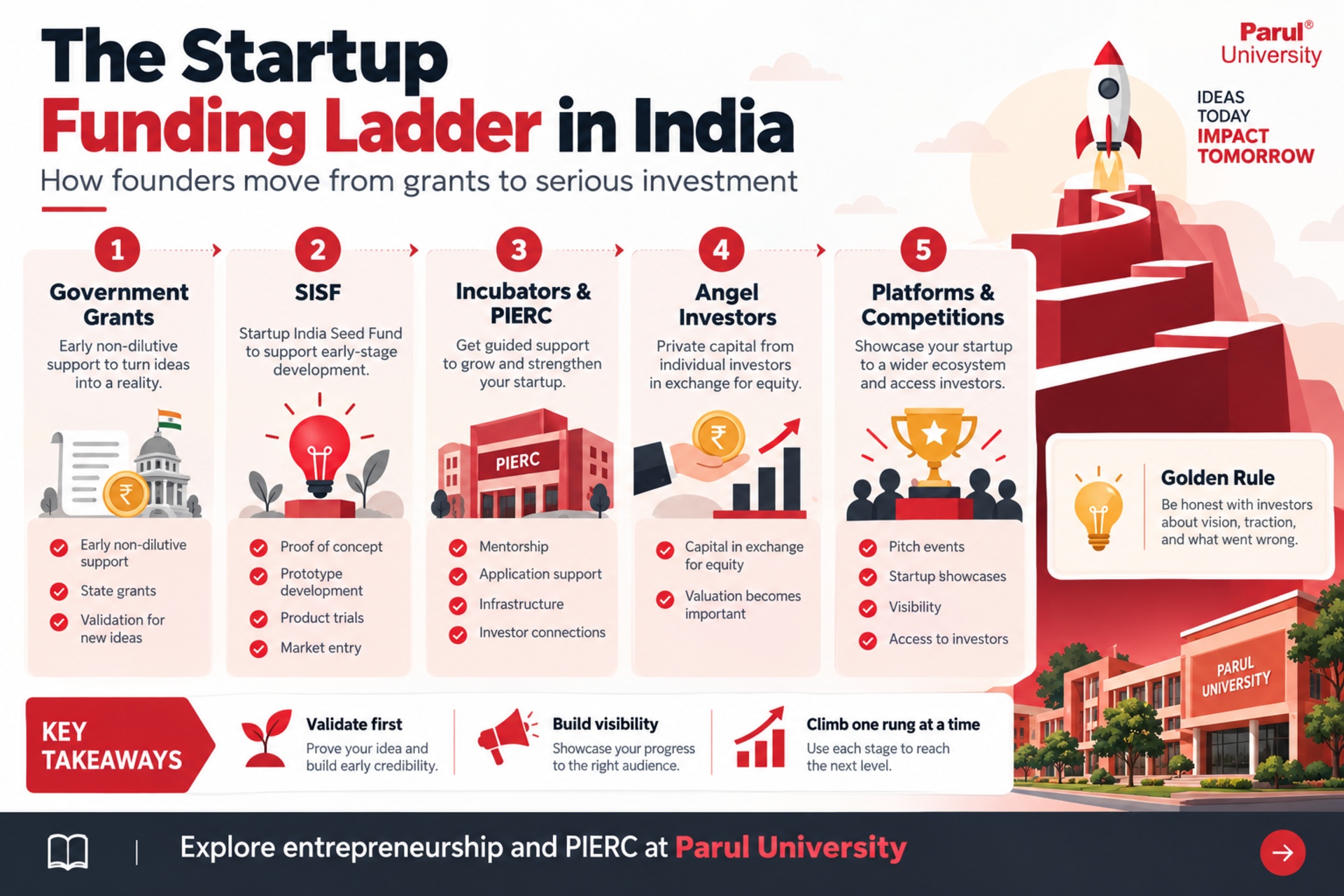
When a PIERC-incubated founder at Parul University grew her brand from an idea into a company with a multi-crore valuation, she did it by climbing a funding ladder, one rung at a time. Understanding that ladder is essential for any aspiring founder. Here is how it works.
Why Funding Is the Hard Part
Fundraising is difficult. Students and professionals who wish to have their startup, do have strong business ideas. But only a few get themselves turned into real companies. The main reason is funding. Most people are, understandably, reluctant to risk their own savings on an unproven idea. The good news is that founders do not have to. India has built a genuine ecosystem of grants, funds, and investors designed to back early-stage ventures, if you know where to look and how to approach them.
Step 1: Government Grants
For many early-stage startups, the first external money comes from the government, non-dilutive funding (meaning you do not give up ownership) meant to help you build and prove your idea. This includes:
- State government grants, such as those offered by the Government of Gujarat, which recognise and support innovative, socially impactful ventures.
- The Startup India Seed Fund Scheme (SISF), a central-government scheme that provides seed capital to early-stage startups for proof of concept, prototype development, product trials, and market entry, typically disbursed through approved incubators.
These grants are especially valuable because they let a founder develop the business without immediately taking on debt or giving away equity.
Step 2: Incubators, the Engine Room
Incubators are one of the most important, and underrated, parts of the funding journey. A good incubator (such as a university-based centre like PIERC) does far more than provide office space. It offers structured mentorship, helps founders prepare and apply for schemes like the SISF, connects them directly with investors, and provides infrastructure and a network of fellow founders. For a first-time founder, an incubator can be the difference between navigating the funding maze alone and having experienced guides through it. Many founders credit their incubator with securing their first grant and their first investor meetings alike.
Step 3: Angel Investors and Valuation
When the startup goes a level up, chances are there that they start to gain visibility. They start to attract angel investors. Angel investors are individuals who invest their own money. They do it in exchange for equity or share of ownership.
This is often a startup’s first significant private investment. It also introduces the concept of “valuation”, an agreed estimate of what the company is worth, which determines how much equity an investor receives for their money. Reaching a strong valuation is a key marker of investor confidence and a milestone many founders aim for.
Step 4: Investigating Investment Platforms & Competitions
Fundraising is crucial. For that you should know the platforms where you can find investors. Apart from direct interaction, there are certain platforms that helps you too. These are dedicated platforms with investors, and through pitching competitions. Taking part in events like TiE Women competitions are medium that give you platform. The founders get a stage to pitch, become visible with serious investors, and access to wider ecosystem. So a single competition can open doors that lead, eventually, to real investment. Winning or even competing can be a launchpad far beyond the prize itself.
The Golden Rule: Honesty With Investors
Planning to have a startup, it is very necessary that you research well. Good research helps you to understand whether you are going in the right direction or not. One rule for successful fundraising is transparency. It is purely for the good when the founders are honest about their idea, vision, what went wrong and what their expectations are from the startup. Even the investors are also looking for truth as they are listening you with an intent to invest. Being dishonest, and giving partial truth is not right for the business. It is a genuine fundraising strategy. When the investors gain trust in you, they get convinced to invest. Aspiring students who dream of making a startup, they should keep a note of it.
Also Read: Solnce Energy Founded by Parul University Students Supported by PIERC.
Frequently Asked Questions
What are the ways startups in India get funds?
Startups require a lot of research and analysis along with trials that the product or service will work in the target market or not. The funding is another important part. Funding gets approved when the idea is liked by the investors. Indian startups have to climb the ladder starting with government grants for the initial stage. The non-dilutive capital: incubators share knowledge, provide mentorship, scheme applications and investor connections. Angel investors who invest for equity; and investment platforms and pitching competitions that connect founders with investors. Each stage supports t he next.
How does startups get help from SISF?
SISF is Startup India Seed Fund Scheme (SISF). The startups have to register for this. It is a central government scheme. It provides seed capital for inception. It is given based on proof of concept, prototype development, product trials, and market entry. The funds are given after approval. It helps the founders to prepare and submit their applications. It is non-dilutive, so founders do not give up equity.
What does a startup incubator do?
A startup incubator plays the role beyond the office space. The role is to provide structured mentorship. They help founders. They guide founders to apply for grants and schemes like the SISF. They help the founders by connecting them with investors. They also provide the infrastructure and a network of fellow founders. They are crucial for them because they assist and guide the founders to make their work better and secure funds for further operations.