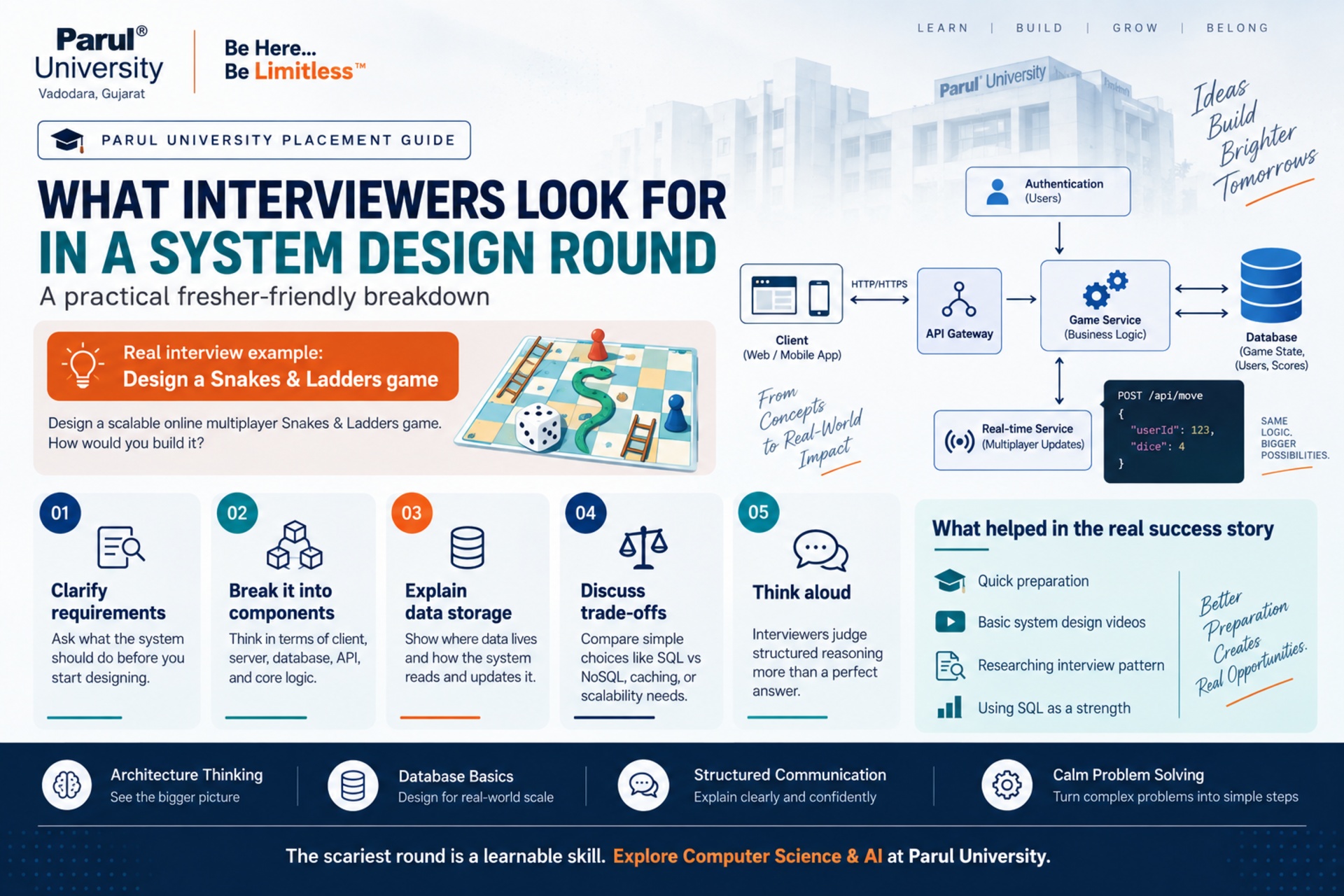
When a Parul University student, Vishnu Vardhan, sat for his interview for HashedIn by Deloitte, he cleared the coding and Data Structures rounds comfortably. Then came the round most freshers dread: system design. He was asked to design a Snakes and Ladders game, and he admits he had very little system-design knowledge going in. How he handled it and got the offer is the best possible introduction to this interview round.
What Is a System Design Interview?
A system design interview asks you to design the architecture of a software system, rather than solve a single coding problem. Instead of “write a function to reverse a string,” the question is “how would you build this application?”, a game, a chat app, a URL shortener, a ride-hailing service. The interviewer wants to see how you think about the bigger picture: the components a system needs, how they fit together, how data is stored, and the trade-offs involved. It is less about a single right answer and more about structured, sensible thinking.
What the Interviewer Is Really Testing
System design questions are deliberately open-ended, because the interviewer is assessing how you reason, not whether you memorised a diagram. They want to see whether you can clarify requirements before designing, break a large system into logical components, reason about data and how it is stored, and discuss trade-offs out loud. For a fresher especially, nobody expects a production-grade architecture. They expect clear, structured thinking, exactly what Vishnu demonstrated even without deep prior knowledge.
A Real Example: Designing a Game in the Interview
Asked to design a Snakes and Ladders game with almost no system-design background, Vishnu did three smart things that any student can copy. First, he prepared fast and focused: two days before, he used Glassdoor to understand the company’s interview pattern and watched a few YouTube videos on system-design basics. Second, in the interview, he applied what little he had learned rather than freezing. Third, and most cleverly, he steered the discussion toward his strengths. Recognising that system design connects closely to databases, he guided the conversation toward SQL, where he was confident, and answered the SQL questions that followed well. Combining basic system-design understanding with his database knowledge, he completed the round successfully.
How to Prepare for a System Design Interview as a Fresher
You do not need years of architecture experience to handle a fresher-level system design round. Focus on the fundamentals:
- Learn the building blocks: clients and servers, databases (SQL and NoSQL), APIs, load balancing, and caching, at a conceptual level.
- Practise a clear method: clarify requirements, sketch the main components, decide how data is stored, then discuss trade-offs.
- Research the company’s pattern on sites like Glassdoor, and watch a few structured system-design walkthroughs.
- Think aloud throughout; the interviewer is following your reasoning, so narrate it.
- Steer toward your strengths where you can, connecting the design to areas you know well (like databases).
Above all, stay calm and reason logically. As Vishnu’s experience shows, interviewers value your problem-solving approach more than a perfect answer, a principle that runs through every stage of a good interview. And Understanding what agentic AI is.
FAQs
How to define a system design interview?
A system design interview is related to the design of a software system. The interviewer focuses on asking how one can design the architecture of a software system. They will test whether you can design a game, chat application or URL shortener. The focus will be less on, or not on, solving a single coding problem. The interviewer wants to test you on whether you can break a system into components and handle data storage. They test whether you can reason about trade-offs or not. The main focus is on structured thinking over a single correct answer.
What should a fresher take care of for system design interviews?
It is always said that foundations should be made strong. To start from the base; clear your concepts. Start with conceptual blocks such as clients, servers, databases, APIs, load balancing, and caching. Work on practising clear methods that include clarifying requirements, outlining components, deciding data storage, discuss trade-offs. It is also important to research well about the company you are going to appear for. Find the areas you feel you are weak in, work on them, learn the soft skills, and learn to reason well, as freshers are judged on it and not on perfect technical knowledge.
What are the important things that interviewers are looking for in system design interviews?
Interviewers don't look for correct answers. They want to check the candidate's thinking, clarify requirements, ability to break a system into logical components, reason about data and discuss trade-offs clearly. For freshers, they expect structured, sensible reasoning rather than a production-grade design, and they value calm, logical problem-solving over a memorised answer.