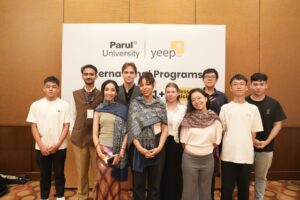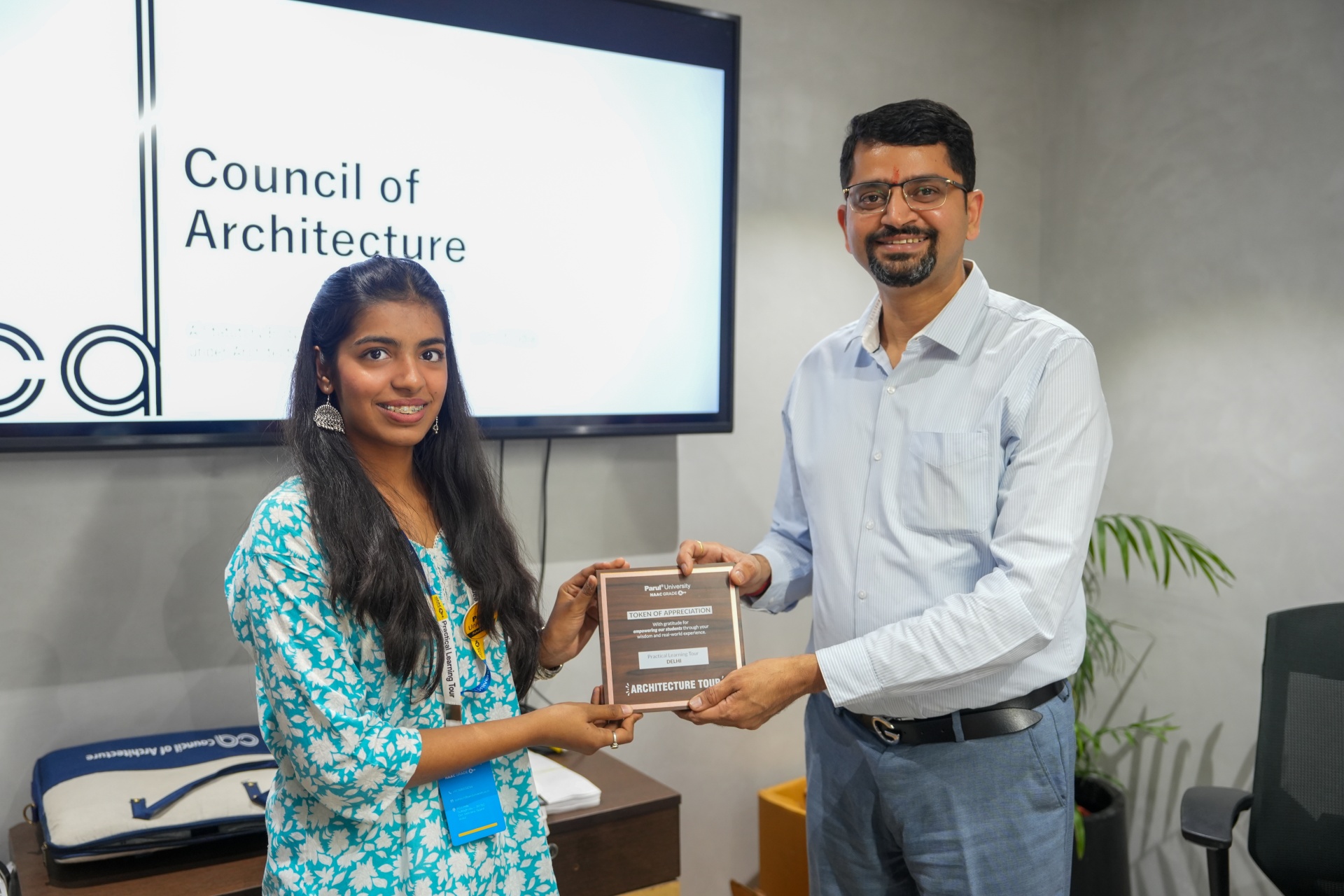
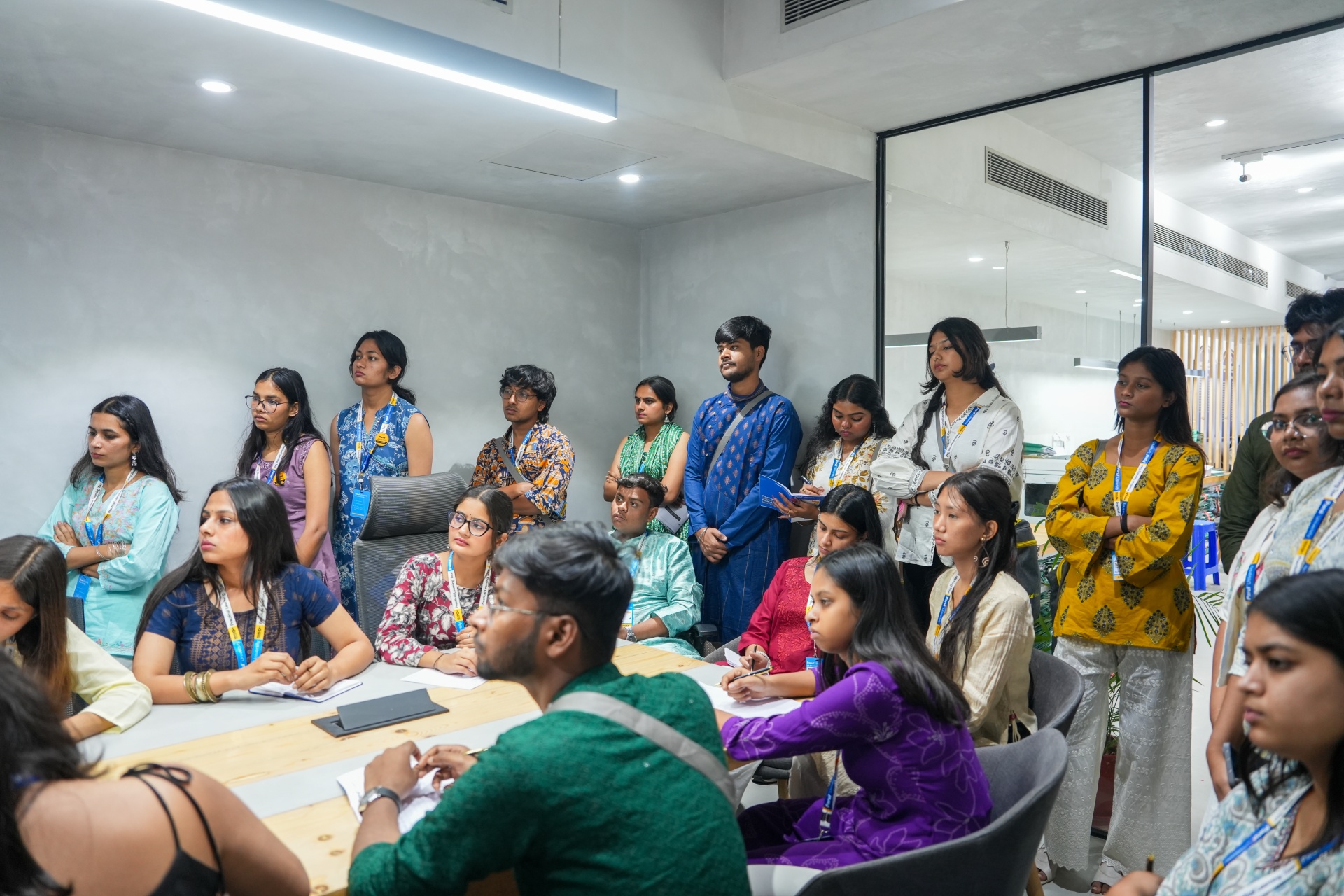
Three sessions across the Parul Institute of Architecture Delhi tour took the students inside the institutional spine of Indian architecture: the regulatory body, the municipal practice, and the academic foundation. The Council of Architecture (COA) governs the profession itself. These three institutions together define the infrastructure of professional architecture in India. The COA defines who can practice. NDMC defines how that practice operates in the public domain. SPA Delhi defines how the next generation enters the profession. A student of the Parul Institute of Architecture who has visited all three understands the system the profession operates inside.
Council of Architecture: the rules every architect should know
The session was anchored by Mr. Deepak Kumar, the administrative officer at the COA. He explained to students the institutional architecture of the profession. He shares how the central government of India regulated the practice of architecture in India, what kinds of work come under COA jurisdiction, and what the regulatory landscape looks like for a Chartered Architect.
- Central government framework: the COA operates under central legislation defining who can practice architecture in India and what the standards of that practice must be.
- Work Monitored: they oversee design, supervision, consultancy, sub-disciplines of architectural practice and each of them have separate specific regulatory expectations.
- Handbooks and magazines: the regulatory body published the handbooks and trade magazines that carry all laws relevant to the architectural practice, meant to keep the practitioners updated.
- Negotiation and record keeping: COA hosts an arbitration process for disputes within the profession and keeps a check of the record-keeping standards expected of the registered architects.
- Training and faculty: the council oversees training programmes for faculty members at architecture institutions, ensuring uniform standards of pedagogical quality.
- Thesis, UG, PG publication: the COA publishes selected undergraduate, postgraduate, and thesis-level work, providing a national venue for academic visibility.
Patience is the only key to success.
Mr. Deepak Kumar, Administrative Officer, Council of Architecture
The Chartered Architect designation Mr. Kumar walked the students through is the formal recognition of professional status under COA registration. The integrated five-year B.Arch syllabus, regulated by the council, is the entry pathway. The council is currently planning implementation work over the next five to ten years to update the regulatory framework as the profession itself evolves, including new categories of work that artificial intelligence, modular construction, and infrastructure-integrated design have made common.
Every student of the B.Arch programme at Parul University graduates into a profession governed by the COA. The professional-practice modules in the syllabus cover registration, fees, contracts, and the regulatory framework Mr. Kumar described. The COA-recognised B.Arch programme is the prerequisite for becoming a Chartered Architect in India.
Read More: India’s leading architecture firms at Delhi Tour 2026.
NDMC: urban management inside the Lutyens' Bungalow Zone
The New Delhi Municipal Corporation (NDMC) session was taken by Mr. Ashok Singh, Head of the Architecture Department at the NDMC and an officer of the Indian Administrative Service. NDMC controls and monitors one the most carefully managed urban areas in India, including Lutyens’ Bungalow Zone, the central government precinct, and the nearby civic infrastructure. The session covered working view of urban management as a discipline that operates between architecture and civic adminstration, it also gave the students knowledge on:
- Urban Zones in India: The area of NDMC is considered to be one of the most carefully created and consistently recognized; they have high green coverage, structured public space and integrated heritage preservation.
- IAS officer and architecture role: an IAS officer who guides the architecture department brings administrative discipline to urban design decisions.
- Planning and management: when an IAS officer is also part of the planning committee, we get to see the integration of architectural design with civic services, traffic management, waste collection and public infrastructure.
- Civic space improvements: designs and continuous upgrades of public spaces, plazas, parks, walking paths, and environments elevate the experience of NDMC areas.
- The greenery: Integrating green environments in the layout makes the structural build up more easy and significant.
- Smart city initiative: the NDMC’s participation in the national Smart Cities Mission and the integration of digital infrastructure into the urban management framework.
- Lutyens’ Bungalow Zone preservation: the regulatory and operational discipline required to preserve a 100-year-old urban precinct in a rapidly developing capital city.
The challenge Mr. Singh described to the Parul Institute of Architecture students is structural. Restoration of heritage buildings in a heavily used central business district must continue while the area itself remains operational. The construction done in the active urban zone like NDMC sometimes have logistical challenges that suburban or greenfield doesn’t have. Material movement, crowd management, traffic re-routing, and continuous coordination with multiple government agencies are part of every project.
The Bachelor of Planning at Parul University and the Master of planning in Urban Design are the academic pathways for students interested in the kind of municipal and urban management practice the NDMC session demonstrated.
Read More: Dr Ajit Pai at Parul Institute of Architecture’s Delhi Tour 2026!
SPA Delhi: how architects are educated
The School of Planning and Architecture (SPA) Delhi session was hosted by Dr. Virendra Paul, Director. SPA Delhi is one of the country’s anchor institutions for architecture, urban design, and planning education, and provides the academic standard against which other architecture programmes calibrate themselves. The session for Parul Institute of Architecture students covered the educational frame within which the architecture profession operates in India.
- Architectural Planning: the importance of planning lies in the foundational determinant of how the country can be built.
- Architecture in Indian regions: every region has its own traditions, which are reflected in the architecture; this informs their contemporary practice.
- How architecture started in India: the ancient history and origin, medieval traditions, colonial period and post-Independence eras to the present.
- Importance of urban planning: planning as a discipline distinct from but integrated with architecture, and the reasons Indian cities need stronger planning capacity.
- RIBA framework: the Royal Institute of British Architects framework as one international reference point for architectural education and practice standards.
- How SPA Delhi works for students: the studio model, the integration of theory with design practice, and the academic culture that produces SPA graduates.
- NASA and NOSPLAN as student bodies: the National Association of Students of Architecture (NASA) and the National Organisation of Students of Planning (NOSPLAN), both with their national headquarters at SPA Delhi, as the student-led platforms for architecture and planning education in India.
Success takes time and patience, you really need to work hard for some years.
Dr. Virendra Paul, Director, School of Planning and Architecture (SPA) Delhi
Dr. Paul described to the Parul Institute of Architecture students how the studio model at SPA Delhi operates: long studio hours, peer review, faculty critique, and the iterative discipline of design development across a semester or year. The studio is where architectural education actually happens. The lecture hall is supportive. The studio is the heart of the institution. Students from any architecture programme in India who want to understand how the discipline is taught at its most rigorous benefit from understanding the SPA Delhi studio model.
Parul Institute of Architecture studios are built on similar principles as discussed by Dr. Paul. This education pattern is spread out over a five-year B.Arch programme.
Read More: AR. Rajesh Satish at Parul Institute of Architecture’s Delhi Tour 2026!
FAQs
What does COA stand for, and what is its importance?
COA stands for Council Of Architecture. It is a regulatory body under the central government of India that monitors the practices of architecture. They put out the framework for handbooks, magazines, courses and degrees in India. The negotiation in professional disputes in terms of architecture and related fields comes under them along with the training of faculty.
What is the Lutyens' Bungalow Zone in New Delhi?
The Lutyens' Bungalow Zone is the central New Delhi precinct designed by Edwin Lutyens in the early 20th century during the planning of New Delhi as the British colonial capital. The zone includes the bungalow-style residences of senior central government officials, the central vista, and surrounding heritage structures. The New Delhi Municipal Corporation (NDMC) governs the zone and is responsible for maintaining it. The zone is the subject of significant ongoing debate about whether to preserve its current low density or to allow controlled densification.
What is SPA Delhi (School of Planning and Architecture, Delhi)?
The School of Planning and Architecture (SPA) Delhi is an Institution of National Importance under the Ministry of Education, Government of India, and one of the country's leading institutions for architecture, urban planning, and urban design education. SPA Delhi hosts the national headquarters of the National Association of Students of Architecture (NASA) and the National Organisation of Students of Planning (NOSPLAN). The institution provides the academic standard against which other architecture programmes in India calibrate themselves, with a studio-driven pedagogical model and integration of theory with iterative design practice.
What is NASA and NOSPLAN in Indian architecture education?
NASA (National Association of Students of Architecture) and NOSPLAN (National Organisation of Students of Planning) are the national student bodies for architecture and planning students in India. Both organisations have their national headquarters at SPA Delhi. NASA and NOSPLAN host annual conventions, design competitions, knowledge-sharing programmes, and cross-institution student collaborations. Architecture and planning students across COA-recognised institutions in India participate in NASA and NOSPLAN events as part of their professional development.
How does the B.Arch programme at Parul University align with COA regulations?
The B.Arch programme at Parul Institute of Architecture is approved by the Council of Architecture (COA) and follows the integrated five-year curriculum that the COA mandates for architectural education in India. Graduates of the programme are eligible to register as Chartered Architects with the COA after completing the prescribed training period. The professional-practice modules in the syllabus cover COA regulations, registration procedures, fee structures, contract law, and the regulatory framework that governs architectural practice in India. Parul University also offers a Master of Architecture, a Master of Architecture in Urban Design, and a Bachelor of Planning, all aligned to relevant regulatory frameworks.